Middle East Crude Oil Market Shaken Again as Strait of Hormuz Risks Escalate
- Input
- 2026-10-05 15:39:43
- Updated
- 2026-10-05 15:39:43
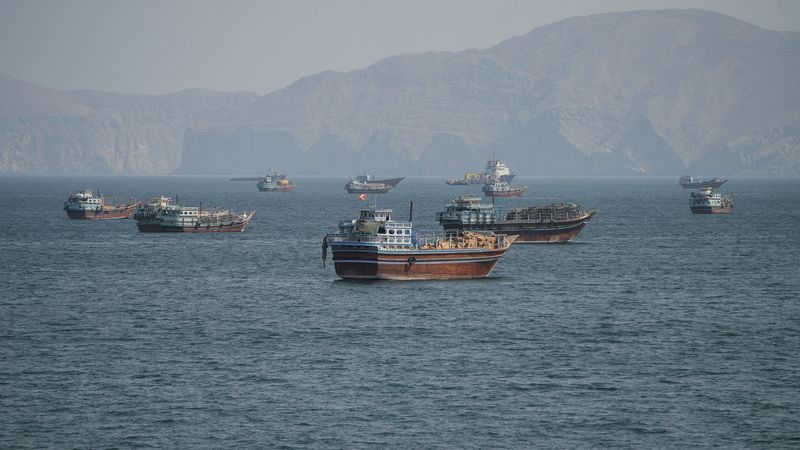
[Financial News] With new attacks targeting ships occurring one after another around the Strait of Hormuz, warning signs have flashed again for crude oil exports from Middle Eastern countries, which had been recovering to prewar levels. Major oil producers agreed to freeze output next month, while Saudi Arabia sharply cut prices for crude exported to Asia.
On the 4th (local time), The Wall Street Journal (WSJ), citing the United Kingdom Maritime Trade Operations (UKMTO), reported that at least eight incidents involving ships being hit had been reported near the Strait of Hormuz since the 28th of last month. On the 3rd, the naval wing of the Islamic Revolutionary Guard Corps (IRGC) threatened in a radio broadcast on a common vessel channel, saying, "Never trust or use the southern route provided by the U.S. Navy," and warning that it would attack and destroy vessels using the route.■Iran Resumes Strait of Hormuz Attacks The attacks resumed just as Middle Eastern oil producers were aggressively increasing export volumes by leveraging U.S. naval escorts and strikes against Iran. Gulf oil producers, including the United Arab Emirates (UAE), have actively used a "shuttle operation" in which tankers carrying crude from inside the Persian Gulf pass through the Strait of Hormuz and then transfer the oil to large vessels waiting outside the strait.
According to global energy research firm Kpler, oil producers in the region excluding Iran exported an average of 16.5 million barrels per day from September 1 to 28, nearing prewar levels. Saudi Arabia had sharply increased its exports from an average of 2.45 million barrels per day in August to 6.9 million barrels per day in September, based on estimates by Standard Chartered Bank.
However, the latest series of attacks suggests that the flow of Gulf crude is slowing again. Lori Johnston, founder of energy analysis firm Commodity Context, said, "We estimate that crude oil shipments have declined by about 2 million to 3 million barrels per day in the past few days." According to shipbrokers, Gulf oil producers are paying between $30 million and $40 million per round-trip shuttle through the Strait of Hormuz, equivalent to $15 to $20 per barrel, even before insurance premiums are included. That amounts to approximately 53.8 billion won.
International oil prices have also continued to surge as the risk of attacks rises again. Brent crude futures settled last week at $102.25 per barrel, up approximately 5% from the previous week. Hamad Hussein, chief economist at Capital Economics, said, "The increase in attacks on ships shows how vulnerable the current balance in the oil market is," adding, "If tensions escalate further or energy infrastructure is directly hit, oil price volatility could become even more extreme." He expects Brent crude to remain around $100 per barrel through the end of this year.■OPEC+ Output Freeze; Saudi Arabia Cuts Asian Selling Prices OPEC+, a group comprising the Organization of the Petroleum Exporting Countries (OPEC) and non-member oil-producing countries, held a video conference on the 4th and agreed to freeze production for November.
The decision came as disruptions to Middle Eastern exports continued, despite a gradual increase in the volume of crude transported through the Strait of Hormuz.
Representatives of seven oil-producing countries, including Saudi Arabia, reviewed recent developments in the global oil market and reaffirmed the key role of the "cooperation declaration" in maintaining stability in the global energy market.
The committee particularly emphasized the importance of protecting international maritime shipping routes to ensure a smooth and uninterrupted supply of energy resources. It also expressed deep concern over recent attacks targeting energy infrastructure, noting that restoring damaged facilities to normal operations would require enormous amounts of time and money and could affect overall supply capacity.
Gulf OPEC+ producers have failed to meet their production targets as exports have been disrupted by tensions in the Persian Gulf. In recent months, their export volumes have fallen to 60% to 80% of prewar levels. OPEC statistics showed that the output of the seven core OPEC+ countries that attended the meeting remained about 5 million barrels per day below the level before the war with Iran began in February, even though their production surged from 630,000 barrels per day in July to 25 million barrels per day in August.
Giovanni Staunovo, an analyst at UBS, said, "OPEC+ froze its production limits as expected," adding, "As a result, supply and demand in the oil market remain tight."
Meanwhile, Saudi Arabia unexpectedly cut the Asian selling price for crude scheduled for delivery in November. The move contrasts with the results of a survey conducted by British media, which had expected the November official selling price to rise by $3 per barrel in line with increases in benchmark Middle Eastern crude prices.
According to British media, Saudi Arabia set the official selling price for November-delivery Arab Light crude bound for Asia at $5 per barrel below the average price of Oman crude and Dubai crude. That was a $3-per-barrel decrease from the previous month, marking the largest discount since June 2020.
Saudi Aramco, the state-owned oil company, cut the November official selling prices for Arab Medium and Arab Heavy sold to Asia by an additional $5 per barrel each. Sources said Aramco had considered discounting crude loaded in Oman to offset the burden on buyers caused by record-high freight rates. The move is seen as an effort to prevent rivals such as the UAE from taking over the Asian market while regional conflicts continue to hurt exports.
In contrast, after Saudi Aramco resumed crude exports from Yanbu Port on the Red Sea coast, it raised the official selling prices for November-delivery crude sold to Northwestern Europe by $3 per barrel for all grades.
[email protected] Yoon Jae-jun, Hong Chae-wan Reporter