Small High Schools Offer Fewer Courses, with Incheon Showing a Gap of Up to 10.5 Courses
- Input
- 2026-10-05 13:37:59
- Updated
- 2026-10-05 13:37:59
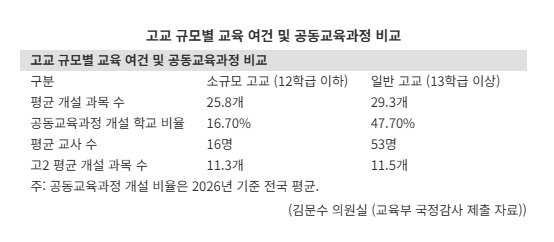
[Financial News] High schools with 12 or fewer classes offer fewer courses than schools with 13 or more classes, raising concerns that their students have less choice of courses. Incheon showed the largest gap among cities and provinces, with small high schools offering an average of 10.5 fewer courses than schools with 13 or more classes.
Kim Moon-soo, a lawmaker from the Democratic Party of Korea who sits on the National Assembly Education Committee, said this on the 5th based on parliamentary audit data on the high school credit system that he received.
The joint curriculum promoted by the Ministry of Education to guarantee course choices for students at small high schools was also offered more widely at larger schools. The proportion of small high schools that offered a joint curriculum was 16.7%, compared with 47.7% for other schools. In every city and province with small high schools, the proportion was lower for small high schools.
After Incheon, the differences in the average number of courses offered by small high schools and schools with 13 or more classes were largest in Gangwon State at 7.4 courses, followed by North Jeolla Province at 7.1, South Chungcheong Province at 6.9, and Seoul at 6.6. Seoul, however, had only one small high school. Daegu, Daejeon, and Sejong City had no small high schools, while Ulsan had more courses at its small high schools.
Differences also emerged among small high schools across regions. The average number of courses offered to second-year students, who begin taking a full range of elective courses, was 10 in Incheon and 30 in Ulsan, where there was only one small high school—a threefold difference. These figures are based on the first semester of the 2026 school year and exclude joint curriculum courses.
The average number of teachers at small high schools was 12 in Incheon and 14 in South Jeolla Province, both less than half of the 30 in Jeju Province, which had the highest number among small high schools.
Kim said, "Serious educational disparities are emerging depending on where people live and the size of their schools," and added, "Given the high school credit system's emphasis on alignment with students' intended majors, it is urgent to devise measures." He further noted, "Education offices need to consider securing a standing pool of instructors and hiring them based on schools' requests, among other options."
[email protected] Kim Man-gi Reporter