One in Six University Buildings Is More Than 40 Years Old; Older Buildings More Often Rated as Needing Repairs
- Input
- 2026-10-05 11:50:03
- Updated
- 2026-10-05 11:50:03
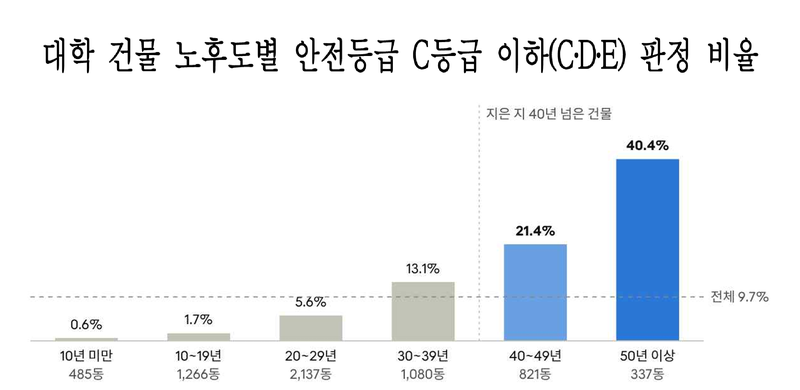
[Financial News] One in six university buildings nationwide is more than 40 years old. Among buildings over 40 years old with confirmed safety grades, 26.9% were rated C or lower, indicating that repairs are needed.
Rep. Han Byung-do of the Democratic Party of Korea released on the 5th the results of an analysis of data on 13,953 educational buildings at 382 universities nationwide, submitted by the Ministry of Education. Of these, 2,381 buildings, or 17.1% of the total, are more than 40 years old, while 754 are more than 50 years old.
The older the buildings, the higher the proportion rated C or lower. Of the 6,126 buildings with recorded safety grades, 1,158 were more than 40 years old. Among them, 312, or 26.9%, were rated C or lower. This was 4.7 times higher than the 5.7% recorded for buildings less than 40 years old. The proportion reached 40.4% among buildings more than 50 years old.
Regardless of construction year, 225 buildings rated C, D or E contained classrooms. These buildings also include dormitories with capacity for 9,137 students, gymnasiums with a capacity of 22,524 people and libraries with 22,711 reading seats.
The number of aging buildings is expected to increase more rapidly in the coming years. A total of 2,589 buildings constructed between 1986 and 1995 will pass the 40-year mark over the next decade. If the buildings continue to be used as they are, the number more than 40 years old will rise to 3,506, or 25.1% of the total, in 2030 and to 4,970, or 35.6%, in 2035. That would mean more than one in three buildings.
By use, buildings more than 40 years old accounted for 23.9% of those with research facilities, 21.7% of those with faculty research offices, 21.3% of libraries and 20.6% of classroom buildings. All exceeded the overall average of 17.1%. The proportion for dormitories was just 7.1%.
At national universities, 720 of 3,771 buildings were more than 40 years old, accounting for 19.1%, higher than the 16.4% at private universities. Among the nine flagship national universities, 394 of 1,799 buildings, or 21.9%, were more than 40 years old. Assuming the current conditions remain unchanged, Chungbuk National University (CBNU), Chonnam National University (CNU), Kyungpook National University (KNU) and Pusan National University (PNU) will each have at least four out of 10 buildings more than 40 years old within a decade. At Seoul National University, buildings constructed around the time of its move to Gwanak Campus in 1975 reached the 50-year mark at once, leaving 74 buildings that are more than 50 years old.
Some buildings constructed before Korea’s liberation are still being used as classrooms. Dasan Hall and Changhak Hall at Seoul National University of Science and Technology (SeoulTech), both Registered National Cultural Heritage sites, underwent complete interior renovations in 2011 and 2013, respectively. Around 20 classes are held in each building.
Rep. Han Byung-do pointed out, "As the proportion of buildings receiving a C grade, indicating a need for repairs, rises sharply with age, we can no longer leave the safety of spaces where students study and live solely to individual universities." He continued, "The Ministry of Education must conduct a comprehensive inspection of aging university facilities, regardless of whether the institutions are national or private," and stated, "It must set repair and reconstruction priorities, starting with lecture buildings and dormitories more than 40 years old, and prepare a mid- to long-term improvement plan and funding measures to support them."
[email protected] Kim Man-ki Reporter