Diagnosing Jeju’s Employment Structure and Safety Net for Non-Regular Workers, Seeking Common Ground with Central Labor Policies
- Input
- 2026-10-05 11:49:06
- Updated
- 2026-10-05 11:49:06
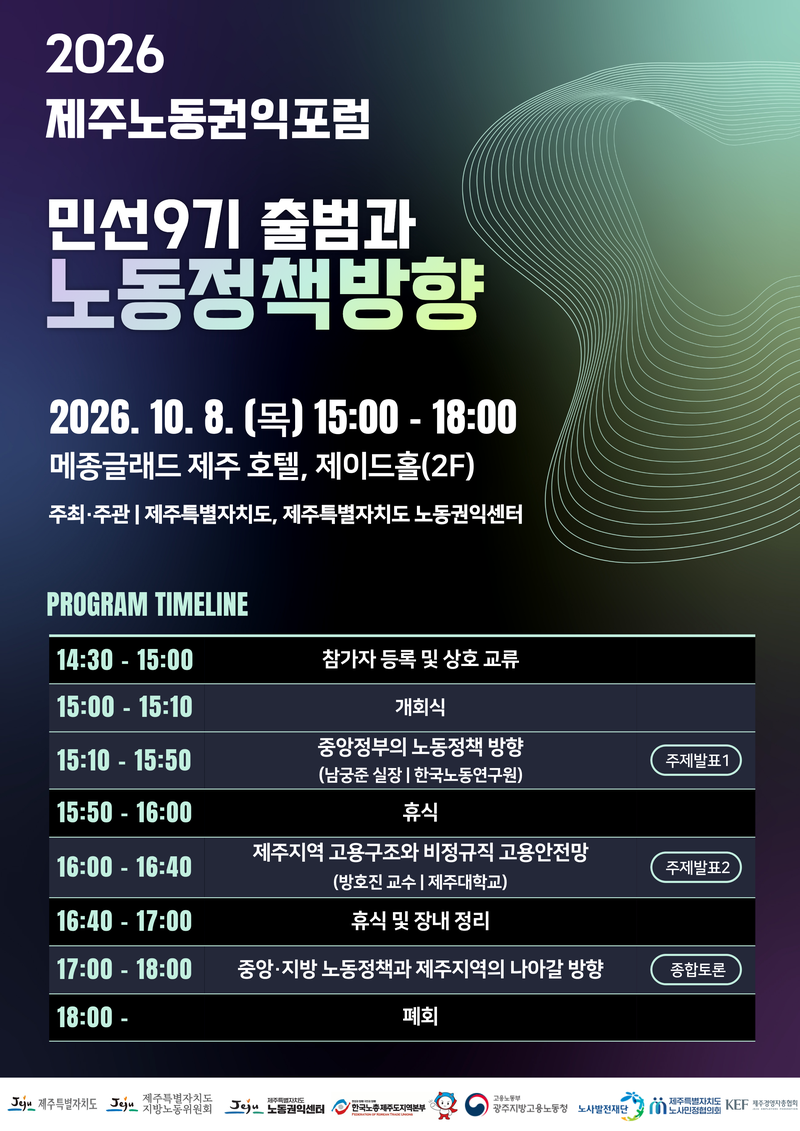
【Financial News Jeju = Reporter Jeong Yong-bok】 A forum will be held in Jeju to assess how changes in central government labor policies may affect the island’s employment market and to seek ways to strengthen the safety net for non-regular workers and implement local labor policies.
According to Jeju Special Self-Governing Province on the 5th, the province and the Jeju Labor Rights Center will hold the “2026 Jeju Labor Rights Forum” at 3 p.m. on the 8th in Jade Hall at Maison Glad Jeju.
The theme is “The Launch of the Ninth Popularly Elected Administration and the Direction of Labor Policies.” The forum focuses on Jeju’s employment structure and the employment safety net for non-regular workers. Local labor policies must do more than implement systems created by the central government; they must also reflect regional differences in industrial structure, company size and employment arrangements to work effectively in the field.
Jeju has a large tourism and service sector, and labor demand varies significantly between peak and off-peak seasons across industries. Even the same labor policy can have different effects on the ground depending on the employment structure and workplace conditions, making local assessments and supplementary measures necessary.
The forum will also address the employment safety net for non-regular workers as a separate topic.
The first presentation will be delivered by Namgung Jun, a director at the Korea Labor Institute. Under the topic “The Direction of Central Government Labor Policies,” Namgung will explain the main trends in government labor policies and present the issues that local governments and regional labor markets should consider in their response.
Bang Ho-jin, a professor at Jeju National University (JNU), will then present on “Jeju’s Employment Structure and Employment Safety Net for Non-Regular Workers.” Bang is expected to assess the employment structure and labor conditions in Jeju’s labor market and propose policy directions that take the region’s characteristics into account.
The key question is how much the gap between central government policies and conditions in Jeju can be narrowed. Even if the government establishes systems related to wages, employment stability and labor rights protection, their effectiveness may be limited if they fail to sufficiently reflect local industries, workplace sizes and employment arrangements.
Conversely, expanding independent support programs by local governments can create limits in funding and continuity if they are not connected to central government systems. This is why Jeju Province has placed “linkage between central and local labor policies” at the center of the forum.
Kang Soo-young, head of the Honam Regional Office of the Korea Labor Foundation, will chair the panel discussion. Officials from the Jeju Regional Office of the Korea SMEs and Startups Agency (KOSME), the Jeju Provincial Headquarters of the Federation of Korean Trade Unions (FKTU), the Jeju Chapter of the Korean Confederation of Trade Unions (KCTU) and other organizations will participate to discuss the labor policies and implementation measures Jeju needs in the field.
As representatives of labor, business and public institutions will all take part, the discussion is expected to seek common ground at the regional level among employment stability, companies’ workforce needs and labor rights protection.
The forum is hosted and organized by Jeju Special Self-Governing Province and the Jeju Labor Rights Center. The Jeju Provincial Headquarters of the Federation of Korean Trade Unions, the Gwangju Regional Employment and Labor Office, the Jeju Labor-Management-Government Council, the Honam Regional Office of the Korea Labor Foundation and the Jeju Employers Federation are participating as partner organizations.
Jeju Special Self-Governing Province plans to review the opinions and policy proposals presented at the forum and reflect them in future labor policies. It also plans to continue strengthening cooperation among labor groups, business organizations and related institutions.
Kang Ae-sook, director of Jeju Province’s Economic Vitality Bureau, said, "It is necessary to consider both the central government’s policy direction and Jeju’s regional characteristics." She added, "Based on opinions from the field, we will develop labor policies tailored to Jeju’s circumstances and strengthen their implementation."
[email protected] Jeong Yong-bok Reporter