Six Candidates for Secretary-General of the United Nations (UN Secretary-General) Hold First Joint Public Discussion... Jeju Forum for Peace and Prosperity Becomes a Government-Wide Diplomatic Platform
- Input
- 2026-10-05 11:11:48
- Updated
- 2026-10-05 11:11:48
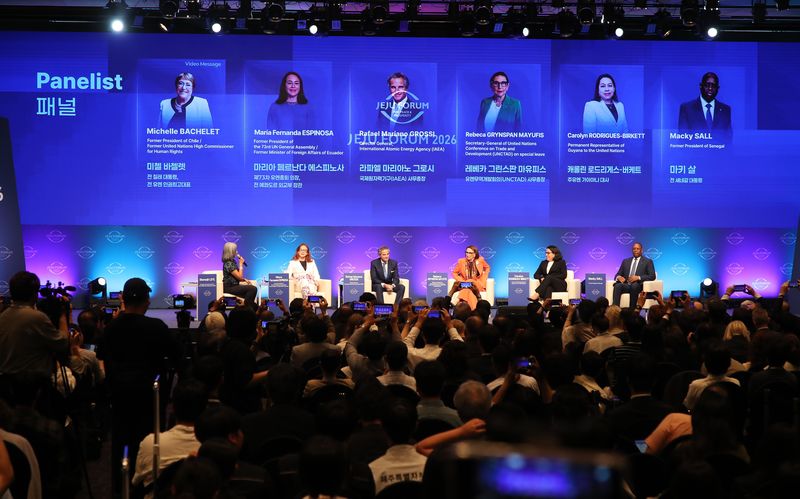
[Financial News | Jeju = Jeong Yong-bok, Reporter] An analysis has found that the 21st Jeju Forum for Peace and Prosperity expanded into a government-wide diplomatic platform after six candidates for UN Secretary-General took the stage together in Jeju for the first time and held a public discussion, while the Ministry of Foreign Affairs participated as a co-host for the first time. However, the analysis also identified the need to manage international outreach outcomes using verifiable indicators and institutionalize the roles and financial contributions of the co-hosting organizations.
A policy issue brief published by the Jeju Research Institute on the 5th analyzed the achievements and challenges of the 21st Jeju Forum for Peace and Prosperity, held from June 24 to 26 at Haevichi Hotel and Jeju Stone Park. The study was conducted by research fellow Lee Jung-hwa and associate research fellow Cho Nam-woon.
The most notable change at this year's forum was the participation of the Ministry of Foreign Affairs as a co-host. It was the first time the Ministry of Foreign Affairs had joined the forum as a co-hosting organization. With a video congratulatory message from the president, the on-site attendance of the speaker of the National Assembly, and the participation of current and former leaders at the level of heads of state or government and heads of international organizations, the researchers assessed that the Jeju Forum for Peace and Prosperity had expanded from an international event led by a local government into a diplomatic platform with a quasi-national-event character.
The public discussion among the UN Secretary-General candidates was highlighted as a particularly symbolic moment. Six candidates for UN Secretary-General took part in the same discussion and exchanged views on the future of multilateralism and international cooperation. It was considered the first time that the candidates had debated together in one place.
In effect, Jeju secured the first public forum for examining the candidates' policies and views on international issues ahead of the selection of the next UN Secretary-General. A message sent to the Jeju Forum for Peace and Prosperity by UN Secretary-General António Guterres was also listed as an official statement from the Office of the UN Secretary-General.
The researchers viewed these records not merely as short-term event publicity, but as evidence of whether the Jeju Forum for Peace and Prosperity is being recognized as an international multilateral diplomacy venue. The participation of 11 current and former leaders at the level of heads of state or government, along with heads of major international organizations, also enhanced the forum's diplomatic significance.
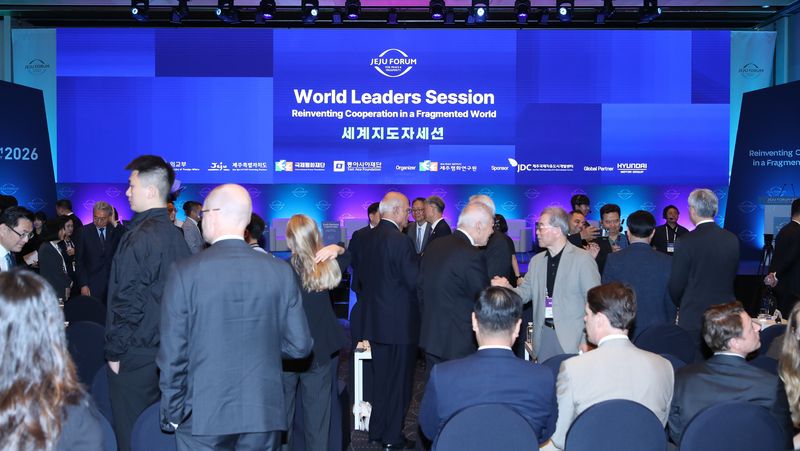
Major sessions were broadcast overseas through television and online channels. The candidates' discussion held in Jeju was also recorded in the archives of international civil-society and policy platforms tracking the selection process for the UN Secretary-General.
Jeju Island also awarded honorary resident certificates to the discussion participants. The initiative was intended to create a foundation for continuing cooperative relations between Jeju and international figures, rather than allowing their visits to remain one-time events.
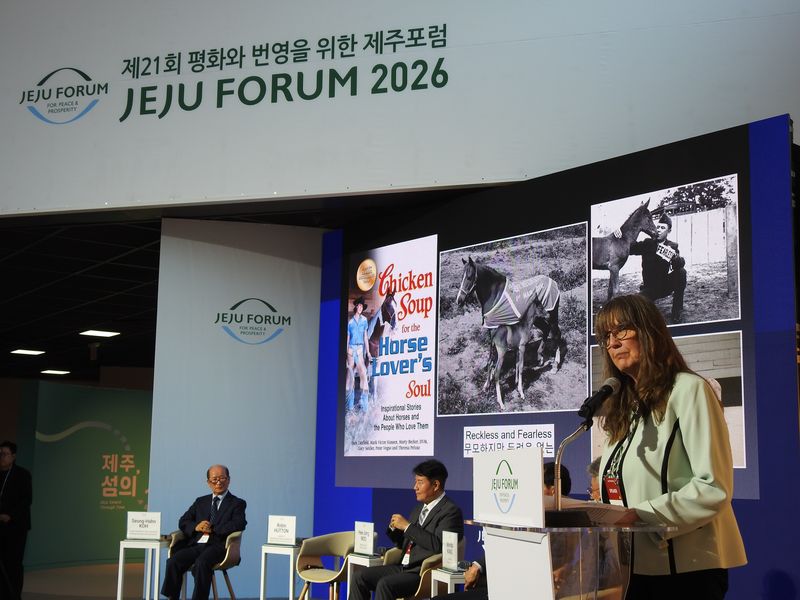
The forum also sought to connect the story of its host location, Jeju, with international issues. A session on Staff Sergeant Reckless, the Jeju war horse who served in the Korean War, and a film screening focused on the Jeju uprising linked Jeju's history and collective memory to the international themes of peace and reconciliation.
The researchers regarded these programs as content that distinguishes the Jeju Forum for Peace and Prosperity from other international events and proposed continuing them at each edition.
An experiment was also conducted to connect the benefits of hosting the forum with local businesses. The organizers worked with restaurants in Pyoseon-myeon, where Haevichi Hotel is located, to encourage participants to dine at local establishments. Increased sales at the restaurants were also confirmed during the event. The approach sought to spread participants' spending to nearby restaurants and local businesses, moving beyond the pattern in which attendees consume only inside the event venue and accommodations before leaving.
Another distinctive feature was the expansion of the event space beyond Haevichi Hotel to Jeju Stone Park, combining Jeju's natural and cultural assets with the international event.
As the Jeju Forum for Peace and Prosperity has grown in scale, the challenges it must address have also become clear. One key recommendation is to ensure that the Ministry of Foreign Affairs' participation as a co-host does not remain a one-time collaboration, but instead institutionalize the roles, responsibilities, and criteria for sharing financial resources among the central government, Jeju Island, and the co-hosting organizations.
The researchers also proposed changing how publicity outcomes are evaluated. Rather than relying on reported figures such as the number of countries to which content was broadcast or the number of media reports published, they said indicators were needed to verify whether actual broadcasts and reports took place and how many people they reached.
The researchers concluded that the Jeju Forum for Peace and Prosperity could objectively demonstrate its international standing only by separately accumulating data on overseas coverage and broadcasts, online dissemination, and policy impact, rather than converting the promotional effects of the international event into an advertising-equivalent value.
The researchers also identified the establishment of a management system that accumulates achievements using consistent criteria for each edition as a future task. Standardizing not only the participating countries and number of participants, but also diplomatic achievements, participation by international organizations, local economic effects, overseas media exposure, and the use of local content would make it possible to compare the forum's development over the long term.
The researchers assessed that the Jeju Forum for Peace and Prosperity had demonstrated its potential to advance both international multilateral diplomacy and the local economy.
Research fellow Lee Jung-hwa said, "The Jeju Forum for Peace and Prosperity showed Jeju's potential to grow into a hub of international multilateral diplomacy." Lee added, "The challenge is to continuously accumulate achievements from each edition and establish a system for managing Jeju's international standing."
[email protected] Jeong Yong-bok Reporter