Nearly Half of Elementary School Classes Have 20 or Fewer Students... Junior College Enrollment Outside the Capital Region Falls Below Half
- Input
- 2026-10-05 10:48:57
- Updated
- 2026-10-05 10:48:57
According to the report 'Changes in Korea's Educational Institutions Examined Through Basic Education Statistics,' released by the Korean Educational Development Institute (KEDI) on the 5th, 48.8% of elementary school classes nationwide had 20 or fewer students as of April 1 this year. That was up 36.9 percentage points from 11.9% in 2000. Over the same period, the share of large classes with 36 or more students plunged from 68.9% to 0.04%, or 46 classes.
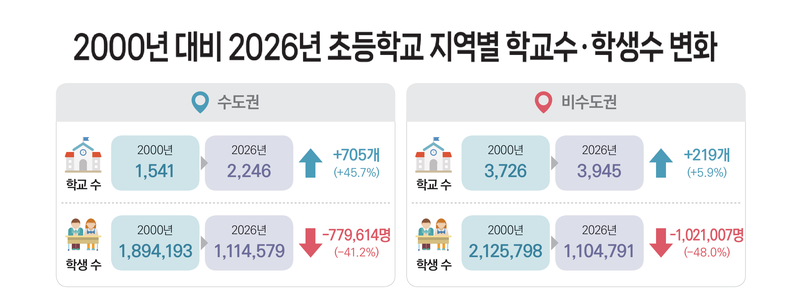
The number of elementary school students declined nationwide, with a sharper drop in areas outside the capital region. The number of elementary school students in the capital region fell 41.2%, from 1,894,193 in 2000 to 1,114,579 this year. Outside the capital region, the number dropped 48.0%, or 1,021,007 students, from 2,125,798 to 1,104,791. The average age of elementary school teachers rose by 3.4 years, from 38.9 in 2000 to 42.3 this year.
Among higher education institutions, junior colleges experienced sharp declines in both the number of institutions and student enrollment. Junior college enrollment fell 44.7%, from 913,273 students in 2000 to 504,897 this year. In particular, enrollment at junior colleges outside the capital region dropped 55.5%, from 596,182 to 265,407, falling below half its 2000 level.
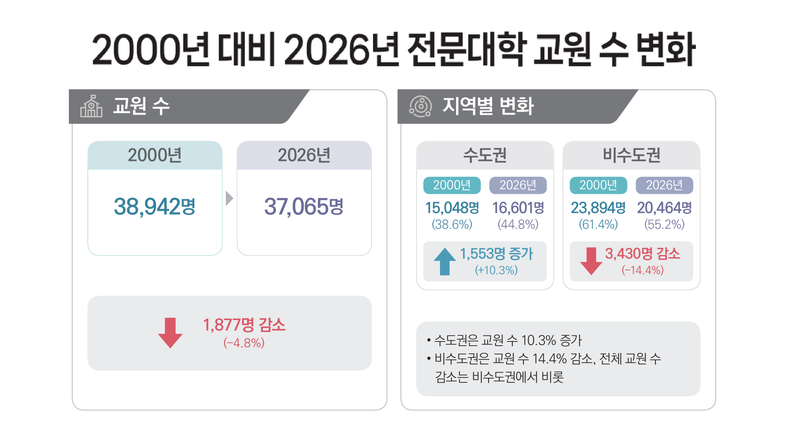
The number of junior college faculty members in the capital region increased 10.3%, from 15,048 to 16,601, while the figure outside the capital region declined 14.4%, from 23,894 to 20,464. In its report, the Korean Educational Development Institute analyzed that the entire decline in the number of junior college faculty came from areas outside the capital region, resulting in contrasting regional trends in faculty recruitment, which affects the quality of education.
At four-year universities, including universities of education, industrial universities and general universities, total enrollment increased 2.0%, from 1,856,927 students in 2000 to 1,894,516 this year. Growth was concentrated in the capital region: enrollment at universities there rose 18.7%, while enrollment at universities outside the capital region fell 7.7%. As a result, the share of total university enrollment accounted for by universities in the capital region expanded from 36.9% to 42.9%.
[email protected] Kim Man-gi Reporter