Solidigm's U.S. Listing to Raise Capital: 'Revaluation of Investment Value' vs. 'Dilution of Shareholder Value' [What Do You Think?]
- Input
- 2026-10-05 14:40:29
- Updated
- 2026-10-05 14:40:29
[Financial News] The possibility of Solidigm, SK hynix's U.S. subsidiary, going public in the United States next year has brought external financing into the spotlight. Solidigm needs to make substantial investments to capitalize on growth opportunities in the enterprise solid-state drive (eSSD) market amid an artificial intelligence (AI) supercycle.
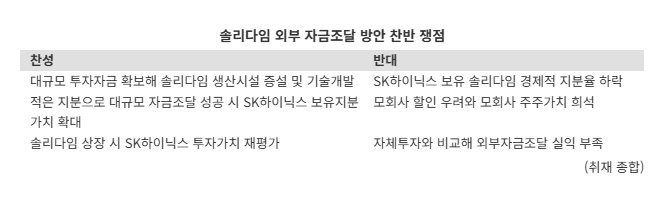
Analysts say that if Solidigm raises substantial external capital in the U.S. market to expand its production facilities, it could secure the NAND and eSSD supply chain in the United States while prompting a reassessment of the investment value of SK hynix. However, minority shareholders have raised concerns that attracting external capital could dilute the value of the parent company's shares through a separate listing.■ SK hynix Value Could Rise Alongside SolidigmIndustry sources and foreign media reported on the 5th that Solidigm could reach a valuation of up to $150 billion (approximately 202 trillion won) if it lists on the Nasdaq in the United States next year. Analysts say the listing could allow Solidigm to use the substantial investment funds it raises amid the AI boom to significantly expand its NAND production capacity. At the same time, the value of SK hynix's stake could be confirmed, potentially leading to a reassessment of its investment value.
Solidigm is a U.S. company launched after SK hynix agreed in 2020 to acquire Intel's NAND and SSD business for approximately $9 billion (about 12 trillion won). Its main products are eSSDs for servers, cloud computing, and AI data centers.
The argument is that Solidigm could create additional business value by raising external capital through a new-share issuance and investing the proceeds in new fabrication plants and research and development. If Solidigm commands a high valuation and raises substantial capital by selling a relatively small stake, the value of SK hynix's holding could increase further. Until now, SK hynix's corporate value has been assessed mainly on the basis of its HBM and DRAM businesses.
Kim Young-gun, a researcher at Mirae Asset Securities, said, "If Solidigm raises investment funds by selling part of its stake, it would secure investment capacity of approximately $15 billion (about 20.4 trillion won) in the United States." He added, "It is appropriate to view this issue not as a subsidiary's separate listing, but as a means of recovering investment from mergers and acquisitions (M&A) and securing funds for follow-up investments." Kwon Jae-yeol, a professor at Kyung Hee University Law School, also noted, "If the listing proceeds are used to expand NAND plants in the United States, the value of SK hynix will ultimately rise." He added, "For Solidigm to continue operating in the United States, becoming a listed company would also be advantageous as a condition for its continued operations."
SK hynix has stated in principle that it will "make long-term shareholder value the basis for every decision." The company is reportedly carefully comparing the value of the stake it would give up to use Solidigm's external capital with the value of deploying SK hynix's own funds.■ Concerns Over a Parent-Company Discount... Protecting Existing Shareholders Is KeyHowever, some analysts say it is necessary to determine whether raising funds through a separate Solidigm listing would benefit existing SK hynix shareholders. They explain that the share of profits accruing to existing shareholders and the cash distribution structure could change as external capital is attracted through the listing.
In a recent report, Lee Young-gon, head of the research center at Toss Securities, wrote that SK hynix's economic ownership stake in Solidigm could decline if Solidigm attracts external investors through a pre-IPO placement and a public offering. In other words, after external investment is secured, SK hynix would have to share with outside shareholders the profits and growth value from Solidigm that it previously enjoyed. The possibility of a "parent-company discount," in which the value of Solidigm's stake held by SK hynix is not fully reflected in its share price, has also been raised.
Lee Sang-heon, a researcher at iM Securities, said, "The profits Solidigm generates are already reflected in SK hynix's performance and corporate value." He added, "If SK hynix's ownership stake in Solidigm declines as a result of attracting external investors, the portion of those profits attributable to SK hynix shareholders could decrease even if Solidigm generates the same level of earnings."
The benefits of external financing compared with SK hynix's own investment capacity are also at issue. Lee said, "If there is not enough money to invest, raising funds through a listing and expanding production capacity could also benefit the parent company's shareholders." He added, "If the company has sufficient capacity to invest on its own, as SK hynix does, it must consider why it should bring in external shareholders and whether the benefits would be substantial enough to justify accepting dilution of its stake."
The conclusion, therefore, is that measures to protect the interests of existing shareholders must be presented alongside the method and scale of capital raising. The head of the research center said, "If SK hynix attracts external capital through Solidigm and secures new growth opportunities, that in itself may not necessarily lead to damage to shareholder value. However, because existing shareholders' economic ownership will be diluted, the company must also present capital allocation principles and shareholder-return policies capable of offsetting that dilution."

[email protected] Park So-hyun, Park Ji-yeon Reporter