[Exclusive] DPK moves to close loopholes in nationwide farmland survey, mandate dissolution of speculative agricultural corporations
- Input
- 2026-10-05 15:51:11
- Updated
- 2026-10-05 15:51:11

Illegal farmland use by agricultural corporations has fallen into a blind spot in government oversight. Even when the Ministry of Agriculture, Food and Rural Affairs (MAFRA) uncovers agricultural corporations engaged in real estate businesses, the authority to impose administrative sanctions remains at the discretion of local government heads.
The ruling Democratic Party of Korea (DPK) plans to introduce an amendment to the Act on Fostering and Supporting Agricultural and Fisheries Business Entities that would mandate dissolution orders for agricultural corporations and grant the MAFRA minister the authority to issue such orders. As with the Farmland Act amendment proposed in May, the measure would strengthen intervention by central government agencies on their own authority. It also follows the principle underlying the proposed special act on the nationwide farmland survey: clear-cut speculation must be dealt with harshly.
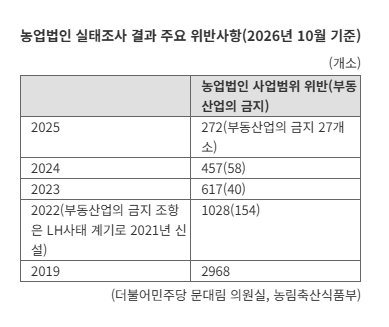
According to the results of a survey of agricultural corporations—including agricultural companies and farming associations—submitted by MAFRA to DPK Rep. Moon Dae-rim on the 5th, there were 272 violations last year involving the business scope of agricultural corporations under the Act on Fostering and Supporting Agricultural and Fisheries Business Entities. Of these, 27 involved violations of the ban on real estate businesses.
After a real estate provision was introduced in the wake of the Korea Land and Housing Corporation real estate scandal (LH scandal) in 2021, the cumulative number of violations over the four years starting in 2022 reached 279. Agricultural corporations that engage in activities outside their designated business scope are subject to dissolution orders. If a local government head petitions a court for dissolution, the court reviews the case and issues the order.
The problem is that MAFRA has no direct means of sanctioning an agricultural corporation even after identifying an illegal act through its survey. Under the current Act on Fostering and Supporting Agricultural and Fisheries Business Entities, a local government head—such as a mayor, county governor or district office head—may petition a court for dissolution. The law says that the head may file a petition, rather than requiring the petition to be filed. If a local government takes no follow-up action because of an excessive workload or its own judgment, the speculative corporation remains in operation. There is not even a legal basis for a central government agency to determine whether a local government has carried out the administrative action.
Agricultural corporations account for about 0.2% of farmland owners, or 11,540 entities, but organized real estate speculation exploiting corporate names has long been identified as a major threat to the farmland ecosystem. The scheme involves establishing an agricultural corporation, purchasing farmland cheaply near areas slated for development, then dividing the ownership stakes and reselling them.
In recently announcing supplementary measures for the nationwide farmland survey, MAFRA said it would treat agricultural corporations operating real estate businesses as engaging in speculation and impose farmland disposal orders on the relevant land. However, it plans to enact a special act to defer such orders in cases involving elderly farmers leaving land fallow or unavoidable neglect.
The DPK has decided to pursue an amendment to the Act on Fostering and Supporting Agricultural and Fisheries Business Entities modeled on the mechanism of the Farmland Act amendment passed by the National Assembly in May this year. It plans to convert dissolution petitions, which are currently left to local governments' discretion, into a mandatory requirement and allow the minister to petition a court for dissolution directly.
The earlier Farmland Act amendment likewise converted farmland disposal orders, which had previously been left to local governments' discretion, into a mandatory requirement and allowed the MAFRA minister to issue such orders directly. Critics have also warned that the measure could place an administrative burden on bona fide agricultural corporations operating as family farms.
Rep. Moon submitted a request to the National Assembly for a legal review to support the amendment. Moon said, "If agricultural corporations that have exploited farmland as a means of speculation are identified but no follow-up measures are taken, the purpose of a nationwide survey cannot be fulfilled. We will respond firmly to farmland speculation while clearly defining the targets and criteria for action so that farmers and agricultural corporations that diligently work the land do not face unnecessary burdens."
[email protected] Choi Yong-jun, agriculture specialist Reporter