Small and Mid-Sized Capital Firms See Debt Costs Rise from the 3% Range to the 6% Range... Is a 'Refinancing-Rate Shock' Coming? [FN Market Watch]
- Input
- 2026-10-05 13:57:19
- Updated
- 2026-10-05 13:57:19
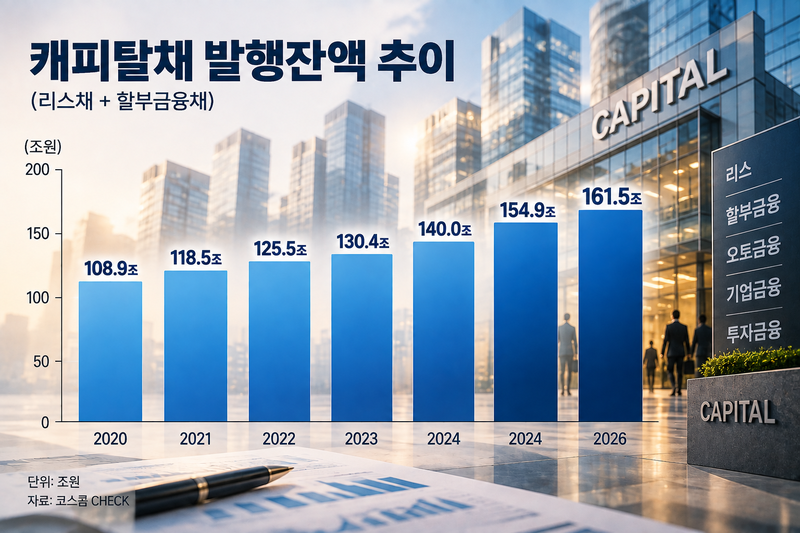
According to Koscom's CHECK Expert+ on the 5th, the outstanding balance of lease bonds and installment-finance bonds combined stood at KRW 161.4629 trillion. This was an increase of KRW 6.5557 trillion, or 4.2%, from KRW 154.9072 trillion at the end of 2025. Compared with KRW 130.3594 trillion at the end of 2023, the balance had grown by KRW 31.1035 trillion, or 23.9%.
As the market has expanded, new funding rates for small and mid-sized capital firms have risen to around 6%. Korea Asset Capital issued private-placement bonds totaling KRW 15 billion on the 29th and 30th of last month at annual rates of 5.6% to 5.7%. Its funding rate, which had remained between 4.7% and 5.1% annually over the past two years, has now approached 6%.
The increase in DB Capital's funding rate has been even more pronounced. It issued two-year private-placement financial bonds worth KRW 16 billion at an annual rate of 6.0% on the 29th of last month, and raised another KRW 4 billion through two-year bonds at the same rate on the 2nd of this month. Its funding rate, which had been in the 3% to 4% range, has risen into the 6% range since August.
Korea Capital also issued KRW 50 billion of hybrid capital securities at an annual rate of 6.470% on the 1st of this month. The problem is that the capital-firm bonds, whose outstanding balance has grown to approximately KRW 161 trillion, will be refinanced sequentially as they mature during a period of rising interest rates. According to Korea Investors Service (KIS), rates on newly issued bonds by specialized credit finance companies began exceeding the weighted average rate on existing funding liabilities in the second quarter of this year. Bond-market experts forecast, "As existing low-rate bonds are replaced with new bonds carrying higher rates, an increase in the average funding cost of specialized credit finance companies will be unavoidable."
KIS's stress test also highlighted the burden on lower-rated capital firms. Assuming that market rates rise by an additional 25 basis points every six months through 2027 and that all maturing corporate bonds are refinanced, the weighted average corporate bond rate was estimated to rise by 0.6 percentage points for AA-rated capital firms and by 0.8 percentage points for A-rated and below firms. The resulting additional interest expense was equivalent to 17.5% and 27.0% of net income, respectively.
Chae Young-seo, a researcher at KIS, noted, "Investment demand for bonds issued by specialized credit finance companies is declining as repo funds' purchasing capacity weakens in addition to the rise in market rates." The increase in spreads has been particularly pronounced among A-rated and below firms, which have relatively limited access to funding markets. As a result, they face greater upward pressure on issuance rates and funding costs than higher-rated firms.
The fact that higher funding costs are emerging alongside pressure on asset quality is another concern. At the end of June this year, the delinquency rate for loans overdue by one month or more at A-rated and below capital firms was 4.1%, approximately three times the 1.4% rate recorded by AA-rated firms.
Park Jong-il, a researcher at NICE Investors Service, said, "The rise in market rates has intensified pressure to increase funding costs, while the shortening of bond maturities has increased the refinancing burden," adding, "Although the quantitative risks of project-finance loans have eased compared with the past, the proportion of vulnerable projects remains high, making an increase in credit-loss burdens unavoidable."
[email protected] Kim Hyun-jung Reporter