U.S. Democrats Flood Congress with Bills to Limit Trump's Powers in Preparation for Post-Midterm Election Landscape
- Input
- 2026-10-05 08:34:02
- Updated
- 2026-10-05 08:34:02
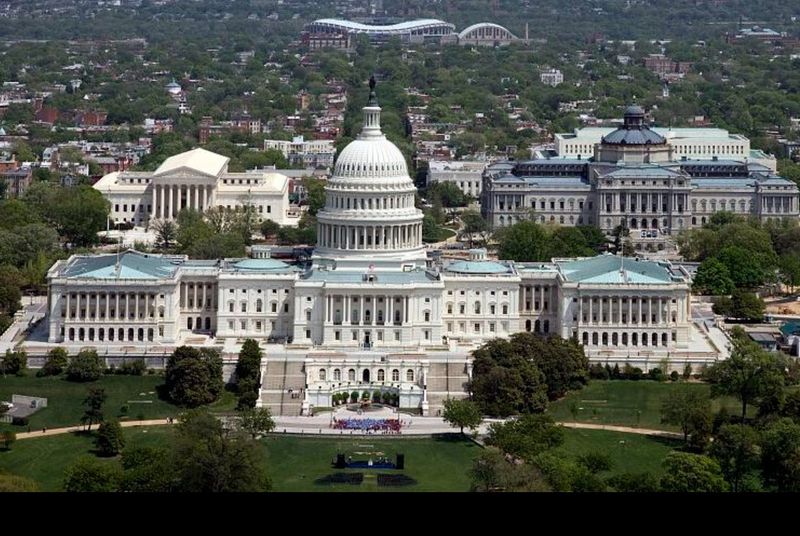
[Financial News] Preparations are underway in political circles to pass legislation limiting President Donald Trump's powers, based on the assumption that the Republican Party led by Trump will lose the U.S. midterm elections in November.
If the Democrats regain control of both chambers of Congress, they plan to reverse the changes made to the United States by the Trump administration over the past two years. The Washington Post forecast on the 4th local time that this would be an arduous undertaking resembling a sweeping national overhaul.
Democratic lawmakers are rushing to introduce related bills. The measures are intended to nullify or prevent the recurrence of actions taken by Trump in areas including foreign affairs and defense, government spending, immigration, the judiciary and his personal affairs. They also appear designed to appeal to voters' anti-Trump sentiment ahead of the election.
Representatives Suzan DelBene of Washington and Don Beyer of Virginia introduced a bill to limit the president's emergency declaration authority, which Trump has used 12 times to impose tariffs, deport immigrants and deploy the National Guard.
Representative Jamie Raskin of Maryland has drafted a bill that would bar the president from receiving money from foreign governments without congressional approval and require public review of White House renovations. The bill targets Trump's receipt of a "Qatari royal family's Air Force One" and the construction of a large White House banquet hall.
A bill has also been prepared to prevent the president from entering into financial settlements with his own administration. It is related to Trump's effort to pursue a $10 billion damages lawsuit against the Internal Revenue Service over the leaking of his tax records and to establish an approximately $1.8 billion "Judicial Victims Fund" in exchange for dropping the lawsuit.
"No Political Enemies Act" and bill to prevent mass layoffs of federal employees also included
Senator Chris Murphy introduced the "No Political Enemies Act," which would prevent the administration from prosecuting or punishing individuals or organizations because of their speech.
At the Justice Department led by Pam Bondi and Todd Blanche, lawyers concerned about Trump's "weaponization of the Justice Department" have resigned or been fired. They are holding bipartisan discussions on ways to restore the department's political independence.
The Partnership for Public Service (PPS), a nonprofit organization that advocates government reform, has proposed a bill strengthening dismissal rules to prevent a recurrence of the mass layoffs of federal employees that followed the Trump administration's launch.
Raskin told The Washington Post, "Trump's use of presidential power can and must be reversed, but doing so will take decades. We face an enormous reconstruction task."
A similar sweeping reform took place in U.S. history immediately after the Watergate scandal, which led to President Richard Nixon's resignation in 1974. Congress at the time passed a large number of bills limiting presidential powers involving the misuse of personal information, surveillance of citizens, the diversion of campaign funds and the declaration of national emergencies.
The Washington Post reported, "Critics predict that the United States after Trump will be swept up in a similar wave of reforms," adding that "lawmakers are expected to rush to act to score political points amid widespread public disgust with Trump's self-aggrandizement and pursuit of personal gain."
However, it remains uncertain whether today's Democratic Party will secure the same political momentum as it did during the Watergate scandal. At the time, the Democrats won a record landslide, holding a 61-39 majority in the Senate and a 291-144 majority in the House.
A Democratic landslide in the midterm elections is needed for sweeping legislative reform
Some scholars, however, believe that the phenomena seen under the current administration stem from Trump's popularity, aggressiveness and personal tendency to disregard traditions and conventions. As a result, they say that even if the Republican Party returns to power, Vice President JD Vance or Secretary of State Marco Rubio is unlikely to behave like "Trump 2.0."
Others counter that amid growing political polarization, future presidents will still have considerable incentive to rely on governing by executive order to strengthen their powers. Trump has issued more than 280 executive orders to date, far more than any previous president.
Some also argue that, fundamentally, modern societies in both the East and the West must first reach a social consensus to restrain the increasingly expansive powers of the presidency and establish leaders who are "committed to the public interest."
Max Stier, president of PPS, stressed, "We need citizens who demand reform." A Pew Research Center poll last year found that 78% of Americans were concerned about the expansion of presidential power.
[email protected] Lee Seok-woo, international affairs specialist Reporter