Songjeong Beach's 'Island House Baby Song Monument' Appears on Busan Tourism Lists
- Input
- 2026-10-05 07:53:00
- Updated
- 2026-10-05 07:53:00
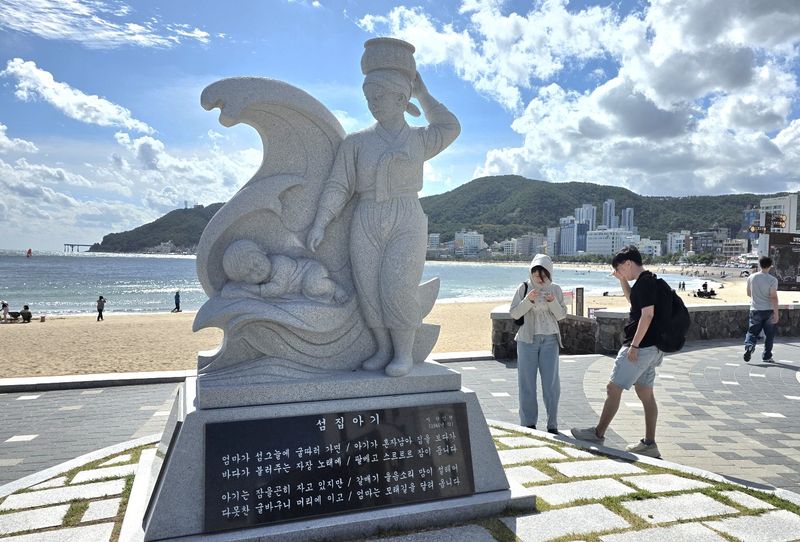
[Financial News] "When mother goes to gather oysters in the island's shade / The baby stays home alone, watching the house / To the lullaby sung by the sea / The baby rests its head on its arm and softly falls asleep / The baby sleeps soundly, but the seagulls' cries make mother's heart tremble / Carrying an unfinished basket of oysters on her head / Mother runs along the sandy path"
These are the lyrics to the beloved Korean children's song 'Island House Baby,' which almost everyone has sung at least once. As it became known that Songjeong Beach was the setting for the song, it joined the new list of attractions drawing domestic and international tourists to Busan. The Haeundae Blueline Park Beach Train, which runs from Mipo in Haeundae through Cheongsapo to Songjeong, has become highly popular after receiving the Korea Tourism Star Awards. As a result, more visitors have begun seeking out the 'Island House Baby Memorial Monument' at the entrance to Jukdo Park near the eastern end of Songjeong Beach.
Han In-hyun, the original author of 'Island House Baby,' was born in Wonsan, North Korea. In 1946, while watching women gathering oysters at Songjeong Beach in Busan, he wrote the poem while longing for the hometown he could not return to and for his deceased mother. In 1950, Lee Heung-ryeol, who came from the same hometown, composed the music, giving birth to the children's song 'Island House Baby,' which has been loved by generations ever since.
Songjeong's scenery, with its blue sea and sandy beach, resembles Myongshasipli in Wonsan, the hometown of Han In-hyun. That landscape became a poem and then a song. The familiar children's song 'Island House Baby' carries more than a simple children's melody; it also captures the scenery of Songjeong's sea in Busan and the longing for one's hometown and mother.
In Songjeong, Busan, visitors can revisit the story of how 'Island House Baby' was born 80 years ago. At the entrance to Jukdo Park at the eastern end of Songjeong Beach, an 'Island House Baby Poetry Monument' was erected last year to share the story of the song's origins and its connection to the area.
Haeundae Blueline Park is also actively working to share this 'special story' of Songjeong with domestic and international tourists. During the Beach Train ride to Songjeong, passengers can hear announcements about the background of 'Island House Baby' and the story connected to Songjeong. The experience allows them to take in the sea outside the window while learning about the place where the song was born and the story behind it.
The children's song 'Island House Baby' has also touched people across generations. A German choir performed 'Island House Baby Brahms Version' at Busan Concert Hall, winning broad affection from children and adults alike. A German girl also sang 'Island House Baby' on Part 1, 'K-Chorus Moves Germany,' of the KBS Chuseok special 'Global Korean Journey: Kim Young-chul Goes,' drawing considerable attention.
Japanese singer Aki Azuma performed 'Island House Baby' in Korean on Episode 41 of MBN's 'Korea-Japan Top Ten Show,' which aired on March 17 last year. At a music program featuring singers from Korea and Japan, a Japanese singer performed one of Korea's representative children's songs, once again showing that 'Island House Baby' can inspire empathy across languages and generations.
In this way, the story of 'Island House Baby,' which began by the sea in Songjeong, Busan, is being sung anew on various stages in Korea and abroad after 80 years.
Through the Beach Train, Haeundae Blueline Park is sharing the special story of 'Island House Baby' so that visitors can experience not only Songjeong's beautiful scenery but also the stories and culture embedded within it.
The 'Island House Baby Village Literary and Drawing Contest' will also be held at 10 a.m. on the 17th in and around Jukdo Park in Songjeong. Participants will express the sea and nature of Songjeong, which formed the backdrop for 'Island House Baby,' through writing and drawing. The program will also allow them to visit the nearby 'Island House Baby Poetry Monument' during the event.
Bae Jong Jin, a representative of Haeundae Blueline Park, said, "Many people still do not know that the beloved Korean children's song 'Island House Baby' began at Songjeong Beach in Busan. After taking the Haeundae Beach Train and hearing the story of 'Island House Baby,' get off at Songjeong and visit the sea that inspired the song and the poetry monument. You will be able to feel a mother's noble love and the longing for one's hometown."
Bae said, "Haeundae Blueline Park will continue working to inform domestic and international tourists that Songjeong is more than just a beautiful beach—it is a place where the story of the beloved Korean children's song 'Island House Baby' is alive. We will make greater efforts to connect local culture with tourism."
[email protected] Byun Ok-hwan Reporter