“Even if just one subscriber remains, the network can’t be switched off” ... Cable TV trapped by “aging HFC”
- Input
- 2026-10-06 16:24:40
- Updated
- 2026-10-06 16:24:40

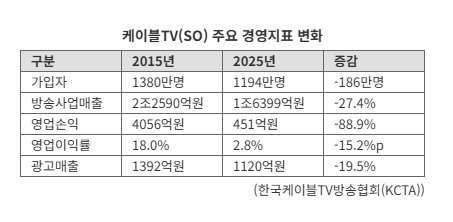
[Financial News] The cost structure of cable TV, in which subscriber numbers are falling but broadcasting network maintenance costs are proving difficult to cut, is worsening the industry’s profitability. Even in areas with only a handful of subscribers, providers find it difficult to discontinue service at their discretion, forcing them to keep operating legacy hybrid fiber-coaxial (HFC) networks, which consume considerable power and carry a heavy maintenance burden. As the contraction of the cable TV market continues, industry voices say regulations governing network operations need to be updated to allow inefficient HFC networks to be phased out and replaced with fiber to the home (FTTH), while protecting users.
According to the broadcasting industry on the 6th, cable television operators (SOs) see a transition from HFC to FTTH as a way to reduce the burden of maintaining their networks while improving their services’ competitiveness. However, it appears that the industry has not yet made a formal request to the government or begun concrete discussions on regulatory improvements.■ HFC’s high maintenance burden makes transition to FTTH a priorityHFC carries signals over fiber-optic cable for part of the route, then uses coaxial cable from a point near the subscriber. Unlike FTTH, which connects fiber-optic cable directly to homes, HFC requires power-consuming equipment such as nodes and amplifiers along the network, creating a significant maintenance burden. According to the FTTH Council Europe and other sources, HFC networks consume about six times as much power as FTTH networks. The industry says they also differ from fiber-based networks in transmission quality and operational efficiency.
The problem is that network maintenance costs are difficult to reduce in proportion to the decline in subscribers. Because HFC provides service by grouping a given area into a single cell, the existing network must be maintained as long as a subscriber in that cell continues to use the service—even if the number of subscribers falls from several hundred to just one. In areas where subscriber numbers are declining rapidly, the entire network effectively has to be operated for the sake of a small number of users.
The aging network is also affecting service competitiveness. According to the industry, while the three IPTV providers roll out new set-top boxes (STBs) equipped with AI, voice recognition and other features every two to three years, the manufacture and introduction of new STBs for cable TV have effectively come to a halt amid shrinking demand as subscriber numbers fall and high purchase costs. The industry says this has created a vicious cycle: declining subscriber numbers weaken the equipment ecosystem, and diminished service competitiveness, in turn, drives more subscribers away.
A transition to FTTH is seen as a way to cut costs and improve service competitiveness. It can improve the quality of high-speed internet and enable services that combine AI with online video services (OTT) such as YouTube and Netflix through new IP-based STBs. With the manufacture and introduction of new STBs for cable TV effectively halted by declining subscriber numbers and high purchase costs, a shift to an IP-based equipment ecosystem is also expected to bring benefits.■ “Cells with only a handful of subscribers left should be eligible for shutdown”However, as long as HFC subscribers remain, providers cannot unilaterally discontinue service and move them to FTTH. At present, they must obtain each subscriber’s consent to change their service plan and individually coordinate a visit to replace the equipment.
An industry official said, “When we explain that the service quality will improve and rates will not go up, most subscribers agree to switch.” However, the official added, “Some subscribers find even the consultation itself bothersome, while others remain unreachable despite repeated attempts, making the transition difficult.”
The current Broadcasting Act contains no provision that directly prohibits shutting down HFC on a cell-by-cell basis. However, if a provider unilaterally discontinues a service that users are currently receiving, it could harm their interests, making it difficult to switch off a network at will. The industry therefore believes standards and procedures should be established to allow HFC to be phased out in cells where subscriber numbers have fallen to or below a certain level, provided that users receive adequate advance notice and alternative services are offered. For example, regulations could provide a basis for shutting down HFC when a cell has 20 or fewer subscribers.
Protecting existing users must also be a prerequisite. Options under consideration include maintaining existing rates and service levels after the transition to FTTH and allowing subscribers who do not wish to switch to cancel without paying a termination fee. An industry official stressed, “In the long term, HFC needs to be replaced with FTTH to deliver AI-based interactive services and more sophisticated content commerce,” adding, “A ‘cell-by-cell network shutdown’ system should be introduced to allow networks in specific, inefficient areas to be closed, provided users are protected.”
[email protected] Choi Hye-rim Reporter