"There Is No Need to Decide on 10 Years' Worth of the $350 Billion U.S. Investment in the First Year"
- Input
- 2026-10-04 18:16:20
- Updated
- 2026-10-04 18:16:20
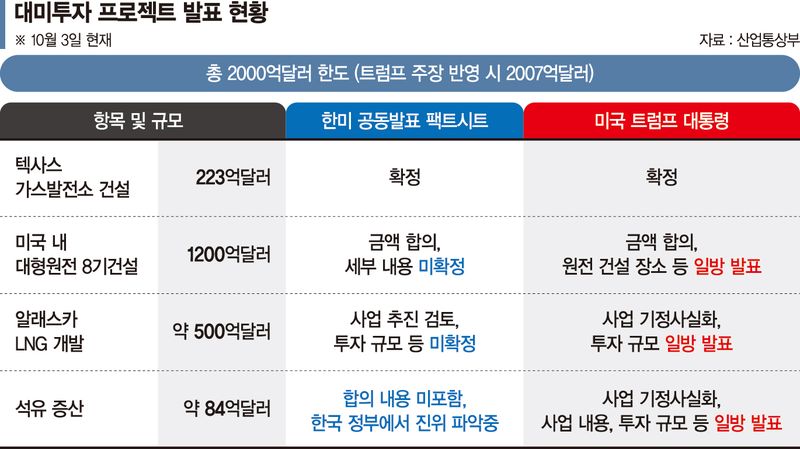
In particular, Donald Trump's pressure for participation in the Alaska LNG project, whose investment has not yet been decided, is putting the principle of selecting projects based on commercial viability to the test.
According to a compilation of experts' views by Financial News on the 4th, the success of the U.S. investment, which will continue over the next 10 years, will depend on how thoroughly the commercial viability of each project and its long-term risks are managed.
Pressure from the United States has immediately emerged as a variable. On the 2nd, local time, Donald Trump responded to a reporter's question about whether "South Korea has not agreed to invest in the Alaska LNG project," saying, "That's fine if they don't want to. We can charge more." He added, "Tell them that if they don't reach an agreement soon, we'll double it." He did not specify what he intended to double.
The Korean government maintains that it has not decided whether to invest in the Alaska LNG project or how much to invest. It is currently reviewing the project's commercial viability.
Professor Koo Ki-bo of the Department of Global Commerce at Soongsil University said, "This is the first year, and there is no need to decide everything for the next 10 years in the first year." He stressed, "The Alaska project should not be finalized without sufficient review and should remain subject to continued discussions."
Cho Sung-dae, head of the Trade Research Office at the Korea International Trade Association (KITA), noted, "It is difficult to make a judgment based solely on whether putting in 100 in terms of commercial viability produces 100 or 150." He said strategic value, including the diversification of energy supply chains and resource security, should also be taken into account.
The first project, the Texas Encinal gas-fired combined-cycle power project, received a relatively positive assessment. Although a power purchase agreement (PPA) has not yet been signed, experts said the project should not be viewed as excessively risky given long-term electricity demand. Kim Tae-hwang, a professor in the Department of International Trade at Myongji University, said, "It is difficult to begin a project after signing every agreement, including a power purchase agreement, at the outset." He added, "Given electricity demand in Texas, I do not believe electricity sales themselves are a matter of major concern."
Managing volatility in large infrastructure projects that take years to complete is another challenge. Nuclear projects are particularly vulnerable because construction takes around 10 years, and cost increases, construction delays, and policy changes can affect long-term profitability. Kim Tae-hwang noted, "We do not know what variables may arise over the next 10 years," emphasizing the need for continuous risk management.
In the U.S. nuclear projects, worth up to $120 billion, a key issue is how much real business opportunity the Korean nuclear industry can secure alongside recovering its investment. Plans are currently being pursued to use two APR1400 reactors and six AP1000 reactors among the eight planned reactors. The basic direction is to prioritize Korean companies' participation in AP1000 projects as well, but specific procurement volumes have not been guaranteed.
Professor Koo Ki-bo emphasized, "This is also important because it serves as the first gateway to determining whether Korea can continuously supply the key equipment needed for U.S. nuclear power plants."
Cho Sung-dae also said, "It is important that we do not simply send money, but that Korean companies secure opportunities to participate in construction and equipment supply during the project." He added, "The discussions should be conducted in a way that secures tangible benefits in subsequent projects as well."
[email protected] Park Ji-young Reporter