[Exclusive] Even the Government Does Not Know Whether Recovered Assets Were Bought by Descendants of Pro-Japanese Collaborators
- Input
- 2026-10-04 18:30:40
- Updated
- 2026-10-04 18:30:40
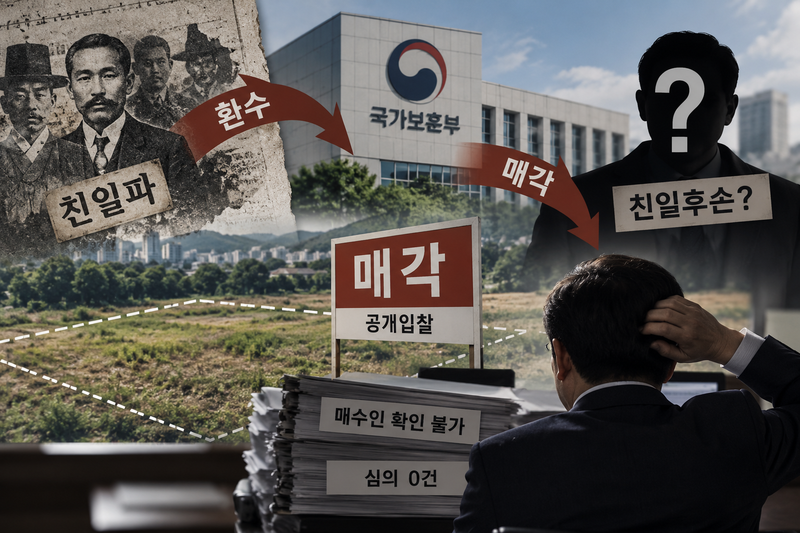
According to data on the public-auction sales of property vested in the state as pro-Japanese collaborators’ property, which the Ministry of Patriots and Veterans Affairs (MPVA) provided to the office of Democratic Party of Korea lawmaker Jeon Hyun-hee on the 4th, 34 properties were sold through public auctions after the subcommittee for deliberation on the sale of property linked to pro-Japanese collaborators was established. The total area was 30,319 square meters, equivalent to more than four soccer fields, and the total sale proceeds amounted to approximately 1.1 billion won.
The problem is that there is no procedure to determine whether the buyers were descendants of the pro-Japanese figures who originally owned the properties. According to Jeon’s office, MPVA says it is difficult to determine whether buyers are descendants because it cannot require them to submit documents verifying their family relationship with pro-Japanese figures in public auctions. In private-contract sales, prospective buyers are interviewed about whether they are descendants of pro-Japanese figures and are required to submit confirmation statements. However, all 34 cases were public auctions and therefore did not go through such procedures.
The 2024 parliamentary audit previously revealed that at least 13 properties recovered by the state had been resold to descendants of pro-Japanese collaborators. MPVA subsequently conducted a full investigation into past private-contract sales and identified seven additional cases of resales to descendants of pro-Japanese collaborators that had not previously been disclosed.
As a measure to prevent a recurrence, MPVA established the Subcommittee for Deliberation on the Sale of Property Linked to Pro-Japanese Collaborators in May last year. The aim was to prevent property vested in the state as pro-Japanese collaborators’ property from being resold to their descendants and to ensure that the sales process was conducted more transparently and professionally.
However, the subcommittee has not met even once since its establishment. Under the current operating rules, reviews are limited to property linked to pro-Japanese collaborators sold through private contracts and property with an appraised value of at least 1 billion won. Public-auction sales of property valued at less than 1 billion won are excluded from review.
As a result, none of the 34 public-auction sales conducted after the subcommittee was established underwent review. They involved public auctions that did not separately verify whether buyers were descendants of pro-Japanese collaborators, while also being excluded from review by the subcommittee.
The prices at which the properties were sold also came under scrutiny. Sixteen of the 34 properties were sold below their appraised values. Proceeds from the sale of property recovered by the state under a special act are transferred to the Fund for the Projects of Martyrs for National Independence and Patriots and used to provide welfare support for independence activists and their bereaved families.
Of the 822 parcels of property linked to pro-Japanese collaborators currently managed by MPVA, 256 are eligible for sale. Jeon pointed out, "The system should be revised so that these properties undergo review by the subcommittee regardless of the method or price of sale."
[email protected] Song Ji-won Reporter