'The First Female Prime Minister Craze Has Faded': Public Opinion Turns Against Takaichi Over Her Policies One Year On
- Input
- 2026-10-04 15:35:43
- Updated
- 2026-10-04 15:35:43
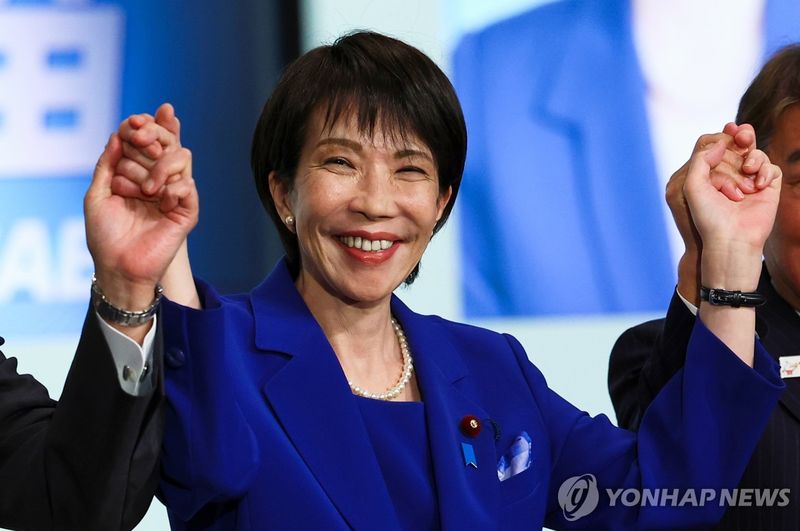
[Financial News Tokyo = Correspondent Seo Hye-jin] The cheers that once greeted Japan's first female prime minister are falling silent as her policy record comes under scrutiny, Japanese media reported on the 4th. Even among young women who once bought items used by Sanae Takaichi and cheered for her like a celebrity, complaints are emerging that "Nothing about our lives has changed."
Mainichi Shimbun reported that the 'Sana-katsu' craze that swept young people has subsided as Sanae Takaichi marked one year since being elected president of the Liberal Democratic Party (LDP). Analysts say moderates are drifting away because of disappointment over the government's response to high prices and its diplomacy toward China, leaving the conservative support base increasingly responsible for sustaining the administration.
Sanae Takaichi won the LDP leadership election on October 4 last year and became Japan's first female prime minister on October 21. Young voters responded positively to the fact that a non-hereditary politician from outside a prominent political family had broken through the glass ceiling of Japan's male-dominated political world.
At the time, her popularity was close to a fandom. The term 'Sana-katsu' emerged by combining 'Sana,' taken from her first name, Sanae, with 'oshikatsu,' the practice of supporting a favorite celebrity or public figure. Some people even expressed their support by purchasing items favored by Sanae Takaichi.
But a year later, voices demanding policy results have grown louder than expectations for change. A woman in her 30s who works in the aviation industry and lives in Chiba Prefecture told Mainichi, "There have been no policies that could improve our lives, and nothing has changed." She also questioned the deterioration in relations with China following Sanae Takaichi's remarks suggesting that Japan might intervene in the event of a Taiwan contingency, saying, "I wonder whether this really helps Japan."
Mainichi reported that the term 'Sana-katsu' has also disappeared from social media. A poll conducted by the newspaper last month put Cabinet approval at 45%, a sharp drop from above 65% when the administration was launched. Even so, the figure remained higher than the 40% disapproval rating. The newspaper explained that a solid conservative support base, estimated at around 40%, is propping up Cabinet approval.
Economic policy is also forcing Sanae Takaichi to choose between her support base and the markets. Nihon Keizai Shimbun, also known as Nikkei, reported that although she advocates "responsible proactive fiscal policy," she has been listening to traditional bureaucrats when formulating actual policies. Contrary to the public perception that she intends to exclude Japan's Ministry of Finance, she is using the bureaucracy to reassure the markets.
The problem is the political burden. Nikkei pointed out that Sanae Takaichi, who has portrayed herself as the successor to former Prime Minister Shinzō Abe, cannot easily make public a policy course different from Abenomics, which centered on increased fiscal spending.
Nikkei analyzed that Sanae Takaichi has used Japan's Ministry of Finance when addressing the markets while presenting an "anti-Ministry of Finance" image to her support base. It added that this ambiguous approach has reached its limits as even the United States government raises concerns about Japan's economic policies, arguing that the government needs to revise its policy of relying exclusively on expansionary fiscal measures.
[email protected] Seo Hye-jin Reporter