By 2040, Hanwha Group Aims to Travel Between the Moon and Earth and Observe the Planet, Investing 43 Trillion Won in Space Infrastructure
- Input
- 2026-10-05 14:28:00
- Updated
- 2026-10-05 14:28:00
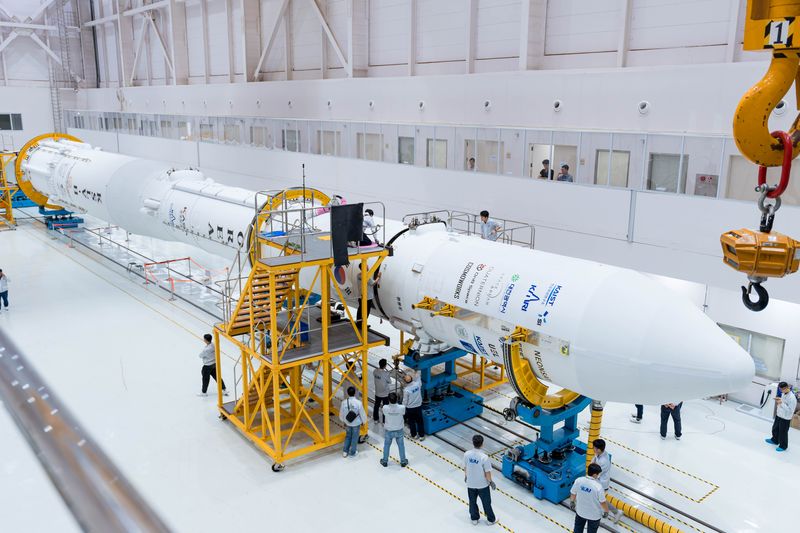
Next-generation launch vehicle with reusable technology in the 2030s... Hanwha Group seeks synergies through KAI acquisition
Industry sources said on the 5th that Hanwha Group is working to realize its blueprint for the space industry in the 2040s. The Nuri project, in which Hanwha Aerospace serves as the system integrator, is a representative example.Nuri's fifth launch is scheduled for the 7th. The launch vehicle will be upgraded through its seventh launch in 2028. At the same time, Hanwha Group is developing reusable launch-vehicle technology modeled on SpaceX's Falcon 9. It has begun the full assembly of a demonstrator and plans to complete a successful test flight in 2028, when the Nuri project concludes. Once the technology is secured, it will be applied to next-generation space launch vehicles in the 2030s.
Hyundai Rotem is developing the launch vehicle engine technology. At the 2nd Aerospace Technology Fair (AEROTEC), held from the 30th through the 2nd, it introduced a methane engine and propulsion system technologies for reusable space launch vehicles being developed under the direction of the Korea Research Institute for Defense Technology Planning and Advancement (KRIT). Methane produces less soot during combustion and offers high fuel efficiency, making it suitable for reusable launch-vehicle engines.
The missions of the next-generation space launch vehicle using reusable technology include a lunar landing in 2032, satellite launches, and meeting demand for space exploration. Hanwha Aerospace is developing a propulsion system for a lunar lander. Hanwha Group is leading the effort from the launch vehicle bound for the Moon to the lunar lander itself. Its goal is to usher in an era of travel between Earth and the Moon in the 2040s.
Hanwha Group is seeking to acquire Korea Aerospace Industries (KAI) to accelerate development of these space launch vehicles. It expects synergies from using KAI's satellite and launch-vehicle technologies. After increasing its stake to 15.89%, it has become subject to the Fair Trade Commission's simplified review for business combinations.
Developing 15-cm-class satellites at an altitude of 400 km... From climate forecasting to support for strikes by the K9 Thunder and other systems
Hanwha Group is also accelerating advances in satellite technology for satellites launched by its space launch vehicles. At AEROTEC, Hanwha Systems displayed a physical mock-up of a small synthetic aperture radar (SAR) satellite with a resolution of 50 cm. This follows its successful launch in 2023 of a domestically developed 100-kg SAR satellite with a resolution of 1 meter, and it continues to develop higher-resolution SAR satellites.Of particular note is the development of VLEO (very low Earth orbit) UHR (ultra-high-resolution) SAR satellites capable of capturing 15-cm-class imagery at altitudes of 400 km or less. Hanwha Group also unveiled a space AI solution that analyzes satellite imagery capable of capturing objects at 15-cm resolution. The technology can be used for a range of applications, from forecasting climate and environmental changes and estimating damage from disasters to resource exploration and precisely tracking enemy movements. For military applications, it can support precision strikes using systems such as the K9 Thunder self-propelled howitzer and the K239 Chunmoo multiple rocket launcher produced by Hanwha Aerospace.
[email protected] Kim Yoon-ho Reporter