K-Perf Metric for Rebellions' NPU and AI Chips Applied at KEPCO for First Time
- Input
- 2026-10-04 12:23:08
- Updated
- 2026-10-04 12:23:08
The Ministry of Science and ICT said on Oct. 2 that KEPCO, Rebellions and the Telecommunications Technology Association (TTA) had signed an MOU titled 'Technology Cooperation for K-Perf-Based AI Video Analysis in the Power Sector Using Korean AI Semiconductors' at Rebellions' headquarters in Seongnam, Gyeonggi Province.
Under the agreement, KEPCO will pilot the conversion of its AI video analysis infrastructure, previously operated separately at each substation, into an integrated NPU-based monitoring and control system. The agreement's key objective is to assess the performance of Korean-made AI semiconductors in an actual operating environment.
Rather than merely evaluating the chips' computational performance, the project will comprehensively assess processing performance, stability and cost-saving effects during AI video analysis and produce objective data.
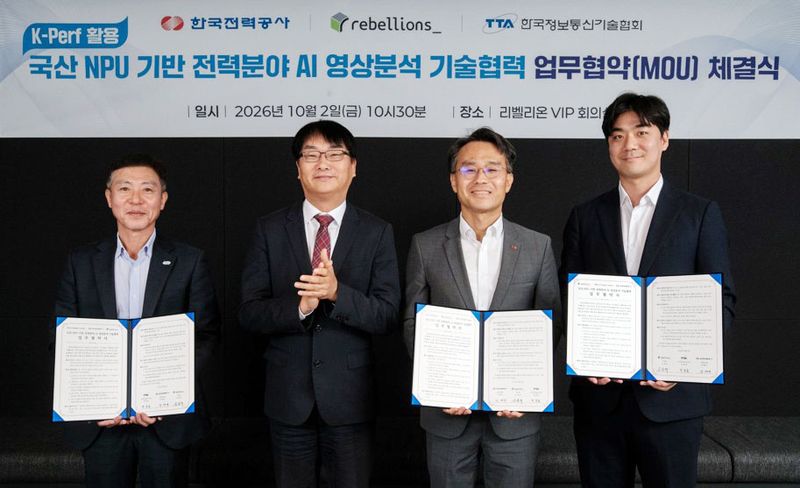
KEPCO will conduct the pilot operation at power facilities and develop use cases, while Rebellions will handle NPU performance optimization and provide technical support. TTA will verify performance and reliability under conditions that reflect actual operating environments at power facilities.
In particular, K-Perf, developed last year, will be applied for the first time to a company's actual adoption of Korean-made AI semiconductors. K-Perf is a metric created to help demand-side organizations objectively compare the performance of Korean-made AI semiconductors and decide whether to adopt them. In December last year, 15 demand-side and supply-side organizations participated in establishing detailed metrics based on real-world usage conditions, including measurement models, testing conditions, time to first token (TTFT), speed stability for long responses (TPOT) and throughput per hour (TPS).
In June, the Ministry of Science and ICT, TTA and the Institute for Information and Communications Technology Planning and Evaluation (IITP) conducted pilot K-Perf tests on two Korean-made AI semiconductors in generative AI service environments, including AI chatbots and document search. This time, the scope of verification will be expanded to AI video analysis at power facilities.
Lee Do-gyu, head of the Information and Communications Policy Office at the Ministry of Science and ICT, said, "This agreement signifies that a system in which demand-side organizations and suppliers discuss performance using a single standard has begun to operate in the field. As KEPCO, which is responsible for the nation's power grid, is using K-Perf in a demonstration of AI video analysis at substations, we expect it to become a powerful reference for expanding the technology to other demand-side organizations."
One of the biggest obstacles to the Korean-made NPU industry's efforts to secure global markets has been obtaining real-world cases in which the chips are operated by demand-side companies over an extended period, beyond demonstrating the chips' performance alone. The government expects the results of this demonstration to serve as an achievement in efforts to take Korean-made NPUs into global markets.
[email protected] Lee Gu-sun Reporter