Nationwide fisheries foreign workforce surpasses 25,000; zero cases of 'departure guarantee deposits' detected this year
- Input
- 2026-10-04 11:55:17
- Updated
- 2026-10-04 11:55:17
【Financial News, Jeju = Jung Yong-bok, Reporter】 The number of foreign workers employed on domestic fishing vessels, at aquaculture farms and elsewhere in the fisheries sector has recently surpassed 25,000 based on combined statistics. The number of foreign workers on vessels under 20 tons has more than doubled in four years, while the number of foreign workers in Jeju's fisheries sector has approached 1,500. However, no so-called 'departure guarantee deposits' paid by foreign fishing crew members were detected in government inspections this year, raising the need to strengthen management systems in line with the expansion of the workforce.
Data submitted by the National Federation of Fisheries Cooperatives and the Ministry of Oceans and Fisheries to Moon Dae-rim, a Democratic Party of Korea lawmaker on the National Assembly's Agriculture, Food, Rural Affairs, Oceans and Fisheries Committee, showed that 9,662 foreign crew members holding E-10-2 status were working on coastal and nearshore fishing vessels of 20 tons or more as of June this year.
The number of foreign workers under E-9 status employed on vessels under 20 tons, at aquaculture farms and in salt harvesting stood at 15,588 as of August this year. The latest figures combined total 25,250.
The foreign workforce in the fisheries sector is broadly divided into two systems. E-10-2 workers are primarily foreign fishing crew members employed on coastal and nearshore vessels of 20 tons or more, while E-9 workers are foreign workers employed on vessels under 20 tons, at aquaculture farms and in salt harvesting. Although they work in the same fisheries sector, their systems for entry, employment and management are different.
The recent increase has been particularly pronounced among E-9 workers. The number of foreign workers under E-9 status in the fisheries sector rose from 8,707 in 2022 to 15,588 in August this year, an increase of 6,881, or 79.0%.
The number of foreign workers on vessels under 20 tons rose from 3,424 to 6,997 over the same period, an increase of 3,573. It rose 104.4% in four years, more than doubling.
The number of E-10-2 foreign crew members on vessels of 20 tons or more rose from 9,242 in 2022 to 10,199 in 2023 and 10,268 in 2024. It then fell to 10,034 last year and 9,662 as of June this year. Since 2022, the figure has generally remained around 10,000.
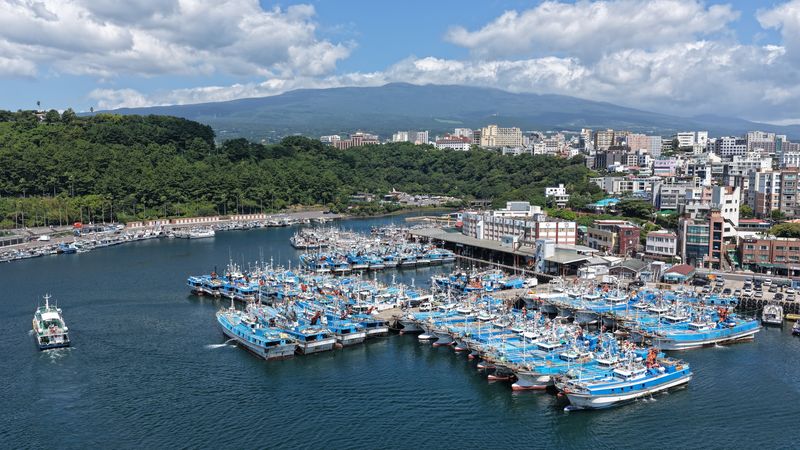
Jeju has also seen an increase in foreign workers. The number of foreign workers under E-9 status in Jeju's fisheries sector rose from 1,007 in 2022 to 1,482 in August this year, an increase of 475. The figure has risen 47.2% in four years. Jeju's current total accounts for about 9.5% of all E-9 foreign workers in the fisheries sector nationwide.
As the foreign workforce has grown rapidly, workplace departures by E-10-2 foreign crew members have shown a declining trend. The number of workers who left their workplaces fell from 1,866 in 2022 to 1,460 in 2023, 1,267 in 2024 and 847 last year. The figure declined 54.6% over three years. As of June this year, 405 departures had been recorded.
The problem is that it is difficult to conclude that the management of foreign crew members has improved solely because the number of departures has declined. In the management of foreign crew members, concerns have continuously been raised about so-called 'departure guarantee deposits' that workers cannot recover if they fail to complete their contracts or leave their workplaces.
In simple terms, foreign crew members pay a certain amount to a local labor-sending agency or similar entity before coming to Korea and can recover it only after completing their contract. Critics say this imposes an additional burden on crew members beyond official recruitment fees.
There are concerns that foreign crew members may find it difficult to leave their workplaces even under poor working conditions or in unfair situations because they do not want to lose their deposits.
There is a significant gap between the cases reported repeatedly by the media and the results of the government's official inspections. According to Moon's office, no cases of collecting departure guarantee deposits were detected in relevant inspections this year. Only one case was identified in a joint inspection by the relevant agencies last year.
The Ministry of Oceans and Fisheries and the National Federation of Fisheries Cooperatives say that when separate contracts are made between overseas labor-sending agencies and crew members, or when transactions are conducted in cash, it is difficult to verify them through domestic inspections alone. Critics therefore say it is necessary to distinguish whether 'zero cases detected' means that departure guarantee deposits do not exist or that they are simply difficult to uncover under the current inspection system.

Some have also called for a system that goes beyond domestic workplaces and receiving agencies to verify the costs foreign crew members paid before leaving their home countries, as well as their contracts with local labor-sending agencies.
The timing of labor supply is another challenge facing the fisheries sector. Although the number of foreign workers has increased rapidly, voices from the field continue to say that it is difficult to secure the workers needed during the peak fishing season, when catches and workloads are concentrated.
Fishing seasons vary greatly by region and species, so simply increasing the total number of workers for the year may not resolve labor shortages in the field. The implication is that the timing of worker arrivals must be coordinated by determining how many workers are needed in each region for each species and during each fishing season.
With the number of foreign workers in Jeju's fishing and aquaculture industries rising to 1,482, there is a growing need to examine not only the increase in headcount but also workplace-specific demand, working conditions, accommodation, wages and recruitment costs.
Moon Dae-rim said, "Reducing departures among foreign crew members is important, but management should not focus solely on the departure rate. The government and the National Federation of Fisheries Cooperatives must accurately assess conditions to determine whether unfair costs, including departure guarantee deposits and excessive recruitment fees, are being passed on to crew members."
He added, "Foreign workers are already a key workforce in the fisheries sector, but labor shortages during the peak fishing season continue. We must establish a system that identifies demand by region, species and fishing season and supplies legal workers to the places that need them when they are needed."
[email protected] Jung Yong-bok Reporter