JDC Signs Collective Bargaining Agreement with Subsidiary Union... First Case in Public Sector
- Input
- 2026-10-04 11:23:43
- Updated
- 2026-10-04 11:23:43
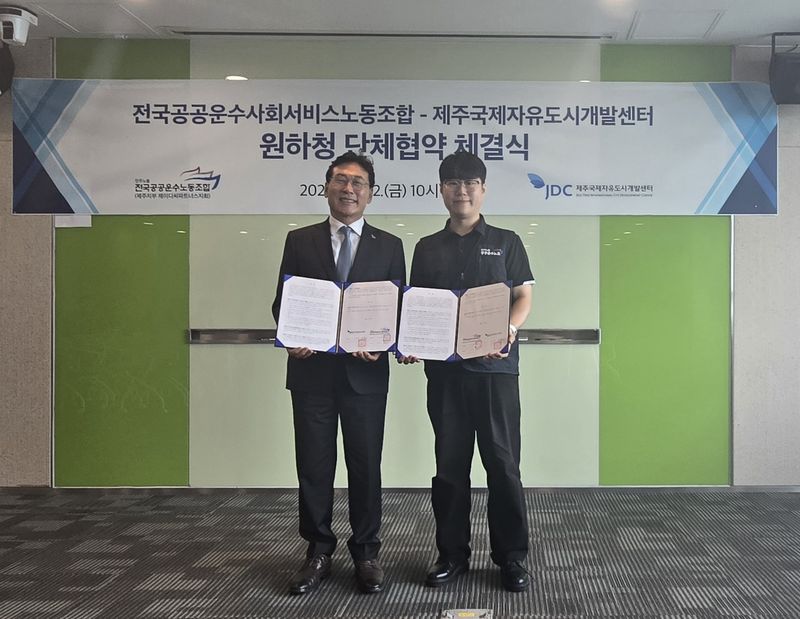
[Financial News Jeju Province = Reporter Jeong Yong-bok] The Jeju Free International City Development Center (JDC) has signed a collective bargaining agreement with its subsidiary's labor union. This is the first case in the public sector since the enforcement of the revised Labor Union Act in which a prime contractor and a subsidiary's labor union directly negotiated to combine employment stability, safety and health, and labor-management communication measures into an agreement.
According to JDC on the 4th, JDC Chairman Song Seok-eon and Kim Dong-gu, Chairman of the JDC Partners Branch of the Jeju Province Chapter of the Korean Public Service and Social Service Workers' Union, signed a collective agreement between prime contractors and subcontractors at the JDC headquarters on the morning of the 2nd.
Officials from relevant agencies, including Kim Sang-yong, Chairman of the Jeju Special Self-Governing Province Regional Labor Relations Commission, and Na Sang-myeong, Director of the Jeju Labor Improvement Guidance Center of the Gwangju Regional Employment and Labor Office, also attended the signing ceremony.
The key point of this agreement is that JDC, the prime contractor, negotiated directly with the union to reach an agreement on working conditions, safety, and communication systems, separate from the direct employers of the subsidiary workers. Previously, it was common practice for workers in public institutions’ subsidiaries or outsourced workers to conduct direct collective bargaining with their affiliated companies, even though the prime contractor's decisions influenced wages and workforce management.
Labor and management regard this agreement as the first instance of a shift in labor-management relations between prime contractors and subcontractors in the public sector. The agreement includes provisions for the proactive implementation of the guidelines for protecting contract workers in the public sector, which were announced by the government last September.
It also includes provisions to strengthen the functions of the Labor Safety and Health Council and to establish a labor-management relations body that expands communication between workers of the prime contractor and its subsidiary in accordance with the revised Trade Union and Labor Relations Adjustment Act.
The union cited the abolition of the bid success rate and the guarantee of employment size as concrete achievements of direct negotiations. The bid success rate refers to the ratio between the estimated price and the actual contract amount when a public institution enters into a service or subcontracting agreement. Since a reduction in costs during the subcontracting process can affect on-site labor costs and workforce management, this has been cited as one of the major issues for indirectly employed workers in the public sector.
Branch Chairman Kim Dong-gu stated, "Through direct negotiations with the prime contractor, we secured the abolition of the winning bid rate and a guarantee of employment scale, laying the foundation for job security and improved treatment for subsidiary workers." He added, "We will protect the rights and interests of subsidiary workers and continue mutually beneficial cooperation through rational labor-management communication," and expressed his hope that "this agreement will spread as a model case in the public sector."

This agreement is also significant in that it shows how labor-management relations between prime contractors and subcontractors will change in actual workplaces following the implementation of the revised Trade Union Act.
Since the revised law came into effect, there have been a continuing number of instances in industrial sites where subcontracting labor unions demand negotiations with prime contractors. There are also quite a few workplaces where labor and management stand at odds over the extent to which the prime contractor constitutes a bargaining partner.
The JDC case differs in that, in this situation, the public institution found common ground through direct negotiations with the subsidiary's labor union rather than waiting for legal judgments and conflicts. In particular, given that the agreement covered not only wages and welfare benefits but also employment scale, safety and health, and labor-management communication systems, it is likely to influence future negotiations between prime contractors and subcontractors at other public institutions.
However, given that the operational structures of subcontracting and subsidiaries, the roles of prime contractors, and the methods of determining labor conditions differ among institutions, the scope of negotiation and employer liability for each individual workplace must be determined separately.
How JDC incorporates the government's guidelines for protecting contract workers into actual contracts and workforce management in the future will also determine the effectiveness of the agreement. Labor and management also agreed to share the negotiation process leading up to this agreement and the details of the agreement with other public sector workplaces.
JDC Chairman Song Seok-eon said, "JDC has initiated the first collective bargaining agreement between prime contractors and subcontractors in the public sector since the revised Trade Union Act," adding, "We will proactively implement the guidelines for protecting contract workers and ensure that exemplary labor-management relations between prime contractors and subcontractors spread throughout the public sector."
[email protected] Jeong Yong-bok Reporter