Passenger Demand Slows in the Second Half, but Cargo Continues to Surge... Korean Air's Earnings Outlook Bright
- Input
- 2026-10-06 05:59:00
- Updated
- 2026-10-06 05:59:00
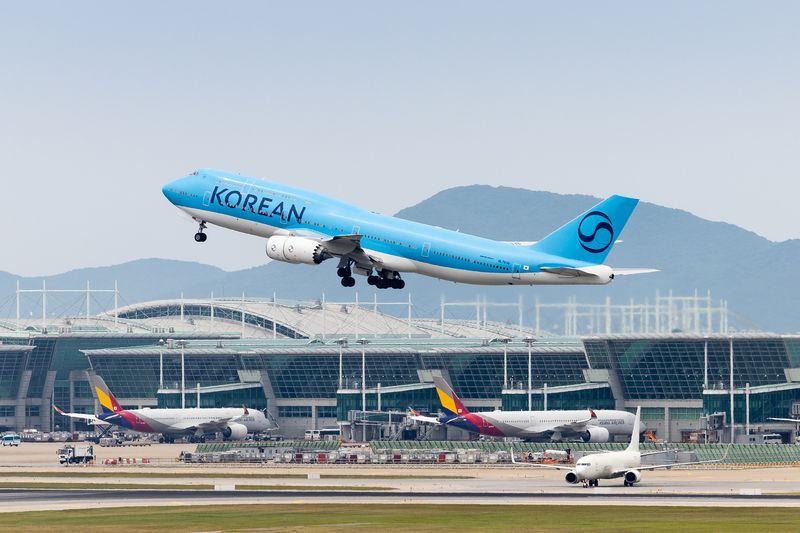
According to the International Air Transport Association (IATA) on the 6th, global passenger demand in August fell 0.8% from the same month a year earlier, as measured by revenue passenger kilometers (RPK). The cumulative growth rate for January through August was just 0.4%. Air cargo, by contrast, has continued to trend upward. Measured in cargo tonne-kilometers (CTK), global cargo demand rose 4.4% in August and 4.6% cumulatively from January through August. This means air cargo growth has significantly outpaced passenger demand this year.
Cargo demand between Asia and North America rose 13.2% in August, marking its seventh consecutive month of growth. The route's double-digit growth rate has also continued for four straight months. This is considered favorable for Korean Air, which depends heavily on revenue from routes to the Americas. Routes to the Americas accounted for the largest share of Korean Air's cargo revenue in the second quarter, at 53%. Europe followed with 23%, while Southeast Asia accounted for 12%. If the increase in cargo volumes between Asia and North America continues, Korean Air is positioned to secure additional cargo and expand its cargo revenue.
The growth of the cargo business is already reflected in the company's results. Korean Air's standalone cargo revenue in the second quarter was 1.5419 trillion won, up 486.5 billion won from the same period a year earlier.
Market forecasts indicate that Korean Air's cargo business will continue to grow for the time being. The company's consolidated cargo revenue in the third quarter is estimated to increase by approximately 34.0% from the same period a year earlier.
Korean Air's investment in next-generation freighters is also viewed as a move to respond to this demand. The aircraft purchase agreement with Boeing that Korean Air finalized last month includes eight 777-8F freighters. Including the seven existing A350-1000 passenger aircraft orders that were converted to Airbus A350F freighters in October last year, the total comes to 15 aircraft. Other airlines are also expanding and modernizing their fleets in anticipation of growth in the cargo business. Ethiopian Airlines, for example, ordered 10 aircraft last month on the 30th, including eight 777-8F freighters and two 777 Freighters.
An industry official said, "While the recovery in global passenger demand has been uneven due to the fallout from the conflict in the Middle East, cargo demand, particularly to the Americas, continues to rise steadily. However, with fuel costs also climbing sharply, airlines' profitability will depend on how much they can improve fuel efficiency while expanding their cargo capacity."
[email protected] Jung Won-il Reporter