Copper prices boost sales as AI piles up orders ... Cable makers poised for a strong Q3
- Input
- 2026-10-14 07:29:00
- Updated
- 2026-10-14 07:29:00
[Financial News] Expectations are growing that South Korea’s cable industry will post earnings growth in the third and fourth quarters as rising copper prices coincide with expanding demand for power infrastructure driven by artificial intelligence (AI). While higher copper prices are being reflected in product selling prices and boosting revenue, demand to expand power grids for data centers and replace aging facilities is driving an increase in orders.
According to the Korea Resource Information Service (KOMIS) on the 14th, spot copper traded on the London Metal Exchange (LME) averaged $14,483 per metric ton last month, the highest monthly price since the relevant statistics were first compiled. That was up 22.7% from $11,803 in December last year. Copper prices have surged this year amid a combination of factors, including increased demand from AI data centers and power grid investment, as well as production delays at major mines.
Rising copper prices generally boost revenue for the cable industry, which uses copper as a key raw material. When bidding on new projects, companies set selling prices to reflect higher copper prices. They also use “escalation” clauses in existing long-term contracts to reflect changes in raw material prices in their selling prices. This means that even when the same volume is supplied, the sales amount rises as copper prices go up.
The increase in power infrastructure orders is also positive for the cable industry’s performance. According to companies’ half-year reports, LS Cable & System’s order backlog stood at 7.8336 trillion won at the end of June this year, up 38% from 5.6463 trillion won at the end of June last year. Taihan Cable & Solution’s order backlog also grew from 2.8907 trillion won at the end of June last year to 4.0629 trillion won at the end of June this year.
Analysts say the sharp increase in power consumption by AI data centers, combined with demand to replace aging power grids, has led to more orders. An industry official said, “Demand for cables arises not only inside data centers but also during the construction of transmission and distribution networks to supply large amounts of power.”
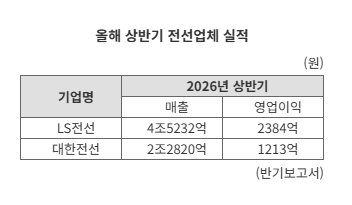
Expectations for second-half results are also rising, fueled by a sharp increase in raw material prices and expanding orders. According to FnGuide, Taihan Cable & Solution is forecast to post consolidated revenue of 4.3974 trillion won and operating profit of 229.3 billion won this year, up 21% and 78%, respectively, from the same period last year. LS, which owns a 92.6% stake in LS Cable & System, is forecast to record revenue of 41.5639 trillion won this year, up 30% from last year, and operating profit of 2.0509 trillion won, up 95%.
Market forecasts point to copper prices remaining strong for some time. However, some say the cost burden could be substantial if prices rise excessively, since the cost of purchasing raw materials also increases along with selling prices. If copper prices rise too much, customers may also delay their projects.
An industry official explained, “Even if the increase in copper prices is reflected in selling prices, funds to purchase raw materials have to be put up first,” adding, “The working capital needed until payment for deliveries is received increases, which could put pressure on cash flow.”
Cable makers are responding to fluctuations in raw material prices by using copper futures contracts and other measures, while also expanding production capacity to meet medium- and long-term demand for power infrastructure. LS Cable & System is building a subsea cable production facility in Virginia, United States, with operations targeted to begin in the first quarter of 2028. Taihan Cable & Solution is also building a 400-kV-class extra-high-voltage cable plant in Vietnam, aiming to begin operations next year.
An industry official said, “As investment in power infrastructure continues in response to the expansion of AI data centers, we expect further opportunities to win orders to increase.”
[email protected] Park Ji-yeon Reporter