"Afraid of Red-Letter Days"... Dual-Income Couples Filling Calendar Blanks with Money Face "Childcare Bankruptcy" [How Much Is Enough?]
- Input
- 2026-10-04 10:01:30
- Updated
- 2026-10-04 10:01:30
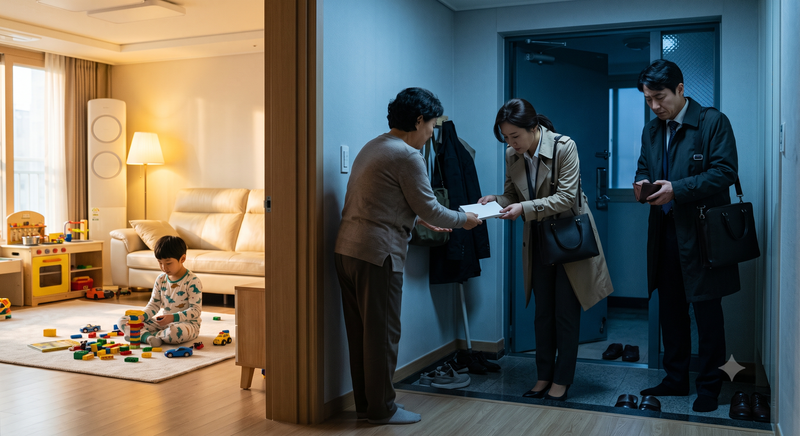
[Financial News] On Sunday morning, October 4, before the fatigue of the Chuseok holiday had fully faded, a deep sigh echoed through the living room of K and his wife's home. The first week of October on the calendar atop the dining table was grotesquely filled with a mix of red and black markings.
It was the so-called golden bridge holiday stretch, running from National Foundation Day on October 3, Saturday, through the substitute holiday system day on October 5 and Hangul Day on October 9, Friday.
The problem was that the elementary school and kindergarten attended by their seven- and nine-year-old children had designated October 6 through 8 as three full days of discretionary school closures. Including the weekend, the schools would be closed for nine consecutive days, but K and his wife, who work for small and midsize companies, had to report to work as usual starting Tuesday, October 6.
With their checking account already overdrawn because of holiday expenses, they were left staring into the abyss, wondering where they could leave their children starting the day after tomorrow.
◇ Emergency Childcare at 150,000 Won a Day... A Bridge Holiday More Frightening Than School Vacation
For dual-income couples, discretionary school closures that suddenly appear during a bridge holiday stretch are less a blessing than a disaster.
Unless they work for a large corporation or public institution where they can freely take annual leave, parents must once again resort to a capitalist patch job to cover the three weekdays without childcare.
Asking both sets of parents, who had already worked hard during the holiday, to look after the children again would be more than unfilial—it would be shameless. In the end, the couple opened a private childcare-matching platform, only to find emergency-care hourly rates during the holiday rising from 13,000 won to well over 15,000 won. Hiring a sitter for nine hours a day over three days would cost about 400,000 won in sitter fees alone. Add the children's meals and snacks, and 500,000 won would disappear in an instant.
Because the cost was too burdensome, they searched local parents' online communities, but the only solution was academy hopping—sending the children to short-term vacation programs temporarily run by English academies or taekwondo schools from morning until afternoon. The children's rest vanished, while their parents' bank balance was drained, creating the worst possible value for money in the first week of October.
◇ 190 Elementary School Instructional Days vs. 250 Working Days... Statistics Reveal a 60-Day Gap
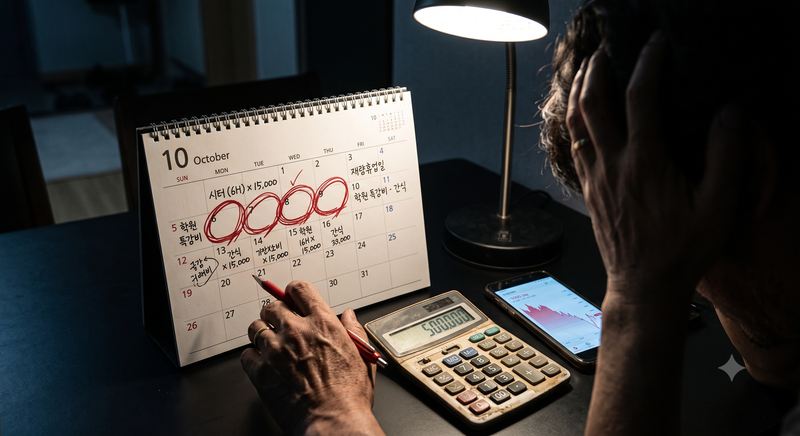
This strange form of "childcare bankruptcy" is not an individual misfortune suffered simply because K and his wife chose the wrong jobs or happened to be unlucky. It is a thoroughly structural blind spot created by the Republic of Korea's education and labor systems.
Under Ministry of Education regulations, elementary schools in the Republic of Korea are required to provide at least 190 instructional days a year. By contrast, the average annual number of working days for employees on a five-day workweek is around 250, excluding public holidays. This means there is a massive structural time lag of 60 days between the days parents must go to work and the days their children attend school.
Summer and winter vacations account for most of this gap, but unexpected breaks such as spring vacation or October discretionary school closures create fatal blind spots that dual-income couples cannot possibly cover with annual leave alone. Parents in their 30s and 40s in the Republic of Korea are effectively filling the 60-day gap created by the national system by grinding down their own savings and their mothers' knee cartilage.
◇ "If This Is How It Is, Single-Income Families Would Be Better Off"... "Fake Income" Created by Systemic Mismatch
Academics and experts diagnose the fundamental cause of childcare gaps as a mismatch between the labor market and the education market.
Women's studies and child welfare experts have consistently pointed out at various policy forums, "The biggest problem is that school-centered and company-centered calendars do not align at all, while primary responsibility for childcare continues to be shifted onto individual families."
Although Neulbom School and public childcare services, for which the state claims responsibility, are expanding, dual-income parents still have nowhere to turn when schools firmly close their doors during bridge holidays except to the "power of capital"—in the form of 500,000 won.
"We spent 1.5 million won giving holiday allowances to both sets of parents during Chuseok, and now another 500,000 won is going out in just a few days because the kids are off. Honey, should I really quit my job? It feels like every won I earn just passes through to the sitter and the academy owner."
This was K's wife's self-deprecating lament as she sat on the living-room sofa and reviewed résumés from emergency childcare sitters. There was a time when they felt reassured by their combined monthly income of 8 million won. But whenever an unexpected school holiday arrived, their combined income once again turned into "fake income," leaving them with nothing.
Dual-income parents in their 30s and 40s feel guilty that they cannot rest with their children and resentful that they must spend money simply to go to work. For them, the bridge holiday stretch in October 2026 is approaching as a season of brutal "childcare bankruptcy," more painful than any red lettering on the calendar.
[email protected] Jeon Sang-il Reporter