Jeju-Style Immigration Policy to Integrate Visa and Social Integration Planning; Regular Talks Planned
- Input
- 2026-10-04 09:12:39
- Updated
- 2026-10-04 09:12:39
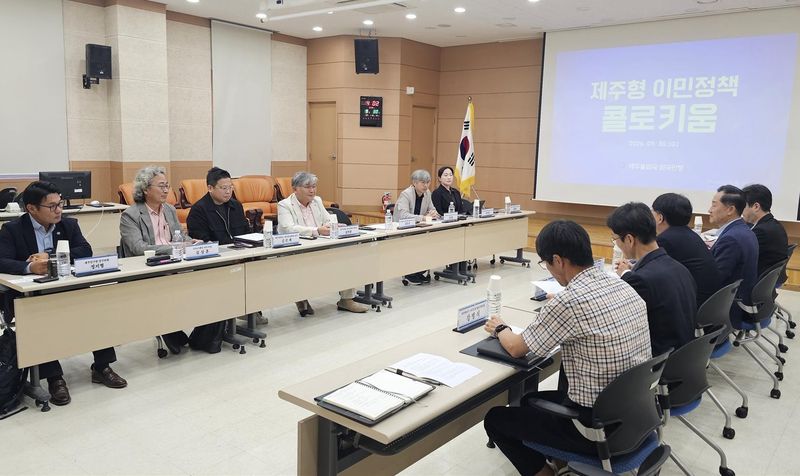
[Financial News, Jeju — Reporter Jung Yong-bok] Discussions are gaining momentum on designing an immigration policy that reflects the characteristics of Jeju Province, covering visa systems, social integration education, and immigration administration. JNU researchers and the Jeju Immigration and Foreigners Office have agreed to establish a cooperation framework for regularly discussing policy issues and on-the-ground challenges in order to develop an immigration policy suited to Jeju.
The Tamna Culture Research Institute at JNU said on the 4th that it had jointly hosted the Jeju-Style Immigration Policy Colloquium with the Jeju Immigration and Foreigners Office on September 30. A colloquium is a small-scale academic and policy forum in which researchers and field experts give presentations and hold discussions on a specific topic.
The meeting examined immigration policy not only in terms of which statuses of stay should be granted to foreign nationals, but also the role of social integration education and local administration after settlement.
The discussions were held in two sessions. Kim Chi-wan, director of JNU's Tamna Culture Research Institute, chaired the first session.
HK research professors Kim Jin-seon, Kim Jin-cheol, Kim Mi-jeong and Kim Tae-yeon examined the current status and challenges of immigration policy in Jeju Province and proposed policy measures under the theme of "Jeju-Style Foreign Visa Policy and Social Integration Education."
The approach is to design visa policy for attracting foreign nationals and social integration policy supporting settlement in local communities as one connected process rather than treating them separately. Even if needed workers are brought in through visa programs, policy effectiveness may decline if language, culture and adaptation to the local community are not properly addressed during the settlement process.
Conversely, social integration policies can also become disconnected from actual immigration policy if they are not linked to what kinds of foreign workers are needed locally and what pathways to stay will be provided.
Ha Yong-guk, head of the Jeju Immigration and Foreigners Office, chaired the second session. Kang Moon-Young, head of the office's Planning, Integration and Nationality Team, presented plans for immigration-related work and projects reflecting Jeju Province's distinct characteristics under the theme of "Identifying Specialized Functions for the Jeju Office."
The discussion focused on identifying which functions could be strengthened by considering Jeju Province's industries, population and conditions for foreign nationals to settle, even within an immigration administration system operated by the central government under uniform standards.
The event was not limited to researchers and government officials. Sun Jae Kim, a professor in JNU's Department of Political Science and Diplomacy; Kim Sang-hoon, secretary-general of NAOMI Center; and Dr. Jung Ji-hyeong of the Jeju Research Institute offered discussion and review comments on each presentation. In effect, the event brought together perspectives from academic research, immigration administration, organizations supporting foreign nationals in local communities, and policy research institutions.
The core of discussions on a Jeju-style immigration policy lies not in the scale of foreign inflows itself, but in how to accept the workers the region needs and what systems should be established to help them live as members of the local community after settling there. That is why interconnected policies covering visa issuance, status management, employment, education, daily-life adaptation and social integration must be reviewed together.
The colloquium now appears increasingly unlikely to remain a one-off event. Ha Yong-guk said, "A variety of topics requiring discussion for establishing a Jeju-style immigration policy were addressed," and proposed holding regular monthly sessions.
Kim Chi-wan also expressed his commitment, saying, "We will continue research on an immigration policy suited to Jeju together with relevant agencies and experts through regular colloquiums."
[email protected] Jung Yong-bok Reporter