[Exclusive] Kia Tasman, Kia's first pickup truck, sees sales plunge at home and abroad; production cuts underway
- Input
- 2026-10-05 14:31:39
- Updated
- 2026-10-05 14:31:39
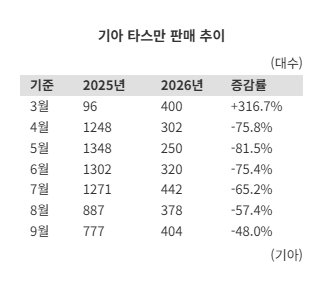
Tasman domestic sales totaled 378 units last August, down 57.4% from 887 units in the same month a year earlier. Overseas sales totaled 704 units that month, plunging 73.2% from 2,628 units a year earlier. Domestic sales in September also fell 48.0% year on year to 404 units, compared with 777 units a year earlier.
Tasman domestic sales began in March last year, reaching 1,200 to 1,300 units per month from April through July. However, monthly sales fell to around 300 to 400 units this year, dropping as low as 250 units in May.
Overseas sales also peaked at 3,412 units in July last year before remaining at around 400 to 900 units per month this year. Cumulative sales since launch totaled 12,157 units domestically as of September and 21,158 units overseas as of August.
The model has underperformed even in Australia, a key market. Kia set an annual sales target of 20,000 units in Australia, but cumulative sales in Australia and New Zealand have reached only about 8,500 units. Incumbent brands are already firmly established in the local fleet market, meaning corporate vehicles, making it difficult for the Tasman to overcome the entry barrier.
Damien Meredith, CEO of Kia Australia, told local automotive outlet Drive in an interview last April, "We have performed in the leisure market, but have struggled in the fleet and rural markets," adding, "To bring Tasman sales up to a satisfactory level, we need to grow these markets."
The Tasman has also lost ground in South Korea's pickup market. According to KGM and Kia, the Tasman's share of domestic sales of Korean-made pickups fell from 37.0% last year to 17.6% in the first nine months of this year. During the same period, KGM Musso and KGM Musso EV models accounted for 82.4%.
Industry observers cite Kia's failure to win over work-use customers, the core buyers of pickup trucks, as a major reason for the weak performance.
"Pickup demand comes more from customers whose livelihoods are tied to self-employment, farming and fishing than from ordinary customers seeking leisure vehicles, and they prioritize fuel economy and utility," an industry source said. "That's why the Musso diesel sells well." The Tasman is sold in South Korea only as a single model with a 2.5-liter gasoline turbo engine.
Lee Ho-geun, a professor in Daeduk College's Department of Future Automotive Engineering, said, "The Tasman has targeted the leisure pickup market to some extent, but it failed to give customers sufficient reasons to choose it in the work-use and fleet markets, which are the pickup's core customer base." He added, "Because pickups are vehicles that many customers buy for work, rather than simply SUVs with a cargo bed attached, the key to a rebound will be how well the Tasman can win these customers back."
[email protected] Kim Dong-chan Reporter