They Repair and Keep Driving... Domestic-Market Chill Hits Korean Pickups After the New-Car Boost Fades
- Input
- 2026-10-05 14:32:39
- Updated
- 2026-10-05 14:32:39
■ Individual Purchases Halve; Share of Corporate and Business Buyers Expands
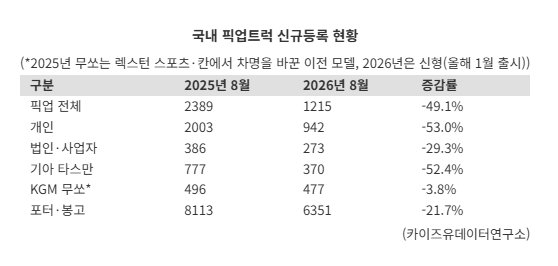
The decline was particularly pronounced among individual buyers. Registrations under the names of individuals without business registrations totaled 942 in August, down 53.0% from the same month last year. Corporate and business registrations fell 29.3% to 273 during the same period. As a result, the share of corporate and business buyers rose from 13.3% of total registrations in March to 22.5% in August. People in their 50s and 60s accounted for 65.3% of individual buyers in August.
Industry officials attribute the decline to the end of the new-car boost driven largely by leisure demand, including camping. The market, which once surpassed 40,000 units on the strength of demand for camping and other outdoor activities, has gradually contracted since the COVID-19 pandemic and fell to roughly 23,000 units last year, excluding imported brands.
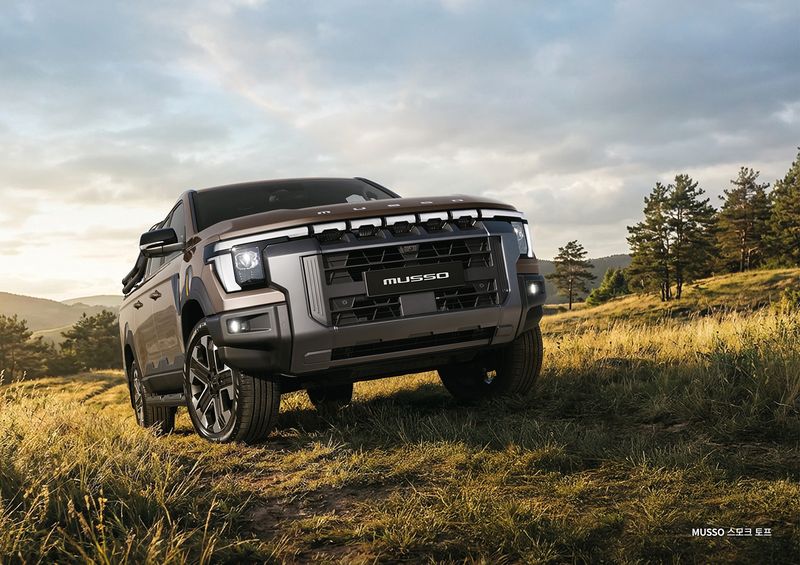
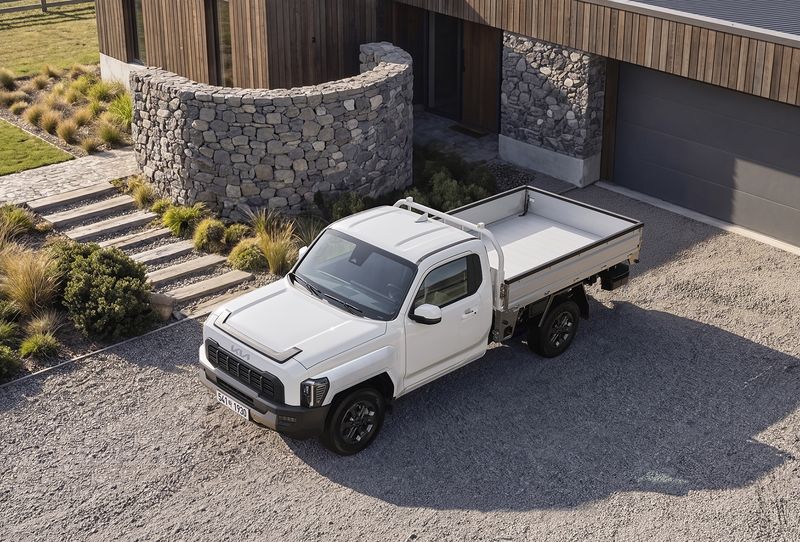
By model, Kia Tasman registrations fell 52.4% year on year to 370 units in August. KGM Musso registrations totaled 477 units, down 3.8% from the 496 units registered in August last year for its predecessor model. The sluggish performance of the electric pickup KGM Musso EV is particularly notable. According to KGM, domestic sales of the KGM Musso EV had been running at 500 to 800 units per month from January through July this year, but plunged to 130 units in August and 107 in September as regional EV subsidies were exhausted.
■ High Maintenance Costs and Economic Chill: Cold Winds Hit Both New and Used Vehicles
Running costs, including fuel economy, are also considered a factor in purchase decisions. The Kia Tasman, which is available only with a gasoline engine, has combined fuel economy of 8.6 kilometers per liter in its two-wheel-drive version, lower than the 10.1 kilometers per liter of the Musso diesel model.Lee Ho-geun, a professor in the Department of Future Automotive Studies at Daeduk University, said, "The domestic pickup market is quite divided between vehicles people buy because they look cool and vehicles they buy to make money. Performance is an advantage for leisure customers, but for business operators who drive long distances every day, fuel costs are directly part of their operating costs."
Pickup trucks are particularly sensitive to economic conditions because many are purchased by self-employed people and others for their livelihoods. According to the Bank of Korea's Financial Stability Situation report released on the 22nd of last month, loans to self-employed borrowers stood at 1,098.5 trillion won at the end of the second quarter, nearing 1,100 trillion won. The delinquency rate rose to 1.99%, up from 1.86% at the end of last year and above the long-term average of 1.60% since 2012.
The market for livelihood-oriented commercial trucks is also actually collapsing. According to the Kaizyu Data Research Institute, new registrations of one-ton trucks, including the Hyundai Porter and Kia Bongo, totaled 6,351 in August, down 21.7% from the same month last year. Registrations also fell 9.8% cumulatively from January through August.
Demand for pickups is also cooling in the used-car market. According to K Car, average used-car prices for the Rexton Sports lineup fell 9.0% to 12.7% this year from last year, based on data from January through September. The decline was greater than the 4.3% to 8.2% drop in prices for internal-combustion-engine one-ton trucks such as the Hyundai Porter and Kia Bongo over the same period. The average time required for listings to sell also increased. The New Rexton Sports Khan took 57 days to sell, up from 39 days, while The New Rexton Sports took 43 days, up from 34.
Sales rose slightly last month, but it is too early to view this as a recovery. Domestic sales of the three Korean-made pickup models totaled 1,228 units last month, up from 1,074 in August, but remained nearly 60% below the 3,038 units sold in March, six months earlier.
Kim Pil-su, a professor in the Department of Future Automotive Studies at Daelim University College, explained, "When the economy is difficult, people delay buying a new car first. Because a car is the second-largest expense after real estate and most people buy one on installment plans, they end up postponing their purchase plans." An industry official added, "When people face financial difficulties, many postpone buying a new car rather than replacing their vehicle immediately, repairing it when it breaks down and continuing to drive it."
[email protected] Kim Dong-chan Reporter