[Exclusive] Red flags emerge over Korea Local Finance Association's alternative investments: 32.8 billion won lost on a 53.9 billion won investment
- Input
- 2026-10-05 13:24:59
- Updated
- 2026-10-05 13:24:59

[Financial News] The Korea Local Finance Association, whose members include local governments and affiliated public institutions, recorded losses of more than 30 billion won over five years on some alternative investments, a review found. Although it posted high returns on stock investments, returns on domestic and overseas real estate investments both remained negative. As risk-rated assets have increased again this year, calls are growing for stronger investment risk management systems at institutions that manage public funds.
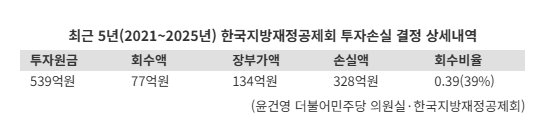
On the 5th, according to the "Detailed Breakdown of Investment Losses Determined over the Past Five Years" submitted by the Korea Local Finance Association to the office of Yoon Kun-young, a Democratic Party of Korea lawmaker on the National Assembly's Public Administration and Security Committee, the association determined losses on three alternative investments from 2021 through last year: two domestic and overseas real estate funds and a Singapore aircraft special-assets fund. The principal invested totaled 53.9 billion won. However, the recovered amount was 7.7 billion won, while the remaining book value stood at 13.4 billion won. Combined, the two amounted to just 21.1 billion won, 32.8 billion won less than the principal invested. The recovery ratio was 0.39, or just 39% of the principal.
There was also a clear difference in performance by asset class. Last year, the association's return on equity investments was 36.95%, the highest since 2017. The return stood at 29.55% through August, while its outstanding equity investment balance exceeded 300 billion won for the first time in the past 10 years, reaching 311.9 billion won.
By contrast, the return on domestic real estate investments was -3.22% last year, while that on overseas real estate was -3.88%; both fell below 0%. In particular, the return on overseas real estate remained negative last year after reaching -6.98% in 2024. The overall return on alternative investments was also just 0.28% last year. As of September 21, the outstanding overseas real estate investment balance was 228 billion won, with an investment return of -1.19%.
Despite their poor performance, real estate alternative investments generated higher outsourced management fees than stock investments. Last year, outsourced management fees totaled 110 million won for domestic real estate and 550 million won for overseas real estate, or 660 million won combined. That was approximately 2.7 times the 246 million won in outsourced management fees for stock investments during the same year.
The risk level of alternative investment assets also increased. Since 2023, the association has managed alternative investment assets under the categories of normal, ordinary, caution, special caution, and estimated loss.
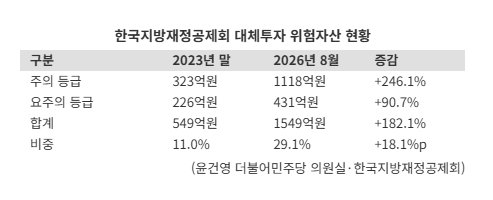
Assets rated "caution" increased from 32.3 billion won at the end of 2023 to 111.8 billion won in August. Over the same period, assets rated "special caution" rose from 22.6 billion won to 43.1 billion won. The combined value of assets in the two categories expanded 182.1%, from 54.9 billion won to 154.9 billion won. By contrast, total alternative investment assets grew just 7.1%, from 497.3 billion won to 532.8 billion won. As a result, the share of assets rated caution or special caution rose by 18.1 percentage points, from 11.0% to 29.1% of the total.
Experts emphasized the need to analyze the causes of the losses and establish a management system capable of detecting warning signs at an early stage. They said a monitoring system was needed to identify abnormal signs in advance, rather than responding only after investment risks had materialized.
Kim Tae-yun, a professor of public administration at Hanyang University, emphasized, "The association should introduce an early-warning monitoring system comparable to those used by private companies and in the market and conduct continuous monitoring."
Some also called for a comprehensive review of the selection of outsourced asset managers and the overall investment process. As of August, 91.6% of the association's alternative investments were outsourced. Local governments receive approximately 1 trillion won annually from the government through the Local Extinction Response Fund, entrust the money to the Korea Local Finance Association, and the association then subcontracts its management to private asset managers. Given that much of the process is ultimately delegated to external managers, it is necessary to examine not only the causes of investment failures but also whether the managers were selected through an appropriate process.
Byoung Hoon Seok, a professor of economics at Ewha Womans University, advised, "If management was outsourced to an external company, it is necessary to verify whether the company was selected according to appropriate criteria and whether investment decisions were made rationally."
Yoon Kun-young said, "For an institution managing public funds, identifying investment risks in advance and minimizing losses are just as important as boosting returns," adding, "Given that some alternative investments have suffered substantial principal losses and that risk-rated assets have also increased, the overall risk management system must be reviewed."
[email protected] Kim Ye-ji Reporter