108 Years Since Jeju's Largest Anti-Japanese Struggle Before the March First Movement... Students Carry Forward "The Courage of That Day"
- Input
- 2026-10-04 08:57:05
- Updated
- 2026-10-04 08:57:05
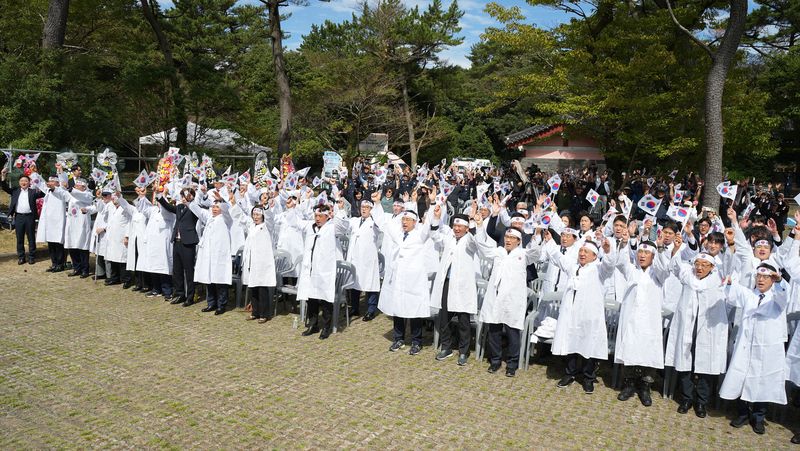
【Financial News, Jeju = Jeong Yong-bok, reporter】 The Muo Beopjeongsa Anti-Japanese Struggle, which took place in Jeju against Japanese colonial rule in 1918 before the March First Movement, has reached its 108th anniversary. Some 500 members of the Korean Liberation Association, bereaved family members, students and residents gathered at the site where the anti-Japanese movement began to honor the sacrifices of their forebears and pledge to carry their spirit into the next generation.
Jeju Special Self-Governing Province said on the 4th that the 32nd commemorative ceremony marking the 108th anniversary of the Muo Beopjeongsa Anti-Japanese Struggle was held the previous morning at the movement's birthplace in Seogwipo City.
The event, jointly hosted and organized by Jeju Special Self-Governing Province and the Jungmun Junior Chamber, was attended by some 500 people, including members of the Korean Liberation Association, bereaved family members, representatives of institutions and organizations, students and residents.
The Muo Beopjeongsa Anti-Japanese Struggle was Jeju's largest anti-Japanese independence movement, launched by Jeju's forebears in October 1918 against Japanese aggression and oppression. It also holds important significance in the region's history of the independence movement because it took place in Jeju before the March First Movement of 1919.
This year's commemorative ceremony was held under the theme, "The Courage to Rise First That Day, Jeju's Spirit to Carry Forward with Residents."
Before the ceremony, Jeju Governor Wi Seong-gon visited Uiyeolsa Shrine, where he laid flowers and offered incense. He then carried Korean national flags and reenacted an anti-Japanese movement street march with members of the Jungmun Junior Chamber before proceeding to the ceremony venue.
The main event proceeded with a national ceremony, a report on the movement's history, the reading of a resolution, a commemorative video, commemorative and congratulatory remarks, a memorial address, a commemorative performance and three cheers of "Long live!" This year's ceremony focused on how to pass the memory of the anti-Japanese movement on to future generations.
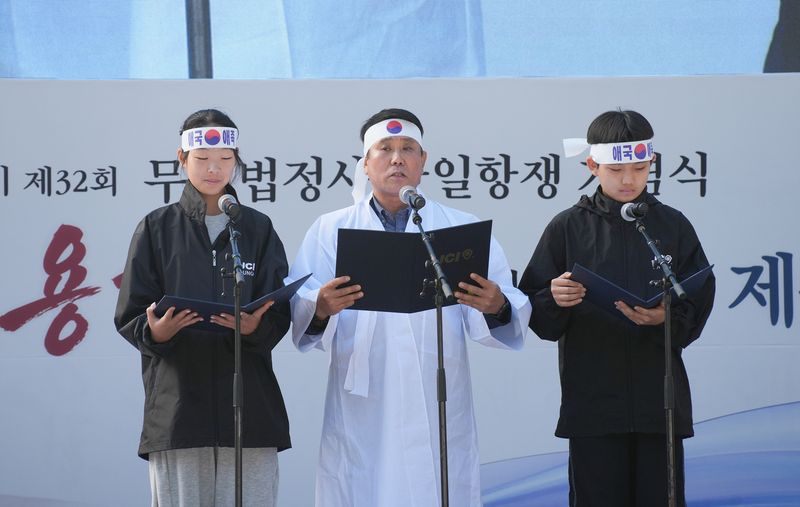
Lim Su-jin, president of the Jungmun Junior Chamber's special members' association, and two student representatives jointly read the resolution. Rather than limiting the adult generation's role to explaining the anti-Japanese spirit, the organizers had students directly participate in the ceremony's key proceedings.
At the final three cheers, attendees waved Korean national flags and recalled the determination of their forebears to achieve independence 108 years ago. The commemorative video, "Until Their Names Were Reclaimed," covered the history of the Muo Beopjeongsa Anti-Japanese Struggle and the efforts of descendants to correct historical accounts that had been distorted or insufficiently brought to light.
The event also conveyed the message that the Muo Beopjeongsa Anti-Japanese Struggle should be remembered in connection with other anti-Japanese movements in Jeju. In a video congratulatory address, Minister of Patriots and Veterans Affairs Kwon Oh-eul said, "The Muo Beopjeongsa Anti-Japanese Struggle led to the Jocheon Manse Movement and the Jeju Haenyeo Anti-Japanese Movement, becoming the root of Jeju's anti-Japanese spirit." He added, "We will remember the will of our forebears together with the people and ensure that their history and spirit are passed on to future generations."
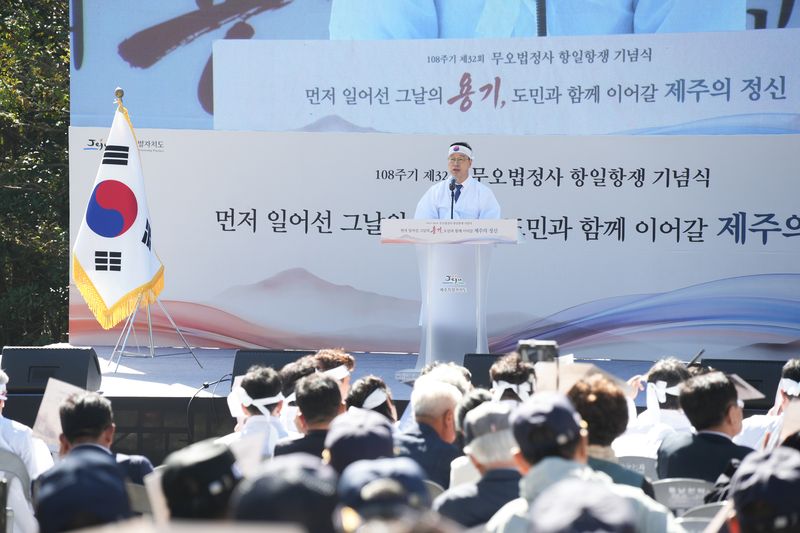
Governor Wi Seong-gon explained the significance of the Muo Beopjeongsa Anti-Japanese Struggle through the values of freedom and dignity. Wi said, "The cries of our forebears were a resolute declaration that they would protect human freedom and dignity." He added, "Because our forebears rose first, we are able to enjoy freedom today."
He continued, "We must cultivate this land, protected by our forebears, into a Jeju where freedom, justice and hope are alive and pass it on intact to future generations." He also stated, "We will strengthen efforts to promote the historical value of the Muo Beopjeongsa Anti-Japanese Struggle."
An art wall introducing the history and significance of the Muo Beopjeongsa Anti-Japanese Struggle was installed at the event venue. A viewing route was also arranged so visitors could tour both the exhibition hall and the event site. A separate memorial incense altar was operated at the venue for elderly bereaved family members and visitors who had difficulty traveling to Uiyeolsa Shrine.
On the 108th anniversary, the ceremony focused on ensuring that the anti-Japanese struggle would not remain merely a commemorative date from the past. Students read the resolution and residents shouted together, carrying the anti-Japanese spirit of Muo Beopjeongsa forward as a living memory in the present.
[email protected] Jeong Yong-bok Reporter