Use of the Northern Sea Route Hits Record High: "Could Accelerate Global Warming"
- Input
- 2026-10-04 03:46:02
- Updated
- 2026-10-04 03:46:02
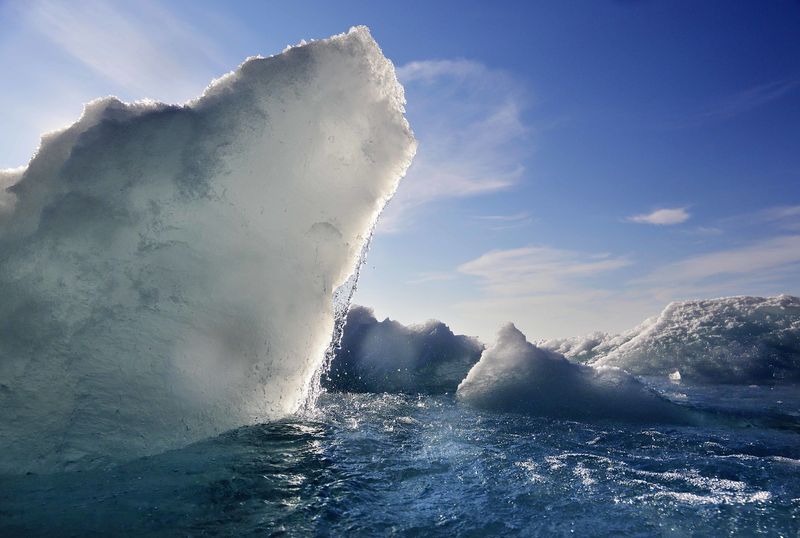
Voyages along the Northern Sea Route have reached a record high amid the war involving Iran and global warming. However, there are growing warnings that using the high-latitude waterway could lead to a major environmental disaster and pose serious risks to seafarers' safety.
Arctic Ocean Use Hits Record High
The Financial Times (FT) reported on the 3rd (local time), citing Lloyd's List Intelligence (LLI), that the number of voyages along the Northern Sea Route reached a record high of 133 last month. That was more than four times the number recorded in 2022 and represented a 46% increase from the previous month. LLI is a London-based global shipping and maritime data and analytics company.
According to LLI, nearly half of the vessels using the route last month were Russian-flagged. Many Chinese vessels were also searching for alternative routes as shipping through the Red Sea was disrupted.
Last month, the Chinese container ship 'Dubai Tower' arrived at the port of Felixstowe in the United Kingdom after traveling from Qingdao through the Arctic Ocean. The voyage was 24 days shorter than a route through the Suez Canal, which connects to the Red Sea, and more than 40 days shorter than sailing around the Cape of Good Hope.
A vessel operated by the same Chinese shipping company also departed Ningbo for Felixstowe on the 27th of last month. It is following the same route as the 'Dubai Tower.'
Sea Ice and Geopolitical Factors
September is the busiest month for the Northern Sea Route. Because this is when the most ice melts, even ordinary vessels without icebreaking capabilities can pass through.
As climate change melts the ice, the sea ice covering the ocean is shrinking rapidly, encouraging greater use of the route. According to the University of Southampton, analysis of satellite imagery showed that Arctic sea ice shrank by the largest amount on record last year. Sea ice has remained at its lowest level in history.
Geopolitical factors have also played a role.
As the Houthi rebels in Yemen, backed by Iran, disrupted shipping after taking control of the Bab-el-Mandeb Strait, which connects the Suez Canal with the Gulf of Aden, Northeast Asian countries began turning to the Arctic Ocean route.
Meanwhile, transit through the Panama Canal, which links the Pacific and Atlantic oceans, has been restricted as the canal suffers a severe drought caused by this year's El Niño phenomenon.
Diversification of Cargo
The Northern Sea Route has primarily been used to transport liquefied natural gas (LNG). LNG produced at gas plants on Russia's Yamal Peninsula and at Arctic LNG 2 has been transported along the route.
Recently, however, bulk carriers transporting grain and iron ore have also been using the route more frequently.
The number of bulk carriers operating along the route last month reached 29. There were 12 in September last year and 18 in August, the previous month.
According to LLI, tanker use is also at a record high.
Risk of Accelerating Global Warming
The Northern Sea Route is divided into 28 sections depending on sea-ice conditions. The Russian state-owned nuclear company Rosatom manages the route. The Northern Sea Route Administration, which operates under Rosatom and has the world's only nuclear-powered icebreakers, sets the guidelines and issues transit permits.
However, concerns about the use of the Northern Sea Route are also growing.
The main concerns are environmental pollution and the risk of accelerating global warming.
Insurers and environmental groups warn that a major accident could cause enormous damage because polar regions have almost no pollution-cleanup facilities. The 1989 Exxon Valdez oil tanker spill in Alaska took more than four years to clean up, and residue still remains on nearby beaches.
According to the Tara Ocean Foundation, even a small oil spill in the Arctic Ocean could accelerate global warming because black droplets absorb sunlight and melt the sea ice on the ocean more quickly.
There have also been warnings that the risk of ships getting into trouble is high.
Tam Meller, technical director at the UK Hydrographic Office, warned that at extremely high latitudes, the Earth curves sharply, creating a significant risk that conventional navigation equipment or electronic chart and positioning systems may not function properly. The Arctic Ocean also has very few search-and-rescue facilities, putting crew members' lives at risk if a vessel drifts or runs aground.
[email protected] Song Kyung-jae Reporter