Tentative Agreement Rejected at First Vote for 11th Straight Year... Warning Sign for HD Hyundai Heavy Industries’ Competitiveness
- Input
- 2026-10-04 01:02:45
- Updated
- 2026-10-04 01:02:45
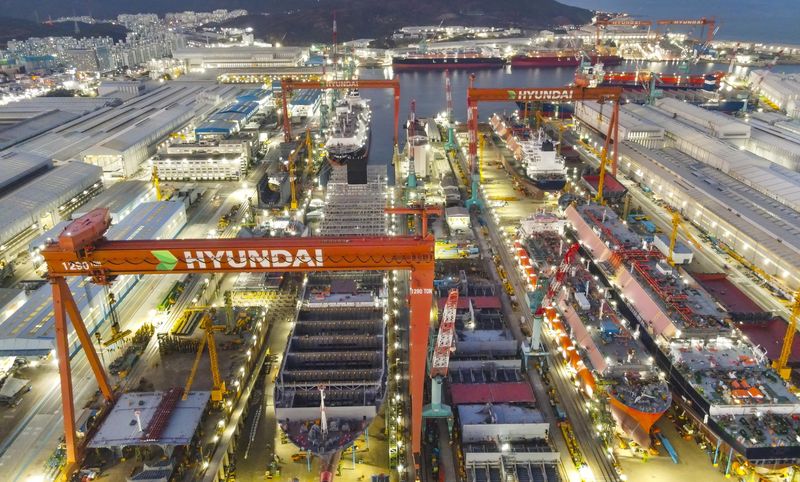
[Financial News, Ulsan—Choi Su-sang, Reporter] HD Hyundai Heavy Industries’ labor and management have set a record for the 11th consecutive year by having union members reject their jointly reached tentative wage and collective bargaining agreement at the first vote. The rejection may have resulted from members’ dissatisfaction with the union leadership’s lack of bargaining power. However, some observers warn that repeated rejections becoming an established practice could weaken HD Hyundai Heavy Industries’ competitiveness.
According to industry sources on the 4th, HD Hyundai Heavy Industries’ union held an approval vote on this year’s tentative labor-management agreement on the 2nd. The proposal was rejected. Of the 7,541 voters, 3,932, or 52.14%, voted against it. A total of 3,588 members, or 47.58%, voted in favor, leaving a gap of 344 votes.
The tentative agreement reached on September 30 after 14 hours of marathon negotiations included a 120,000-won increase in base pay, a lump-sum payment of 11 million won plus 200%, and performance bonuses. The average compensation effect per employee was 40.56 million won, the highest level ever.
Compared with Samsung Heavy Industries, which concluded its wage negotiations this year by agreeing to a 131,786-won increase in base pay, a 7 million-won encouragement payment, and performance bonuses funded by 10% of operating profit, HD Hyundai Heavy Industries’ tentative agreement offered a somewhat smaller base-pay increase. However, its total compensation package, including the lump-sum payment, was larger.
Industry observers say the rejection of the tentative agreement cannot be explained by the size of the compensation alone. Some have suggested that “rejection inertia” may have been at work.
Management also takes this view. From 2016 through this year, the first tentative agreement has been rejected in union approval votes for 11 consecutive years. The company recognizes that this pattern has been repeated every time, including cases in which negotiations extended across two calendar years: the first agreement was rejected, leading to renegotiations.
The results of approval votes over the past three years show that the first tentative agreement in 2023 was rejected, with 68.78% voting against it, while the second tentative agreement was approved with 58.52% voting in favor. In 2024, the approval rate rose sharply from 40.33% for the first proposal to 59.17% for the second. In 2025, it increased from 36.23% to 59.56%.
After renegotiations, compensation terms such as base pay and encouragement payments were raised slightly. In other words, this sent a signal that rejecting the first proposal for now could lead to a better outcome, creating a learning effect over the past 11 years. It created conditions in which the belief that “the first proposal should be rejected for now” could naturally take root among union members.
However, it would be unreasonable to blame the union members for everything. A local labor official said, "Because members could get a better deal through renegotiation, a sentiment may have formed that the first proposal should be rejected unconditionally. But some also criticize the union leadership for not doing its best from the outset, given that its bargaining power increases after the first proposal is rejected. Distrust of the leadership likely also played a role."
An even bigger problem is that the repeated rejection of the first tentative agreement increases the negotiation costs that both labor and management must bear. From the company’s perspective, there will be less reason to present an offer close to the final level from the outset. The union leadership, meanwhile, will inevitably struggle to reach a tentative agreement because of members’ heightened expectations.
Management emphasizes that this issue could burden the company’s long-term competitiveness beyond the immediate labor-management negotiations. South Korea’s shipbuilding industry is facing increasingly fierce competition over future technologies such as eco-friendly vessels and smart shipyards amid intense pressure from Chinese companies. The company believes it is important to determine how much of the profits secured during the boom should be reinvested to strengthen future competitiveness.
Management also argues that repeated prolonged negotiations and strikes, amid rising labor costs each year, could harm productivity and cost competitiveness. Because shipbuilding is highly cyclical, the company is concerned that higher fixed costs accumulated during a boom could become an even greater burden when market conditions deteriorate.
An industry official said, "Amid increasingly fierce global competition, labor-management bargaining also needs to move beyond short-term additional compensation and take both productivity and future competitiveness into account. Rather than assuming that the first tentative agreement must be rejected, the industry needs a bargaining culture that judges proposals based on their content."
[email protected] Choi Su-sang Reporter