Ulsan's Bid to Host Energy Resources Corporation Has Geopolitical Advantages... Integrating Ulsan Port Authority Poses a Dilemma
- Input
- 2026-10-04 08:00:00
- Updated
- 2026-10-04 08:00:00
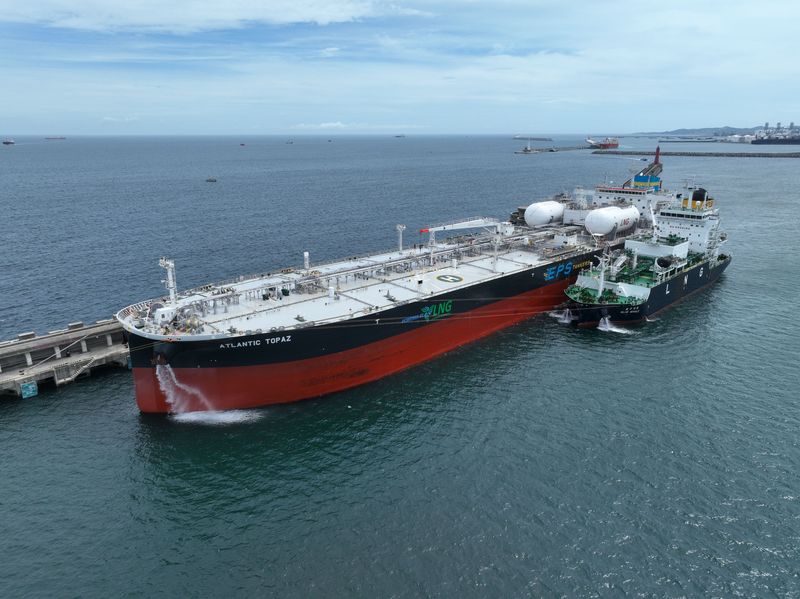
【Financial News | Ulsan—Reporter Choi Su-sang】Ulsan Metropolitan City has set its sights on becoming a global clean-energy hub beyond its status as South Korea's industrial capital, but the momentum behind that goal now stands at a critical crossroads. The city is engaged in fierce competition with Daegu to host the headquarters of a massive state-run energy company that would be created through the merger of Korea National Oil Corporation (KNOC) and Korea Gas Corporation (KOGAS), tentatively named Energy Resources Corporation. At the same time, Ulsan Port Authority, which manages and operates the Port of Ulsan—the foundation of the energy hub and the main artery of Ulsan Metropolitan City's economy—faces the threat of being forcibly absorbed into a centralized organization. Kim Sang-wook, mayor of Ulsan Metropolitan City, has made an all-or-nothing decision by supporting the government's plan to integrate the four port authorities in exchange for the practical benefit of attracting Energy Resources Corporation. However, local politicians from both parties and the port industry warn that Ulsan's ultimate goal, the energy hub, could instead be derailed. They are calling for a sophisticated political solution that could determine Ulsan's future.
■ Inland Daegu vs. Ulsan, the Gateway by Sea
The arguments presented by Ulsan Metropolitan City and Daegu over the headquarters location of Energy Resources Corporation represent a direct clash between quantitative indicators and qualitative value. Daegu is treating a KOGAS-centered absorption merger as a foregone conclusion, citing the company's overwhelming scale and strong financial structure. By contrast, KNOC in Ulsan is in a state of capital impairment and is at a clear disadvantage in terms of scale.
Economic experts, however, are siding with Ulsan Metropolitan City, arguing that the consolidation of public institutions must be based strictly on industrial efficiency rather than simple financial figures or regional allocation. Ulsan has a unique real-economy industrial ecosystem, with the headquarters of KNOC, major refining and petrochemical conglomerates such as S-OIL and SK Energy, and clean-energy research institutes concentrated in the city. Critics say that placing the national energy control tower in landlocked Daegu, a city without access to the sea, would create a severe disconnect from the industrial sites where resources are imported, stored and processed. They warn that this would be an inefficient choice that weakens the country's ability to respond to energy-security threats.
Kim Sang-wook, mayor of Ulsan Metropolitan City, is particularly concerned that the competition could be distorted by political calculations aimed at the election. He says the criteria should be the strengthening of public institutions through clustering and strict industrial pragmatism. A "mechanical divide-and-share allocation" carried out under the banner of balanced regional development, as seen during the first round of public-institution relocations, must not be repeated. Nor should simple population or voter counts determine the outcome. He warns that a politically driven decision to send the headquarters to Daegu would lead to a leveling-down of the country's energy industry as a whole.
■ The Port of Ulsan's Geopolitical Status: An "Irreplaceable Strategic Hub"
The Port of Ulsan, the country's largest liquid cargo port, is regarded as an irreplaceable strategic hub supporting South Korea's energy security. It handles enormous volumes of crude oil imports and refined-product exports, while also leading the global clean marine-fuel market, including the world's first successful bunkering of a large vessel with biomethanol. Furthermore, in the era of Arctic shipping routes opened by climate change, it has the most vessel calls among South Korean ports and has established itself as an outpost for importing energy resources from the Arctic region.
The Port of Ulsan also holds an exceptional position from a geopolitical perspective. An official from Ulsan Research Institute (URI) said, "Like Singapore's sea routes, which serve the world's largest energy hub, the Port of Ulsan is located along a central maritime route in Northeast Asia. It has the optimal conditions for the rapid introduction of resources and transshipment trading to take place immediately on site during a crisis." The official added, "At a time when global supply-chain crises, including the threat of a blockade of the Strait of Hormuz in the Middle East, have become a constant possibility, Ulsan—with its physical reserves and port logistics hub organically integrated—is the optimal location for protecting South Korea's energy sovereignty."
■ The Dream of a Northeast Asian Energy Hub Falters Without Direct Port Control
The problem is that if uniform port integration proceeds as envisioned by the government, dark clouds will gather over the Northeast Asian Energy Hub Development Project, which Ulsan Metropolitan City has pursued at great risk for more than a decade. About 80% of the Port of Ulsan's total cargo throughput consists of liquid cargo, making it a globally specialized port with a close ecosystem linked to the petrochemical and automotive national industrial complexes in its hinterland. However, if it is integrated into a tentatively named Korea Port Authority and reorganized under a centralized governance structure, the Port of Ulsan's unique specialization and responsiveness to local conditions will inevitably be diluted by the uniform decision-making of a massive organization.
Ulsan Metropolitan City would face a particularly unusual situation: even if it succeeded in attracting the massive control tower known as Energy Resources Corporation, it would not be able to directly control the Port of Ulsan, the key gateway through which that energy enters and leaves the country. The head—the headquarters of Energy Resources Corporation—might come to Ulsan, but control over the port logistics that would serve as its hands and feet would be transferred to the central headquarters.
A look at the global market reveals a serious contradiction in this type of governance structure. An official from the port industry said, "The world's leading energy and logistics hubs, including Singapore, Rotterdam in the Netherlands and Houston in the United States, are far from having centralized port control towers." The official continued, "Instead, port authorities led by local governments exercise strong autonomy to shape the market, while private companies trade freely within it."
Therefore, if the Port of Ulsan is downgraded to a regional branch and forced to wait for mechanical decisions from the central headquarters, it could miss the right moment for a swift paradigm shift and large-scale infrastructure investments tailored to the rapidly changing global energy market. Warnings are growing that the result could be not only the loss of any benefit from attracting the massive control tower, but also the complete collapse of the Northeast Asian Energy Hub Development Project itself.
■ Ulsan's Ruling and Opposition Politicians and Labor Movement: "Port Authority Integration Would Make Things Worse"
Accordingly, Ulsan Metropolitan City Council and port labor groups are defining the government's uniform port-integration plan as a centralized retrograde measure that runs counter to a regional decentralized port operating system led by port authorities (PAs), and are demanding its complete withdrawal.
Ulsan Metropolitan City Council recently passed a resolution opposing the integration with the participation of all lawmakers from both the ruling and opposition parties. The council expressed concern that the Port of Ulsan, a specialized port handling 25% of the country's commercial liquid-storage capacity and home to 34 hazardous-materials handling companies, requires highly specialized safety management and a rapid emergency-response system on site. Reducing it to a branch of a massive central organization, the council warned, could paralyze its ability to respond to emergencies.
The port-authority labor union is also pressuring the government by citing specific findings from past research. The union stated, "A 2011 study by the Ministry of Land, Transport and Maritime Affairs already concluded that the annual savings from integrating the four port authorities would amount to only 5 billion won, a negligible figure, and that the move would instead level down the efficiency of each port." The union argues that the tragedy of Japan's Port of Kobe, which lost competitiveness and fell from fourth to 85th in the world rankings, could be repeated at the Port of Ulsan if integration proceeds without sufficient review.
For Ulsan Metropolitan City, the worst-case scenario would be a double blow: failing to attract Energy Resources Corporation while the Ulsan Port Authority is downgraded to a branch.
Ulsan Metropolitan City is pursuing a brinkmanship strategy, seeking to attract Energy Resources Corporation even if it means giving up the Ulsan Port Authority. However, some analysts say the city is likely to face the worst-case scenario if Daegu's strong economic arguments, political pressure based on population size, and the government's determination to integrate the ports all come together. A political solution to address the situation also appears urgently necessary.
[email protected] Choi Su-sang Reporter