"Let's Not Win Dirty": Korea's Choice in a 111-Minute Battle... China Takes Notice: "They Didn't Target Injured Liu Shengshu" [Nagoya Asian Games]
- Input
- 2026-10-03 15:00:00
- Updated
- 2026-10-03 15:00:00
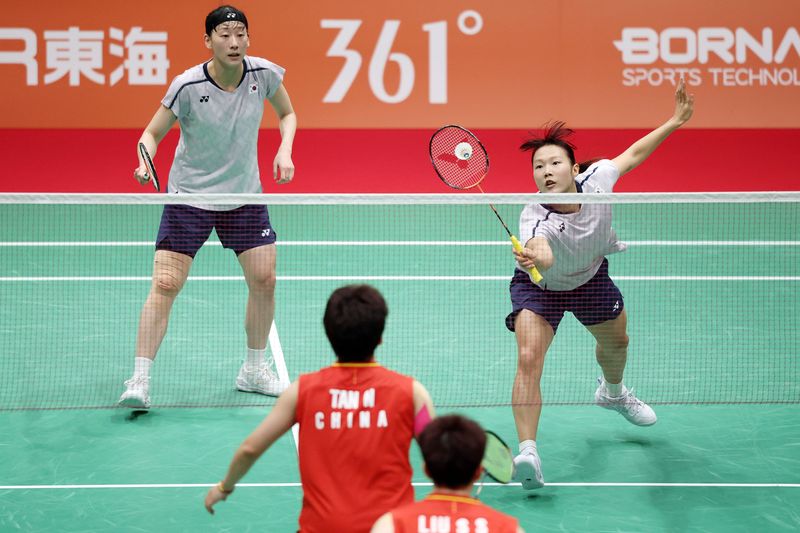
[Financial News] It was truly a "great gold medal" that moved the entire world. There was no cheap trick of relentlessly attacking a weakness while blinded by the desire to win. They chose only a head-on battle. When the South Korean women's doubles pair reached the top of the Asian Games for the first time in 24 years, even defeated China gave them a standing ovation for the "absolute dignity" they displayed beyond the result.
The Lee So-hee–Baek Ha-na pair, both representing Incheon International Airport, defeated the world No. 1 Liu Shengshu–Tan Ning pair from China 2-1 in the women's doubles badminton final at the 2026 Asian Games in Ichinomiya, Aichi Prefecture, Japan, on the 29th. The match, which ended 26-28, 21-18, 21-18, lasted an astonishing 111 minutes, or one hour and 51 minutes, in a suffocatingly intense battle.
As expected from a matchup between the world's No. 1 and No. 2 pairs, the contest was grueling from the start. After exchanging five game points in a fierce deuce battle in the opening game, the Korean pair narrowly lost 26-28. The players' stamina visibly drained as one rally lasted as many as 81 shots. Lee So-hee and Baek Ha-na refused to collapse, taking the second game 21-18 to level the match.
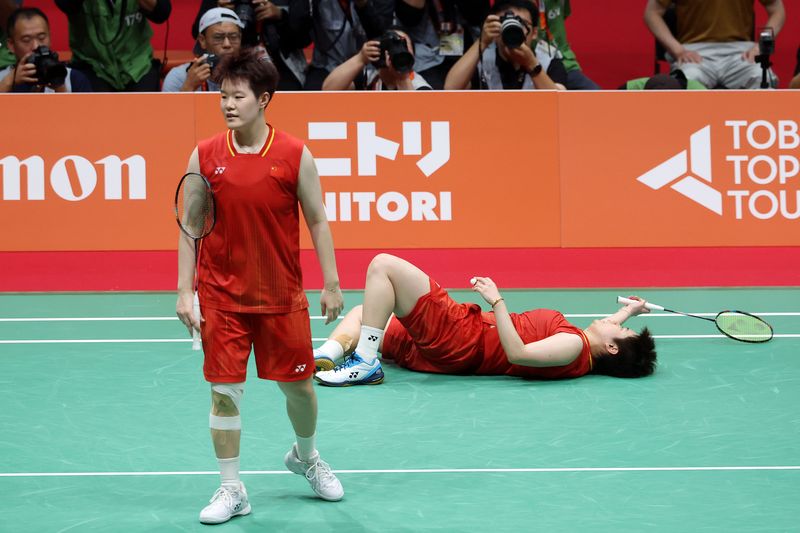
The decisive third game drew the attention of badminton fans around the world. With the score tied at 18-18 and both pairs just three points away from the gold medal, a major twist unfolded on the court. China's Liu Shengshu collapsed with a cramp in her left leg.
Although medical staff came onto the court, Liu could no longer move normally. Her condition was so serious that she had to get down on one knee to return the shuttlecock. In doubles, one player's restricted mobility is a critical weakness. The Korean pair could have repeatedly directed the shuttlecock toward the injured Liu, easily winning the remaining three points and securing its first Asian Games gold medal in 24 years.
But Lee So-hee and Baek Ha-na made a different choice. They rejected the "easiest path" to the gold medal. The Korean pair deliberately avoided sending the shuttlecock to Liu. Instead, they focused their attacks on Tan Ning, who was still moving normally around the court, and chose to battle the world No. 1 pair head-on until the end.
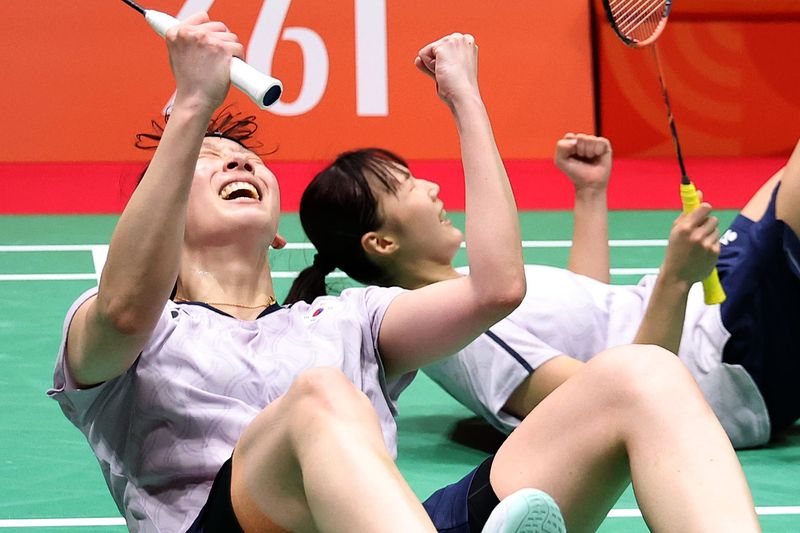

The result was 21-18—a great Korean victory. Without targeting the weakness in front of them, they ultimately overcame the Great Wall of China through sheer ability. Immediately after the match, rather than celebrating, Lee So-hee and Baek Ha-na first approached Liu Shengshu, whose condition was serious enough to require a wheelchair, and checked on her in a moving display of sportsmanship.
Chinese-language media outlets praised the Korean players, setting aside the pain of defeat after witnessing the remarkable scene. Hong Kong outlet HK01 said, "The Korean pair displayed their dignity to the fullest. They did not take advantage of their opponent's injury," praising them for refusing to exploit another person's misfortune. Weibo was also filled with praise, including comments such as, "They built their victory on technical superiority rather than benefiting from their opponent's injury" and "This is sportsmanship that transcends victory and defeat."
Chinese media likewise highlighted the fighting spirit of their players, who knelt and battled until the end, while expressing deep respect for Korea's generous, big-hearted refusal to exploit the crisis.
The women's doubles gold medal had finally returned 24 years after the Busan 2002 Games, when Ra Kyung-min and Lee Kyung-won won the title. The gold medal Lee So-hee and Baek Ha-na earned after 111 minutes of fierce battle will be remembered forever as the most beautiful gold medal in Korean sports history, combining overwhelming skill with an even more dazzling sense of dignity.
[email protected] Jeon Sang-il Reporter