"The 'whale' that bought 1 trillion won a day is pulling out"—KOSPI on thin ice as Samsung Electronics and SK hynix end share buybacks
- Input
- 2026-10-03 13:00:00
- Updated
- 2026-10-03 13:00:00
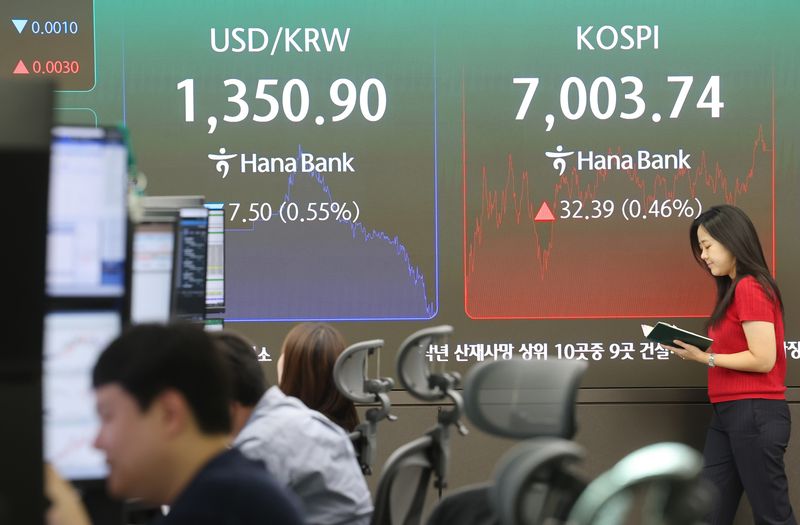
[Financial News] Massive share buybacks by Samsung Electronics and SK hynix are expected to wrap up around the middle of this month. As the "whale" that has supported the KOSPI's lower bound since mid-to-late August disappears, concerns are growing over a liquidity gap and increased volatility after the National Foundation Day holiday.
Samsung Electronics' buyback allocation to be exhausted in two to three days; SK hynix also expected to finish around mid-month
On the 2nd, Samsung Electronics closed at 276,000 won on the KOSPI, unchanged from the previous trading day. It opened at 273,500 won, down 0.91%, and fell as much as 1.63% to 271,500 won early in the session before recovering its losses and moving sideways throughout the day. SK hynix closed at 1,841,000 won, up 0.44%.
The response was lukewarm compared with the overnight mood on U.S. markets. The Philadelphia Semiconductor Index (SOX) rose 1.59% after Micron Technology reported unexpectedly strong earnings, while Micron Technology shares gained 3.03% and SK hynix American Depositary Receipts (ADRs) surged 5.08%. Market observers attributed the capped upside to concerns about a liquidity gap following the end of the share buybacks, as well as caution ahead of the holiday.
As of the previous day, Samsung Electronics had purchased 53.8 million shares, completing the entire buyback volume it had announced. The accumulated purchase amount stood at 14.1565 trillion won. Even considering the company's plan to continue buying shares up to 15 trillion won, only around 840 billion won remains. At its pace of purchasing 2 million shares per day, the remaining volume would be exhausted in two to three trading sessions.
SK hynix has purchased 18.35 million of the 24.07 million shares it reported for repurchase, worth approximately 32 trillion won. The remaining 5.72 million shares are worth about 10 trillion won based on the closing price on the 2nd. At its current pace of purchasing 600,000 to 650,000 shares a day, the buyback is expected to end around the 15th to 17th of this month.
The two whales in "other corporations" that single-handedly absorbed foreign and retail selling
The problem is that the share buybacks have effectively absorbed market selling almost single-handedly. According to the Korea Exchange (KRX), foreign investors net sold 21.5246 trillion won and retail investors net sold 14.1971 trillion won on the KOSPI last month. In contrast, other corporations, which have recently emerged as major market participants due to the share buybacks by Samsung Electronics and SK hynix, posted net purchases of 31.3988 trillion won, absorbing about 88% of the combined selling by the two groups.
The two stocks rank first and second in KOSPI market capitalization, so changes in their trading flows immediately affect the index. Given that the KOSPI has remained range-bound despite record net buying by other corporations, the buybacks appear to have supported the index's lower bound rather than driven it higher. Jeong Hee-chan, a researcher at Samsung Futures, said in a report on the 1st, "With the market participant that has supported the lower end of the index disappearing, concerns are high that the support base could weaken."
Market watches to see whether foreign selling will ease after the holiday
There are also factors that could cushion the impact. The improvement in the memory industry cycle was reaffirmed by Micron Technology's earnings, creating room for foreign selling to slow. Institutions made Samsung Electronics and SK hynix their top two net purchases of the day, buying 158.6 billion won and 131.9 billion won, respectively, in bargain hunting.
Regular rebalancing of exchange-traded funds (ETFs) scheduled immediately after the holiday is another variable. According to Samsung Securities, ETFs subject to rebalancing this month have a combined value of 23 trillion won, of which semiconductor ETFs account for 18.1 trillion won. Considering the holiday, the actual rebalancing is expected to be concentrated on the 8th. However, since the figure includes both purchases and sales, it is unlikely to replace the one-way buying provided by share buybacks and could instead increase short-term volatility.
[email protected] Kim Hee-sun Reporter