Weekend Archaeology Classes in Gimhae Let Participants Restore Pottery and Piece Together Gaya Lives
- Input
- 2026-10-03 10:00:00
- Updated
- 2026-10-03 10:00:00
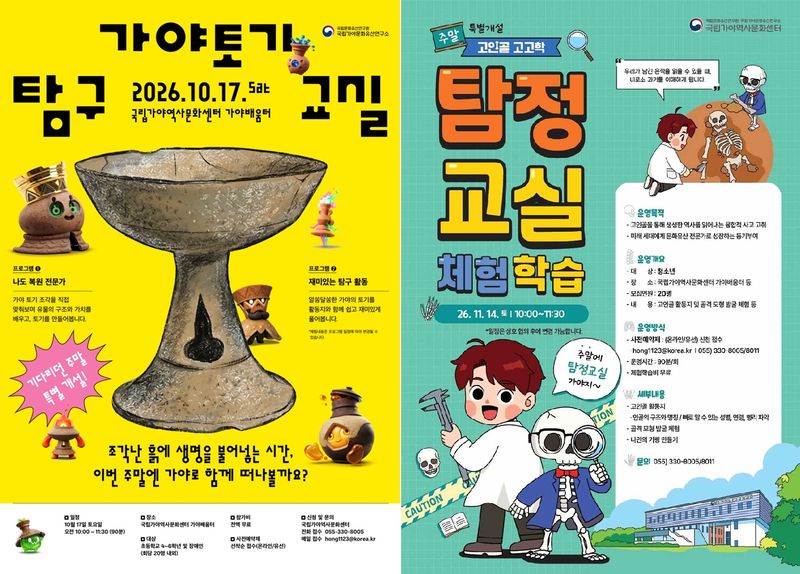
According to the National Gaya Cultural Heritage Research Institute under the National Research Institute of Cultural Heritage (NRICH) and the Korea Heritage Service, special weekend programs will be held on October 17 and November 14 at the Gaya Learning Center of the National Gaya History and Culture Center in Gimhae City, South Gyeongsang Province. Both classes will run from 10 to 11:30 a.m. on Saturdays.
The “Gaya Pottery Exploration Class,” scheduled for October 17, is intended for fourth- through sixth-grade elementary school students and people with disabilities. Participants with disabilities may join regardless of age.
Participants will learn about the historical significance of Gaya pottery through activity sheets, then experience the restoration process by fitting together pieces of an artifact model. They will also assemble pottery using hands-on activity kits.
On November 14, the institute will hold the “Ancient Human Remains Archaeology Detective Class” for local young people. The program will incorporate research findings from the institute's analysis of bones excavated from archaeological sites.
After learning about skeletal structure through an introductory lecture on physical anthropology, the study of human physical characteristics, participants will infer the sex, age and disease conditions of Gaya people. They will also write research notes, excavate skeletal models and make keychains.
Both classes cover the process of restoring and analyzing artifacts after excavation. Participants will reconstruct the forms of pottery and examine the lives of Gaya people by interpreting clues preserved in bones.
There is no participation fee, and around 20 people will be accepted for each program on a first-come, first-served basis. Applications can be submitted by phone or email. Further information is available on the National Gaya Cultural Heritage Research Institute's website.
[email protected] Jang In-seo Reporter