[Han Dong-ha’s Boncho Yeodam (Anecdotes from Materia Medica)] Making Gye-go from Chicken Instead of Ginseng Was Beneficial
- Input
- 2026-10-03 06:00:00
- Updated
- 2026-10-03 06:00:00
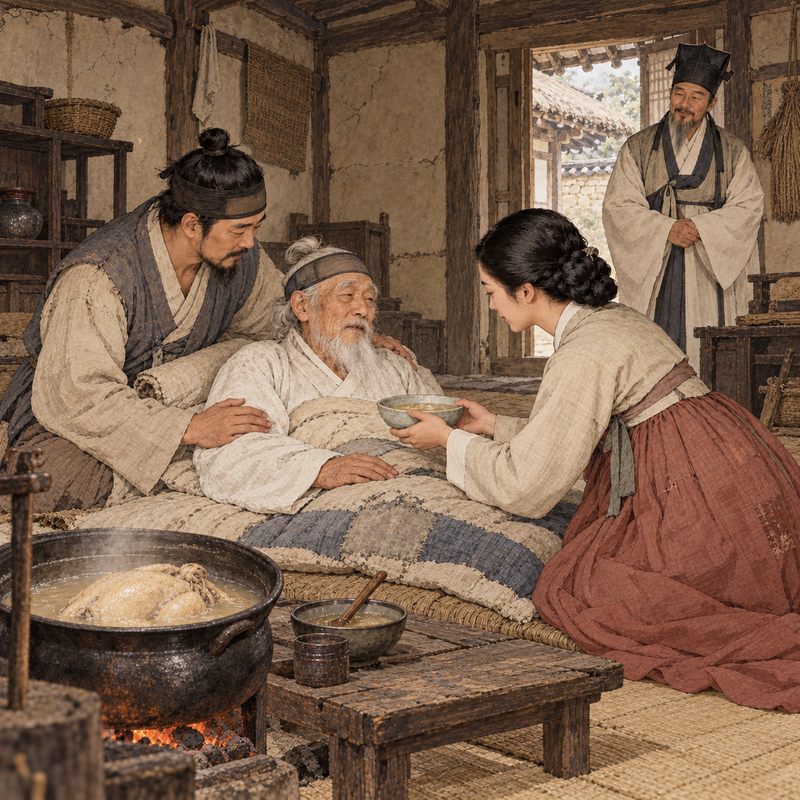
Long ago, there was an elderly man who was about 90 years old. He was overweight, but one day he became confused and unable to speak properly. Whenever he ate or drank, he choked and coughed. His tongue had a yellow coating, and he kept trying to take off his clothes, apparently because of discomfort in his chest.
The old man had been bedridden for so long that he could not get up. When someone tried to help him sit up, he experienced severe lower-back pain and could not move his body. More than any other symptom, his inability to support himself with his lower back caused considerable discomfort.
The old man’s family had no choice but to call a physician to examine him.
"Our elderly father has such severe lower-back pain that he cannot sit or stand. Please find a way to treat him."
The physician visited the old man’s home, examined him, and said,
"From what I can see, the problem is not his lower back. A generally heavy build is usually caused by spleen deficiency leading to an excess of dampness. The inability to speak occurs because severe phlegm and fluid in the spleen and stomach enter the heart, causing the tongue to become stiff. The yellow tongue coating is caused by heat becoming congested in the spleen. The coughing that occurs whenever he eats is caused by the stiff tongue preventing him from swallowing food. His recent lower-back pain is due to dampness in the spleen suppressing the kidney and causing kidney deficiency."
"Then what should we do?"
"In this situation, it may be effective to dispel the phlegm with Yukgunja-tang (Six Gentlemen Decoction). However, because he has fire in the lungs, I will remove ginseng from the prescription, add Chinese yam, and include 1 don of grass-leaf sweet flag. I will prescribe three packets."
The old man took the medicine as prescribed. All his symptoms improved slightly, and he was able to eat twice as much as before. He then ate one food after another, whatever he could, including foods he had been unable to eat until then. The following day, however, the amount he could eat suddenly decreased, and he was unable to eat again.
The old man’s family called the physician again.
"Father is unable to eat again. What happened?"
After examining him, the physician said,
"The elderly man has indigestion because he ate too much at once. From now on, do not give him regular meals for the time being. Give him rice gruel to rest his stomach. I will also prepare two more packets of the previous prescription, so please have him take them."
The family prepared rice gruel for the old man, and he regained his appetite and was able to eat normally again. After he took the two packets of prescribed medicine, all his symptoms gradually improved. Strangely, however, the yellow tongue coating did not improve at all. Although he seemed to regain his appetite, he had no energy whatsoever.
"Father’s tongue coating is still yellow, and he cannot regain his strength. Why are these symptoms not improving?"
"This means that his original qi has not fully recovered. First, we should stop giving him rice gruel."
"He felt better after drinking rice gruel because it settled his stomach and enabled him to eat. Why should we stop giving it to him?"
"Rice gruel can temporarily be given to someone who is seriously ill and unable to eat at all. It relieves hunger without causing indigestion. Thus, when an elderly patient who is ill drinks rice gruel, previously undigested food is fully digested, allowing him to eat well. However, if someone with a chronically weak stomach continues drinking rice gruel, it weakens the stomach even further and does not help restore energy. Therefore, rice gruel should not be consumed for an extended period as the sole food."
"Then what should we do? Please prescribe a good treatment that can restore his original qi."
"Ginseng would be useful in this situation, but the elderly man has fire in the lung meridian and therefore cannot take ginseng. In such cases, it would be beneficial to simmer gye-go, which nourishes the body, and give it to him."
"How is gye-go made?"
"Gye-go has long been used as a food-based treatment when deficiency is severe but ginseng is difficult to use. Take one old native chicken, discard the internal organs, skin, bones, neck, and backbone, and remove only the meat from the wing sections, legs, and lower abdomen. Put the meat in a pot. Add one stalk of fresh platycodon root, 2 nyang of fresh ginger, 5 don of Rou Gui, 20 hawthorn fruits, and 10 yellow chestnuts, then simmer everything thoroughly to make a paste. This gye-go is a restorative food that is effective for people with deficient energy and a weak spleen and stomach."
Following the physician’s instructions, the family simmered gye-go and gave it to the old man. By the time he had finished eating it, the yellow coating on his tongue had gradually improved, and his restlessness caused by discomfort disappeared soon afterward.
In the past, when poor households suffered from deficient energy but could not obtain ginseng, they used gye-go as a substitute medicine. It was also suitable for people who could afford ginseng but could not take it because they had dry blood and fire in the lung meridian. Some people made gye-go simply by boiling chicken, while others added various medicinal ingredients. Both methods were effective.
Source of today’s Boncho Yeodam story
<Gyeongbo Sinpyeon>There was an elderly man nearly 90 years old whose body was heavy and well-nourished. His mind was often confused, he could not speak, and he sneezed whenever he ate or drank. His tongue had a yellow coating, and he was distressed and kept taking off his clothes. He had lain down for so long that he could not get up. When someone tried to help him sit, his lower-back pain became much worse, and he could not turn over. He asked me for medicine for his lower-back pain. After considering the case repeatedly, I concluded that his heavy build was due to spleen deficiency and excessive dampness; his inability to speak was due to phlegm and fluid in the spleen and stomach entering the heart and stiffening the tongue; the tongue coating was due to heat becoming congested in the spleen; his sneezing whenever he ate was due to the stiff tongue being unable to take in food; and the lower-back pain was due to dampness in the spleen overwhelming the kidney and causing kidney deficiency. I removed ginseng from Yukgunja-tang, added Chinese yam and 1 don of grass-leaf sweet flag, and prescribed three packets. All his symptoms improved somewhat, and he ate twice as much. However, the following day the amount he ate suddenly decreased and he could not eat, because he had overeaten and developed indigestion. From the next day, I continued giving him rice gruel to cleanse his stomach, and he recovered his normal ability to eat. I then prescribed two more packets of the same medicine, and all his symptoms gradually improved. However, the tongue coating did not improve at all. I used one chicken’s worth of gye-go made from a yellow-earth-colored chicken, after which the tongue coating gradually improved and his restlessness quickly subsided. Ginseng would not have been effective, so it was omitted. When rice gruel is given to someone who is seriously ill and unable to eat at all, it relieves hunger without causing indigestion. If an elderly person drinks rice gruel early in the morning, all undigested food is digested and the person can eat well. However, if someone with a normally weak stomach takes it continuously, it greatly weakens the stomach.Rice gruel can be given to a person who is seriously ill and unable to eat at all; it relieves hunger without causing indigestion. If an elderly person drinks it early in the morning, retained food is completely digested and the person can eat well. However, if someone with a normally weak stomach takes it continuously, it greatly weakens the stomach. (A certain elderly man nearing 90 was heavyset, often mentally confused, unable to speak, and sneezed whenever he ate or drank. He had a yellow coating on his tongue and kept trying to take off his clothes because he was distressed. Since he had been lying down for so long that he could not get up, his lower-back pain became severe when he was helped to sit, and he could not move his body, so he asked me for medicine for his lower-back pain. After considering the case repeatedly, I concluded that his heavy build was due to spleen deficiency and excessive dampness; his inability to speak was due to phlegm and fluid in the spleen and stomach entering the heart and stiffening the tongue; the yellow tongue coating was due to heat becoming congested in the spleen; his sneezing whenever he ate was due to the stiff tongue being unable to swallow food; and the lower-back pain was due to dampness in the spleen suppressing the kidney and causing kidney deficiency. I removed ginseng from Yukgunja-tang, added Chinese yam and 1 don of grass-leaf sweet flag, and prescribed three packets. All his symptoms improved somewhat, and he ate twice as much. However, the following day the amount he ate suddenly decreased and he could not eat because he had overeaten and developed indigestion. From the next day, I continued giving him rice gruel to cleanse his stomach, and he recovered and was able to eat normally. I then used two packets of the same medicine, and all his symptoms gradually improved. However, the tongue coating did not improve at all, so I used one chicken’s worth of gye-go made from a yellow-earth-colored chicken. The tongue coating gradually improved, and his distress and restlessness quickly subsided. Ginseng was omitted because it would not have been effective. When rice gruel is given to someone who is seriously ill and unable to eat at all, it relieves hunger without causing indigestion. If an elderly person drinks rice gruel early in the morning, all undigested food is digested and the person can eat well. However, if someone with a normally weak stomach takes it continuously, it greatly weakens the stomach.)<Uijongsonik>Gye-go. When poor people develop a deficiency syndrome and have difficulty obtaining ginseng or similar ingredients, this can be used as a substitute. Even when they can obtain ginseng, it is also suitable for those whose constitution is naturally marked by blood dryness and fire in the lung meridian, making ginseng difficult to take. Use one old chicken, removing the internal organs, skin, bones, neck, and backbone, and retaining only the meat from the wing sections, legs, and firm meat beneath the abdomen. Add one stalk of fresh platycodon root, 2 nyang of fresh ginger, 5 don of Rou Gui, 20 hawthorn fruits, and 10 yellow chestnuts, and make a paste using the usual method. ○ For blood dryness, add 2 don of white peony root, soaked in wine and stir-fried until yellow. ○ For yang deficiency, add 1–2 don of aconite. ○ When qi deficiency causes a cold, or when a cold follows sexual overexertion and it is difficult to both tonify and purge, use 3 or 5 don of honeysuckle, 1 nyang of fresh ginger, 10 hawthorn fruits, 9 fresh chestnuts, and one stalk of fresh platycodon root. Make and use the paste together with the chicken. ○ Adjusting the ingredients depends entirely on applying the method flexibly. (Gye-go. When a poor person develops a deficiency syndrome and has difficulty obtaining ingredients such as ginseng, this is used as a substitute. Even if the person can obtain ginseng, it is also suitable when the person naturally has dry blood and fire in the lung meridian, making ginseng difficult to take. Use one old chicken, discarding the internal organs, skin, bones, neck, and backbone, and retaining only the meat from the wing sections, legs, and beneath the abdomen; add one stalk of fresh platycodon root, 2 nyang of ginger, 5 don of Rou Gui, 20 hawthorn fruits, and 10 yellow chestnuts, and make a paste in the usual manner. ○ For blood dryness, add 2 don of white peony root, soaked in wine and stir-fried until yellow. ○ For yang deficiency, add 1–2 don of aconite. ○ When qi deficiency causes a cold, or when a cold follows excessive sexual activity and it is difficult to both tonify and purge, combine 3 or 5 don of honeysuckle, 1 nyang of fresh ginger, 10 hawthorn fruits, 9 fresh chestnuts, and one stalk of fresh platycodon root with the chicken and make a paste. ○ Adjusting the ingredients depends entirely on how flexibly the method is applied.)
/ Han Dong-ha, director of Handong Han Clinic
[email protected] Jeong Myeong-jin, medical writer Reporter