Law Firm LIN Blocks Jooyeon Tech's Delisting: Court Says Early Application of Market-Capitalization Threshold Was Excessive
- Input
- 2026-10-02 20:56:24
- Updated
- 2026-10-02 20:56:24
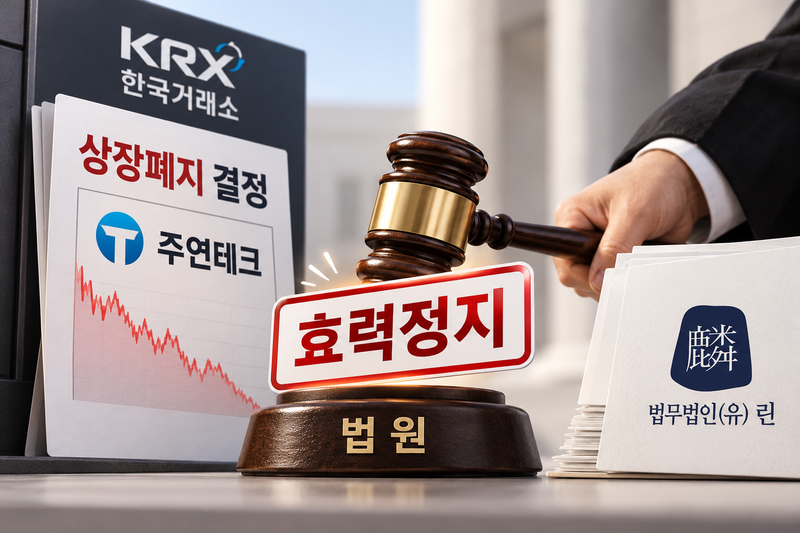
[Financial News] LIN, representing Jooyeon Tech, succeeded in putting the brakes on the Korea Exchange's (KRX) delisting decision. The court suspended the decision after finding that KRX had not given the company sufficient opportunity to respond while applying its strengthened market-capitalization criteria.
According to LIN on the 2nd, the Seoul Southern District Court granted Jooyeon Tech's application for an injunction suspending the effect of the delisting decision against KRX. As a result, the delisting decision issued on the 28th of last month was suspended, and liquidation trading could not proceed.
The key issue in the case was whether KRX had properly applied its strengthened market-capitalization criteria for maintaining a listing to Jooyeon Tech.
KRX revised its listing rules and raised the market-capitalization delisting threshold in stages to between KRW 30 billion and KRW 50 billion. In particular, it moved up the implementation date for the KRW 30 billion threshold by six months, from January 1, 2027, to July 1, 2026.
Jooyeon Tech was designated as an issue under administrative management on July 21, after the new criteria took effect. It subsequently failed to meet the market-capitalization recovery requirement and received a delisting decision on September 28, leaving it on the verge of liquidation trading.
LIN argued that KRX's rules had operated to the company's excessive disadvantage in this process.
Specifically, LIN challenged the fact that KRX judged whether to delist the company based solely on its market capitalization without giving it sufficient opportunity to file an objection and explain its position; strengthened the market-capitalization recovery requirement to maintaining the threshold for 45 consecutive days; and moved up the application date for the KRW 30 billion threshold by six months without providing sufficient time to prepare.
The court also accepted a substantial portion of these arguments.
The court found that it was problematic to limit a company's opportunity to file an objection and explain its position solely because it failed to meet the market-capitalization threshold. It also determined that the transitional measure moving up the implementation date for the KRW 30 billion threshold from the original schedule did not give the company sufficient time to prepare normalization measures, such as raising capital or improving its performance.
The court reportedly determined that these measures imposed an excessive burden on the company and violated the principle of proportionality.
As the key issues raised by LIN were reflected in the court's decision, Jooyeon Tech was able to temporarily avoid delisting and liquidation trading.
Founded in 1988 and listed on the KOSPI market in 2006, Jooyeon Tech manufactures and sells computers. The company said it had been working to restore its market capitalization through improved performance and other measures, but a decline in its share price and weakened investor sentiment after its designation as an issue under administrative management had made it difficult to meet the threshold in the short term.
The decision is drawing attention because it could serve as a reference for other companies that were designated as issues under administrative management or are undergoing delisting procedures under the same market-capitalization criteria. Whether sufficient grace periods and opportunities to explain their positions were guaranteed when KRX applied its strengthened delisting criteria could become a key issue in similar cases going forward.
Nam Kwang-min, an accountant, and Young Hoon KIM, an attorney with LIN's Listed Companies Support Task Force, which led the lawsuit, said, "It is necessary to exercise caution before excluding a sound company's listing eligibility based solely on a short-term market-capitalization indicator." They added, "Once liquidation trading begins after a delisting decision, it becomes difficult to respond, so it is important to promptly review the relevant rules and procedures immediately after the decision."
However, this decision does not constitute a final ruling that the delisting itself is invalid. It is an injunction that temporarily suspends the delisting decision and liquidation trading until the lawsuit on the merits is resolved.
[email protected] Yoo Sun-jun Reporter