Government to Establish Data-Processing Standards for All Agents on the "AI for All" Service
- Input
- 2026-10-02 16:41:14
- Updated
- 2026-10-02 16:41:14
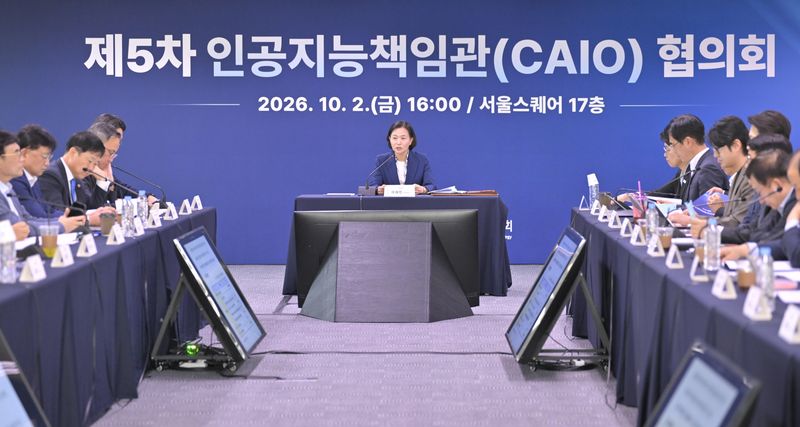
The National AI Strategy Committee held the fifth meeting of the Council of Chief AI Officers (CAIO Council) at Seoul Square in Jung-gu, Seoul, on the 2nd. The meeting reviewed preparations for AI for All and discussed directions for AI-related legislation across government ministries.
The meeting was chaired for the first time by Lee Hae-min, Senior Secretary for AI and Future Planning at Cheong Wa Dae, who also serves as chair of the CAIO Council. Participation was expanded from the existing 28 ministerial-level agencies to 42 central administrative agencies, including 14 vice-ministerial-level agencies such as the Ministry of Personnel Management, the Ministry of Government Legislation, and the Ministry of Data and Statistics.
The Ministry of Science and ICT shared an update on preparations for AI for All and asked each agency to link the public APIs it has already opened to the AI for All service to support AI agent services in the public sector. It also requested the additional opening of APIs and data that have not yet been made public.
As AI agents become connected to public services, privacy and security have emerged as major challenges. The government plans to establish standards for AI agents' processing and use of personal information and verify their security and safety before the service is launched. This is foundational work to expand AI for All beyond a simple question-and-answer service into an agent that uses public data to perform actual tasks.
The government's overall direction for AI legislation was also discussed. It presented four principles for AI-related legislation by individual ministries: legislation centered on the AI Framework Act; closing legislative gaps in the defense and national security sectors; improving predictability for businesses; and responding immediately when adverse effects arise.
It also outlined sector-specific legislative principles covering the promotion of AI development and convergence, the assurance of safety and trust, and the prevention of misuse and abuse.
The Ministry of the Interior and Safety requested that each ministry register and share high-value data and identify demand for integrated data so that it can make use of the government-wide data pipeline launched on the 18th of last month.
The Personal Information Protection Commission proposed establishing comprehensive systems for managing personal information protection and security within each ministry and strengthening the role of chief privacy officers in response to a series of recent major hacking and data-leak incidents.
Lee Hae-min, who chaired the meeting, said, "The CAIO Council is a forum that connects the seams between ministries. As chair, I will personally ensure that it becomes a consultative body that does more than listen to reports by coordinating and making decisions on issues between ministries." Lee added, "I will operate the council regularly so that all ministries can move as one team in the AI transformation, and I will also actively address collaborative initiatives proposed by the ministries."
[email protected] Lee Gu-sun Reporter