"Trademark Registration for New Technologies Like 'Loading and Unloading Robots' and 'Immersion Cooling' to Become Easier"
- Input
- 2026-10-05 12:00:00
- Updated
- 2026-10-05 12:00:00
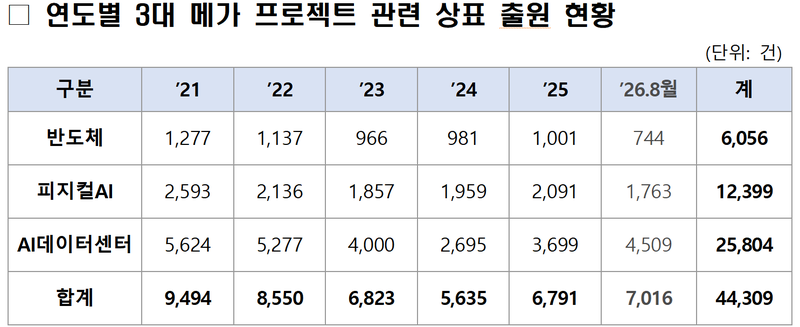
According to the Ministry of Intellectual Property on the 5th, 72 new product names commonly used by industry in the three mega-project sectors were identified as a priority and added to the official notice. The newly disclosed names include 'custom integrated circuits' and 'semiconductor device inspection apparatus for wafers' in the semiconductor sector; 'LiDAR sensor' and 'collaborative painting robots' in the Physical AI sector; and 'bidirectional computer systems for virtual power plants' and 'immersion cooling apparatus for data centers' in the AI data center sector.
Previously, even when new products emerged in the field as technology advanced, there was often a time lag before they were reflected in the official goods classification notice. This made it difficult for applicants to register their rights and select designated goods. When filing a trademark application, applicants must clearly specify the names of the goods to be designated. However, applications using new names not listed in the notice often took longer to undergo eligibility reviews or resulted in orders to make corrections.
To address these inconveniences, the Ministry of Intellectual Property decided to take preemptive measures in response to the surge in trademark applications related to the three mega-projects. Ministry data show that trademark applications related to the three mega-projects totaled 5,635 in 2024 and 6,791 in 2025. This year's figure had already reached 7,016 as of August, surpassing last year's total. Applications using new product names not yet reflected in the official notice also totaled 142 through August this year, nearly matching the 159 applications filed throughout last year.
The 72 newly identified product names will be made public on the Ministry of Intellectual Property's website starting on the 5th of this month and will be officially reflected when the notice takes effect on January 1 next year.
The Ministry of Intellectual Property plans to select representative names and have them reflected in the Nice International Classification of Goods and Services, the international standard for classifying goods and services for trademarks. It will also continue operating a channel through which companies and applicants can directly propose names for products in emerging industries via its website.
Nam Young-taek, Director General of the Trademark and Design Examination Bureau at the Ministry of Intellectual Property, said, "The proactive introduction of new product names will make filing applications more convenient and provide institutional support for securing trademark rights quickly." He added, "We will continue to provide support so that applicants can smoothly secure trademark rights in line with the changing industrial environment."
Meanwhile, this notice on new product names is part of the Ministry of Intellectual Property's recently launched policy to shorten examination periods in the patent and trademark fields. The Ministry recently announced plans to expand its fast-track examination system for technologies in the AI data center and Physical AI sectors, reducing the patent examination waiting period to less than one month. With the names of designated goods also being organized in advance, the ecosystem for "technology-brand package protection" is expected to become stronger. This ecosystem enables advanced technology and startup companies that develop new technologies to quickly obtain patent and trademark rights simultaneously and at scale.
[email protected] Kim Won-jun Reporter