"I felt like I would go crazy without Samsungnix"... Down up to 38% from the peak, holding on precariously [The World of Retail Investors]
- Input
- 2026-10-04 06:00:00
- Updated
- 2026-10-04 06:00:00
[Financial News] It was early June when Mr. A (34), an office worker, made a large purchase of Samsung Electronics and SK Hynix. It was a time when the KOSPI had surpassed 9,000 and was heading toward 10,000, and everyone in the company group chat and at gatherings with friends was talking only about ‘Samjeonyx’.
Comments such as "The day Samsung Electronics goes bankrupt is the day our country goes bankrupt" and "Look how much SK Hynix's price has risen; it can go even higher" poured out.I felt anxious at the thought that I should buy more, even if it meant taking out a loan.Mr. A spent most of the money he had on buying Samsung Electronics and SK Hynix.
And currently, Mr. A's account is recording a -34% decline. For those like Mr. A who succumbed to FOMO (Fear of Missing Out) and invested at the peak, the stock market in the second half of the year is nothing but harsh. As the KOSPI continues to trade sideways, the hopes for "400,000-point Electronics" and "3 million-point Nix" have also faded. Mr. A"I don't have the confidence to cut my losses, but holding on just makes me feel frustrated, so I don't really watch stock news these days."He added, "Still, it is Samsung and SK Hynix, so if we leave it alone, won't it eventually go up?"
That stock that everyone was shouting "Samsung Electronics, no matter what," now
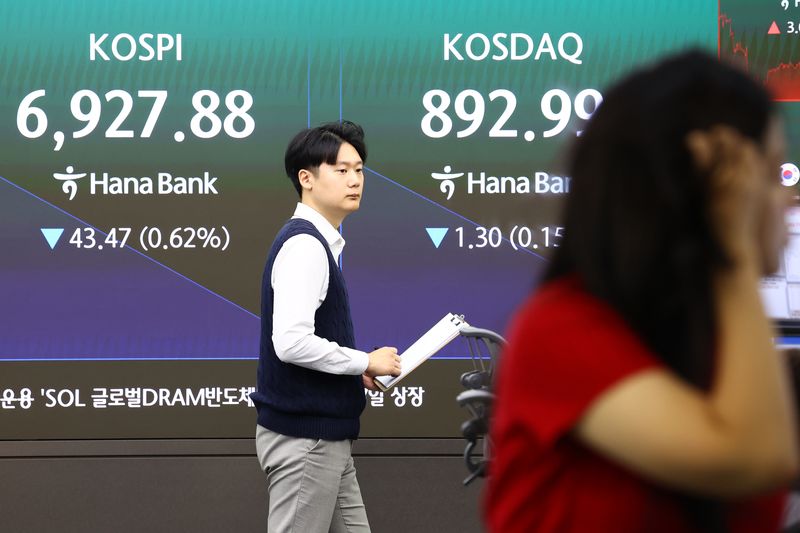
The KOSPI, which had been hot until June, experienced a record-breaking plunge in July, plummeting 22.19% over the course of the month. Although it briefly surpassed the 9,000 mark and came within sight of 10,000 points, it dropped as low as 5,262.77 in a single day during the month.
Since then, the KOSPI has rebounded significantly from its low point, but it has been fluctuating between the 6,000 and 7,000 levels, failing to establish a clear direction. In particular, the sluggish performance of Samsung Electronics and SK Hynix, the two giants of the semiconductor industry that support the domestic stock market, is notable.
Samsung Electronics, which once rose to 374,500 won, fell approximately 26% to 276,000 won as of the closing price on the 2nd, while SK Hynix also closed at 1,841,000 won, dropping nearly 38% from its intraday high of 2,987,000 won. As suchForeigners are suppressing stock pricesForeign investors net sold 21.5108 trillion won on the KOSPI alone in September, and the cumulative net selling amount over the past five months reached 134.9195 trillion won.
Of this, 76.6% of the selling in September was concentrated on two stocks: SK Hynix (11.5805 trillion won) and Samsung Electronics (4.8920 trillion won). The combined market capitalization of these two stocks on the KOSPI stood at 50.85% at the end of September,A structure where selling pressure is likely to concentrate on two stocks whenever foreigners reduce their exposure to Korean stocks.It has been formed.
The share buyback is coming to an end, and now there's the bad news of interest rates on top of that.
HereThere is also concern that the two companies' share buybacks are being completed early.It triggers. According to the Korea Exchange's corporate disclosure channel on the 2nd, Samsung Electronics purchased 53.8 million shares of its own stock by the previous day, a figure that exceeds the buyback volume previously announced by Samsung Electronics. Samsung Electronics had disclosed that it would purchase 53,285,968 shares from August 24 to November 21.
SK Hynix has also purchased 18.35 million shares out of the reported buyback volume of 24.07 million shares since August 20. The purchase rate stands at 76.24%, with the cumulative purchase amount totaling 32.0514 trillion won, and the daily purchase volume is estimated at approximately 600,000 to 650,000 shares. Accordingly, if the company continues to purchase the same volume over the remaining period, it is expected to complete the purchase of the remaining 5.72 million shares within about 8 to 9 trading days.
The situation outside is also not good.The U.S. 30-year Treasury yield reached 5.62% during intraday trading, the highest level since 2002, while the 10-year yield also stood at 5.29%, the highest level since 2007.It has risen to [amount]. If long-term interest rates rise, foreigners have less reason to buy emerging market stocks, which are risky assets. The market's assessment is that while a rebound will only continue if foreign capital returns, rising US interest rates and strong oil prices remain obstacles.
However, Samsung Electronics is reportedly planning to continue buying back its own shares until the cumulative purchase amount reaches 15 trillion won. Based on recent stock prices and average purchase prices, it is expected that approximately 3 million additional shares can be purchased.
Securities Industry: "No Sharp Decline... Memory Upturn Cycle to Accelerate Next Year"
The securities industry views the likelihood of an immediate sharp decline as low. Kim Jae-seung, an analyst at Hyundai Motor Securities, noted, "Once the share buyback ends, a supply-demand gap may arise, causing the stock to appear weak," but added, "That does not mean the stock price will fall sharply or lead to a plunge."The memory semiconductor market will see simultaneous increases in price and shipments starting next yearJin in a strong upward cyclemouthThe prediction that it will happenKim Dong-won, an analyst at KB Securities, presented Samsung Electronics and SK Hynix as top picks, stating, "If HBM led growth last year and general-purpose memory this year, next year is expected to see an all-encompassing growth phase where price increases and shipment volume growth for both HBM and general-purpose memory unfold simultaneously."
"He added, 'While it takes more than three years to build new cleanrooms and expand fabs, the increase in supply to meet the surging demand for memory will be extremely limited as production capacity expansion centered on HBM is carried out in parallel,' and 'the memory market next year is expected to enter an acceleration phase of a strong upward cycle where price increases and shipment growth occur simultaneously.'"
Advice for individual investors was also offered. Lee Kwon-hee, CEO of investment advisory firm Wizwave, on the YouTube channel 'Pyo Young-ho TV' on the 29th of last monthIt may take time to break through the previous high.He recommended reducing the weight of Samsung Electronics and SK Hynix. For investors whose accounts are held in these two stocks for 70 to 80 percent, the advice is to reduce the weight to 30 to 40 percent, with Samsung Electronics at 300,000 to 320,000 won and SK Hynix at 2.2 million to 2.4 million won.
[email protected] Kim Hee-sun Reporter