Why Are South Korean and U.S. Stock Markets Holding Up Despite the Three Major Headwinds of High Interest Rates, High Oil Prices and Inflation?
- Input
- 2026-10-02 14:48:15
- Updated
- 2026-10-02 14:48:15
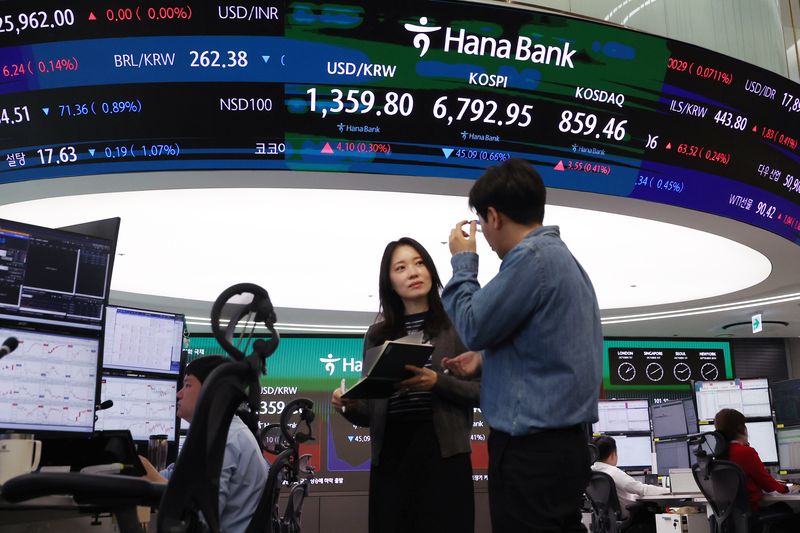
[Financial News] The macroeconomic environment is filled with headwinds, including soaring global policy rates, international oil prices hovering above $100 per barrel, and persistent inflation concerns. Theoretically, high interest rates, high inflation and high oil prices—the so-called "three-high" environment—could easily trigger a sharp correction in stock markets. Yet South Korean and U.S. stock markets, including the KOSPI Composite Index, are showing unexpected downside resilience. Market participants continue to ask, "Why isn't the stock market collapsing despite the accumulation of bad news?"
On the 2nd, securities analysts pointed to the resilience of corporate earnings, led by South Korea's semiconductor industry; the U.S. economic growth that is absorbing the shock from high interest rates; and reduced concerns about excessive tightening by the Federal Reserve System (the Fed) as underlying reasons.
Although the macroeconomic environment remains unsettled, analysts say corporate earnings strength and reduced uncertainty over monetary policy are preventing a sharp market decline.
Global AI Boom and Semiconductor Earnings Cycle Act as a "Shield"
Expectations for improved earnings at major semiconductor companies are cited as a key reason the domestic stock market is holding up amid the global tightening wave. Semiconductor companies account for a substantial share of the KOSPI Composite Index's market capitalization, and their solid earnings trends are supporting the index's downside.Moon Nam-joong, a researcher on Daishin Securities' Global Strategy Team, said, "As the global AI boom continues and the semiconductor industry enters an upcycle, global demand for South Korea's supply chain in advanced technology products remains very strong."
Even as high interest rates curb overall liquidity, the massive trend of AI data-center construction and infrastructure investment is supporting demand for South Korean memory semiconductor companies.
In particular, expectations for growth in the high-performance memory semiconductor market, driven by expanding demand for AI computing, are helping differentiate the South Korean stock market.
Market attention is focused on Samsung Electronics' preliminary third-quarter earnings report, scheduled for the 8th. Analysts expect Samsung Electronics' earnings to improve. Together with Micron Technology's previously announced positive results, the AI semiconductor earnings momentum is expected to support the downside of the domestic stock market.
"Interest Rates Are at 4%, but Growth Is at 8.5%"—Earnings Absorb the Shock from High Rates
The solid growth of the U.S. economy is also cited as a reason stock markets are holding up in a high-interest-rate environment. Although elevated rates are placing pressure on businesses and households, analysts say the economy's nominal expansion and the pace of corporate earnings growth are offsetting much of that impact.Park Sang-hyun, a researcher at iM Securities, noted that the finalized second-quarter U.S. GDP growth rate was revised up to an annualized 2.2% from the previous quarter, while nominal GDP growth reached 8.5%.
Park analyzed, "The fact that nominal GDP growth is far above the 4.0% policy rate suggests that the economy is sufficiently absorbing the shock from high interest rates." In other words, when the economy's nominal size is expanding rapidly, the impact of higher interest expenses and increased financing costs on overall corporate activity may be relatively limited.
Corporate earnings are also showing strong momentum. According to iM Securities, second-quarter profits at U.S. nonfinancial corporations amounted to 9.8% of nominal GDP, the highest level since 1966.
Typically, rising interest rates reduce the present value of future earnings, putting pressure on stock valuations. However, as companies maintain high profitability and absorb rising capital costs, analysts say it is difficult to conclude that higher rates alone will lead to a sustained stock-market decline.
Slowing Core PCE Inflation Eases Fears of Further Tightening; Long-Term Rates Become the "New Normal"
Another factor limiting the stock market's decline is the view that concerns over inflation and central-bank tightening have passed their peak. In particular, U.S. core personal consumption expenditures (PCE) inflation came in below market expectations, somewhat easing concerns about further tightening by the Fed.Junghun Lee, a researcher on Daishin Securities' Macro Team, highlighted the U.S. core PCE price index for August. Core PCE rose 3.0% from a year earlier, below the market forecast of 3.3%.
Lee explained, "Although the figure was also affected by changes to statistical measurement methods, the momentum behind underlying inflation has eased considerably, with the six-month annualized rate slowing to 2.7%."
Lee added, "Concerns in some parts of the market about three to four additional rate hikes this year are excessive," and assessed, "As long as core PCE inflation remains in the mid-to-high 2% range, the Fed has little incentive to overreact." This means that although inflation concerns have not been completely resolved, the pressure on the Fed to respond with further tightening may not be as great as the market fears.
Some analysts say the recent rise in long-term U.S. Treasury yields should also be viewed from the perspective of structural change. Moon Nam-joong of Daishin Securities explained that increased Treasury issuance to fund war responses and economic stimulus, along with expanded corporate bond issuance by big tech companies, is influencing long-term rates.
Rather than interpreting rising long-term rates solely as a precursor to an economic recession, they should be viewed as a structural change resulting from increased fiscal spending and funding demand—in other words, a "new normal."
Moon believes that as long as corporate earnings and AI infrastructure investment continue, rising long-term rates alone will not undermine the upward trend in risk assets.
Oil Prices Are Ultimately Expected to Be the Biggest Test
However, international oil prices remain a potential obstacle to the stock market's relief rally. If rising oil prices reignite inflation, uncertainty over the Fed's monetary policy path could increase, placing additional pressure on stock markets.According to iM Securities, the average monthly price of West Texas Intermediate crude oil (WTI) in September was $95.7 per barrel, up about 16% from the August average of $82.5. Since the increases in oil prices and U.S. diesel prices were not fully reflected in the August inflation data, some analysts have raised the possibility that the consumer price index (CPI) to be released for September could temporarily rise.

Analysts believe the short-term direction of the stock market will be determined by first confirming the earnings strength of major South Korean companies through Samsung Electronics' results and then assessing the severity of the oil-price shock through the U.S. September CPI, which is scheduled to be released on the 14th.
Ultimately, the current stock market is caught between semiconductor earnings and U.S. economic growth, which are absorbing the shock from high interest rates, and the opposing pressures of high oil prices and rising long-term rates.
The securities industry believes that although the market's ability to hold its ground amid the headwinds has been confirmed, stability in inflation and energy prices will be necessary for this resilience to develop into a sustained rebound.
If corporate earnings continue to offset the burden of higher rates and inflation continues to ease, concerns about a sharp market decline may also subside. Conversely, if rising oil prices reignite inflation fears, the market's current period of resilience could face a new test.
[email protected] Kang Jung-mo Reporter