"Working Alone" Claimed 3,884 Lives Over 10 Years... "Two-Person Teams for Hazardous Work Must Be Mandated by Law"
- Input
- 2026-10-02 15:40:00
- Updated
- 2026-10-02 15:40:00

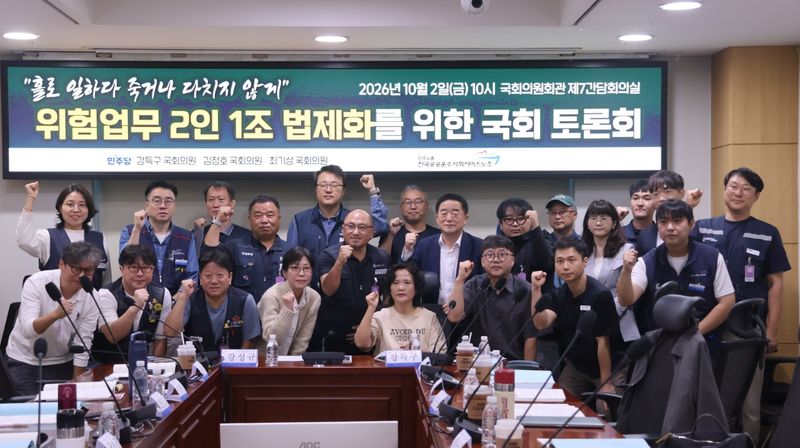
The KPTU and Democratic Party of Korea lawmakers Kang Deuk-gu, Kim Jeong-ho and Choi Ki-sang held a forum titled "Legislating Mandatory Two-Person Teams for Hazardous Work" on the second at Meeting Room 7 of the National Assembly Members' Office Building in Yeouido, Seoul.
According to an analysis of industrial accident statistics presented by Kwak Yi-kyong, head of the Korean Confederation of Trade Unions' (KCTU) Occupational Safety and Health Bureau, 3,884 people, or 55.6%, of the 6,991 people killed in accidents investigated by labor inspectors between 2015 and 2024 died while working alone.
Kwak explained, "The purpose of a two-person team is to ensure that workers performing hazardous tasks are not isolated and that one person can respond quickly when the other is in danger. The conditions needed to actually monitor and respond to a colleague, including securing the work location and line of sight and providing communication tools, must also be specified in detail."
Kwak also emphasized that staffing standards would be difficult to follow in the field unless subcontractors' costs for securing safety personnel were reflected in the bid and winning-bid amounts. "The primary contractor must separately guarantee the necessary costs and check whether the personnel have actually been assigned," Kwak said.
Han In-im, director of the I-eum Policy Research Institute, proposed separately assigning workers who perform the tasks and personnel who monitor hazards. "The monitor's role is to watch for surrounding hazards and respond to accidents while workers perform dangerous duties," Han said. "If two people must work together, staffing should be calculated according to the characteristics of the work, such as by assigning one additional monitor." Han added, "In the case of public institutions, the government must provide budgetary support so that the safety personnel agreed upon by labor and management are actually assigned."
Jung Moon-sung, head of the Public Relations and Organization Department of the KPTU's Seohae Line Branch, introduced a case from the second of last month in which a station worker was assaulted by an intoxicated passenger while responding to a dispute between passengers at Siheung City Hall station. "At the time, there were only 12 workers across 12 stations, so sending support personnel from another station inevitably left that station unmanned," Jung said. "Even though the victim complained of psychological distress, the worker could not take time off and had to remain alone at the station." Of the 18 cases of verbal abuse and assault against station workers identified by the Seohae Line Branch from January last year through September this year, 16, or 88.9%, occurred while they were working alone.
Lee Tae-sung, head of the Korea Electric Power Industrial Development Power Generation Branch of the KPTU, pointed out that staffing for two-person teams operating conveyor equipment was increased following the death of the late worker Kim Yong-gyun, but that some subcontractors are reducing staffing again by adjusting contract amounts and workloads.
Son Jin-woo, director of the Korea Institute of Labor Safety and Health (KILSH), said it was necessary to examine whether the results of risk assessments actually lead to securing safety personnel and allocating budgets. He noted, "Mandating two-person teams by law and conducting risk assessments are not contradictory. The law should establish minimum obligations, while risk assessments should be used as a basis for designing additional measures suited to the characteristics of each workplace."
Park Yoon-kyung, director of the Occupational Safety Standards Division at the Ministry of Employment and Labor, who attended as the government representative, took a cautious stance toward broadly mandating two-person teams for hazardous work through the Occupational Safety and Health Act.
Park explained that the current system includes rules requiring the placement of monitors, signalers and guides, and that standards requiring at least two workers are already in place for some tasks, including diving operations. Regarding expanding the scope of mandatory two-person work, Park said, "It is extremely difficult to define the scope of hazardous work in detail. Even within the same workplace, setting by law exactly which work units should be considered hazardous could make the system too rigid."
Park also noted that laws and systems had been improved to enhance the effectiveness of risk assessments and strengthen worker participation and the right to stop work. The official further proposed supplementary measures through separate laws governing the waste, gas and railway sectors.
[email protected] Park Seong-hyeon Reporter