"Amid Middle East instability"... Korea Customs Service expands administrative support to diversify crude oil import sources
- Input
- 2026-10-02 13:31:42
- Updated
- 2026-10-02 13:31:42
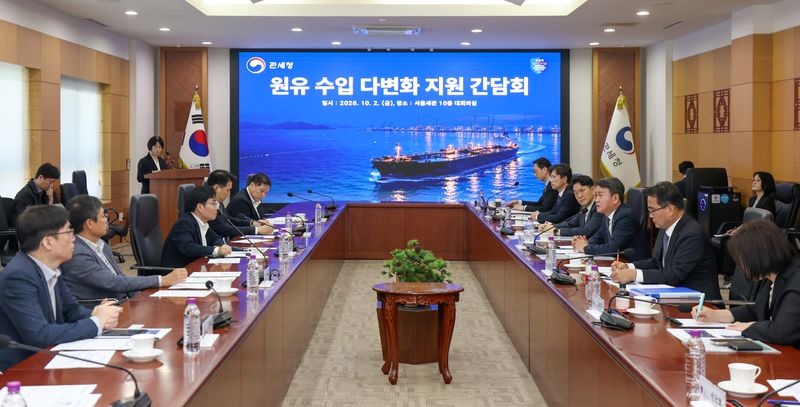
The Korea Customs Service held a meeting on support for diversifying crude oil imports at Seoul Main Customs on the 2nd. Representatives of five domestic refining and petrochemical companies—GS Caltex, HD Hyundai Oilbank, SK Energy, S-Oil and Hanwha TotalEnergies Petrochemical—as well as Korea National Oil Corporation (KNOC) and the Korea Petroleum Association attended.
The meeting was organized to review the support policies for diversifying crude oil imports that have been pursued in response to instability in the Middle East, hear difficulties and requests from the industry, and explore effective additional support measures.
Earlier, as concerns grew over disruptions to imports of crude oil from the Middle East due to instability in the region, the Korea Customs Service activated the "Response System for Stabilizing the Supply of Economic Security Items and Supporting Diversification" in April. Through the system, it has been providing active tax-administration support to domestic refining and petrochemical companies, including extensions of deadlines for import tax payments, installment payments and export refunds for import taxes such as customs duties and value-added tax.
In particular, since May, the Korea Customs Service has introduced and implemented a "special freight-cost measure" under which increases in freight and insurance costs resulting from crude oil imports from the Middle East are excluded from the customs value when certain requirements are met. Applied retroactively to import declarations filed since March, the measure has so far covered 100 cases and reduced the burden of freight and insurance costs by a total of 60.2 billion won, helping minimize losses in the importing industry. The Korea Customs Service plans to continue providing multifaceted administrative support to reduce the country's high dependence on the Middle East and promote diversification of import sources toward non-Middle Eastern regions such as the Americas and Africa.
Meanwhile, the domestic refining industry's dependence on crude oil from the Middle East has remained high at around 70% for many years. As a result, the possibility of a blockade of the Strait of Hormuz or a sharp surge in logistics costs from the Middle East has posed a direct threat to South Korea's energy security and price stability. Refiners have also continued efforts to broaden their crude oil sources to the Americas—the United States and Brazil—and Africa. However, higher logistics costs resulting from longer transport distances and the burden of modifying refining facilities to handle different crude oil grades have been cited as obstacles to switching import sources.
[email protected] Kim Won-jun Reporter