Office worker in their 60s asks, “Can we register the inheritance first and divide it again later?” [Tax and Financial Planning Q&A]
- Input
- 2026-10-10 08:00:00
- Updated
- 2026-10-10 08:00:00
[Financial News] Q. A, a Seoul resident in their 60s, has been wondering how to divide the inherited estate after recently mourning their father. The father left an apartment worth 1.5 billion won at market value and financial assets worth 500 million won. The heirs are A’s mother and two children, including A.
Rather than hold lengthy, complicated discussions right away, the family suggested first completing the inheritance registration for the apartment in the mother’s name, then dividing the shares again once the process was complete, depending on the family’s circumstances. But A was worried that transferring the title again later might lead to unexpected tax issues and sought tax advice.
A. According to BDO SungHyun Accounting Corporation, inherited assets can be divided relatively freely at the initial stage, but once they have been confirmed as each heir’s property, transferring them again may be considered a gift. That is why the method of division should be decided with future ownership and plans for disposing of the assets in mind, rather than rushing to register them.
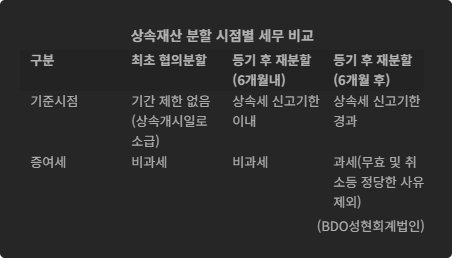
Inherited assets do not have to be divided according to the statutory shares set out in the Civil Act. The heirs may agree freely on how to divide them—for example, with the spouse taking sole ownership of real estate and the children dividing the financial assets. In the heirs’ initial agreement on the division, no gift tax is incurred even if one heir receives more than their statutory share.
The same applies if A’s family agrees that the mother will inherit the apartment, worth 1.5 billion won, on her own while the children divide the financial assets. An agreement among co-heirs is the process by which each heir’s inheritance is first determined, and its legal effect is retroactive to the date the inheritance commenced—the date of the deceased’s death.
Therefore, at the initial division stage, it is advisable to decide how to divide the estate by considering the overall circumstances, including who will continue to hold each asset, whether there are plans to sell it in the near term, and what homes each heir already owns, rather than being bound by statutory inheritance shares.
The issue arises when assets are divided again after each heir’s share has been confirmed through registration or a change of title. For example, if the mother first registers the apartment as her sole inheritance and then transfers half of it to a child, the portion the child acquires in excess of their original inheritance share is, in principle, treated as a gift from the mother. This is because an asset already established as the mother’s property is considered to have been transferred to the child again without payment.
However, the Inheritance Tax and Gift Tax Act provides an exception under which a redivision made by the deadline for filing the inheritance tax return is not treated as a gift. In the typical case where the deceased was a resident of Korea, the deadline is within six months from the end of the month in which the inheritance commenced. Even if the inheritance has already been registered once, no gift tax is imposed if it is divided again within this period.
If there is a legally recognized reason, such as the original division of the inherited estate being invalid or rescinded, a later redivision is not treated as a gift even after the filing deadline. By contrast, if the deadline has passed and the family simply agrees to transfer inherited assets whose ownership has already been finalized, without such a reason, they may have to pay gift tax and penalties.
Ultimately, if A’s family first registers the apartment in the mother’s name and then wants to redistribute the shares, it is important not to miss the inheritance tax filing deadline. After the deadline, even a simple redivision by family agreement may be considered a new gift.
When concentrating an inheritance in the hands of a spouse, the spousal inheritance deduction and the second inheritance should also be considered. The spousal inheritance deduction, available up to a maximum of 3 billion won, can help reduce the tax burden on the first inheritance. However, if the spouse later transfers inherited assets to the children without payment, gift tax may apply; when the spouse dies, those assets are included in the estate again.
If the inherited assets are added to the spouse’s existing separate property, the estate may also be subject to higher progressive tax rates upon the second inheritance. In other words, leaving all the assets to the spouse is not always advantageous.
However, if assets inherited in the first inheritance are inherited again within 10 years, the “short-term successive inheritance tax credit” may be available to ease the burden of double taxation on the same assets over a short period. The credit is based on the amount of tax attributable to the first inheritance: 100% is credited if the second inheritance occurs within one year, with the credit rate decreasing by 10 percentage points each subsequent year.
The division ratio should therefore be determined after considering the value of the spouse’s existing assets, the future value of the inherited estate, and the expected timing of the second inheritance. Focusing only on the initial inheritance tax burden and concentrating the assets in the spouse’s hands could lead to a greater tax burden later through gifts or the second inheritance.
Jeong Seong-gyeong, a managing director at BDO SungHyun Accounting Corporation, advised, “When dividing an inherited estate, it is important to consider not only reducing the initial tax burden but also the assets’ ultimate ownership structure,” adding, “To avoid additional tax burdens from a subsequent redivision, the decision should take into account each heir’s assets and plans for disposing of them, as well as the spouse’s second inheritance.”
[email protected] Lee Jeong-hwa Reporter