[Editorial] A surcharge equivalent to 5% of operating profit for repeated industrial accidents is excessive, layered pressure on businesses
- Input
- 2026-10-02 15:24:56
- Updated
- 2026-10-02 15:24:56
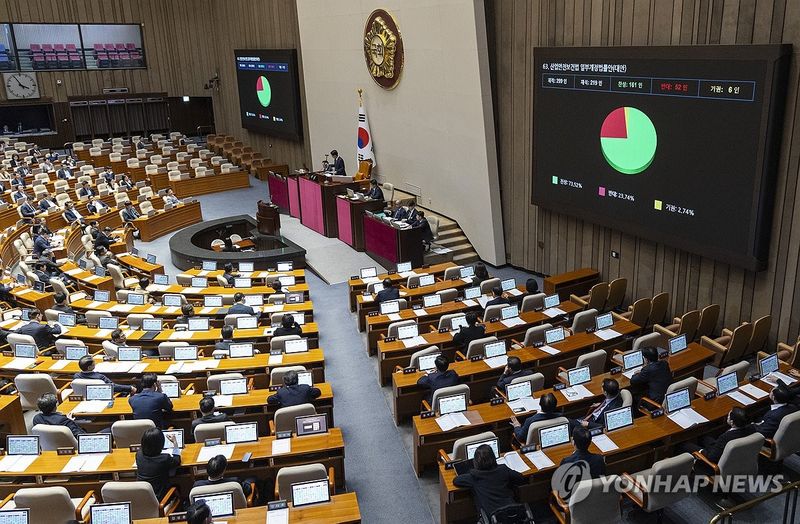
[Financial News] The pressure on companies embroiled in controversy over occupational accidents is becoming increasingly excessive. The National Assembly of the Republic of Korea passed an amendment to the Occupational Safety and Health Act yesterday that imposes a surcharge of up to 5% of operating profit if three or more workers die in occupational accidents within a recent one-year period. With the amendment to the Occupational Safety and Health Act following the implementation of the Serious Accidents Punishment Act, companies face concerns over a double and triple burden.
First, the weight of the surcharge system must be considered. Although the ceiling is set at 5% of operating profit, the amount could reach astronomical levels for some companies. For small and midsize businesses, in particular, it could determine whether they remain viable. A surcharge imposed over a single accident could also lead to financial pressure and a chain of insolvencies.
Relaxing the requirements for work stoppages could also result in excessive interference with management rights. The amendment allows workers and others to demand that an employer halt work when there is "urgent danger or concern," and requires the employer to comply unless there is a special reason not to do so. It also broadens the group of people entitled to exercise the right to stop work. Yet the term "concern" is vague, allowing the standard to be stretched or narrowed arbitrarily. Does anyone recognize that such ambiguous provisions can become the spark for disagreements and disputes between labor and management?
Taken as a whole, the contents of this law leave no choice but to characterize it as excessive pressure on businesses. That is why it has been called the "Second Yellow Envelope Act." Let us review the circumstances surrounding the passage of the Yellow Envelope Act. At the time, the law sparked intense debate over the harm and confusion it could cause after taking effect. The South Korean government and the ruling party believed that workplace disruption would not be significant even if the bill passed. However, once the law took effect, disputes continued over the scope of liability and the parties subject to collective bargaining, while uncertainty actually grew. We have already experienced, through the Yellow Envelope Act, the confusion that can arise when ambiguous provisions are passed and implemented first. Yet the same mistake is being repeated.
At this point, it is understandable that companies' regulatory fatigue has reached an extreme level. The fully revised Occupational Safety and Health Act, in effect since 2020, significantly strengthened administrative sanctions, and the Serious Accidents Punishment Act, which punishes management officials when accidents occur, is also in force. Now, the partial amendment to the Occupational Safety and Health Act is set to impose yet another economic sanction in the form of a surcharge. The structure applies administrative sanctions, criminal punishment, and economic sanctions in layers for the same accident.
It has already been confirmed that imposing two or three layers of post-accident punishment does not reduce occupational accidents as much as expected. The fact that preventable accidents continue to occur even after the Serious Accidents Punishment Act took effect demonstrates the limitations of an approach centered on punishment.
The law has already passed. The only task left is to minimize the side effects of its implementation. The South Korean government should carefully prepare subordinate legislation and detailed implementation guidelines. It should clearly define who is subject to the surcharge, how it will be calculated, and what grounds may justify reductions, thereby increasing predictability. Furthermore, the South Korean government and the National Assembly of the Republic of Korea should listen closely to voices from the field during implementation and pursue supplementary legislation if necessary.