'Don't miss the latest information even when data changes': AI technology developed
- Input
- 2026-10-05 12:00:00
- Updated
- 2026-10-05 12:00:00
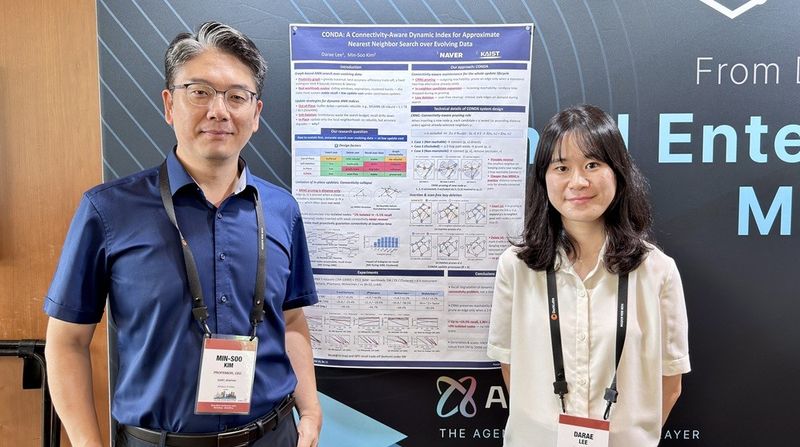
[Financial News] What if an in-house artificial intelligence (AI) were to search for old regulations and provide an answer even though a new document had been uploaded because the company regulations had changed? Researchers at the Korea Advanced Institute of Science and Technology (KAIST) have developed a technology that enables AI to find the latest information more accurately and quickly by maintaining a "search path" to necessary information even as data continues to change.
KAIST announced on the 5th that a research team led by Professor Kim, Min-Soo of the Department of Computer Science had developed CONDA (Connectivity-Aware Dynamic Index), a dynamic vector search technology that stably maintains high search accuracy even in environments where data is continuously added and deleted.
According to the research team, generative AI cannot independently recognize newly emerging information after training is complete. To compensate for this, Retrieval-Augmented Generation (RAG) technology is widely used to search the latest news or internal corporate documents and use them in answers. For RAG to function properly, search technology capable of quickly and accurately locating the information needed to answer a question among vast amounts of data is crucial.
CONDA, developed by the research team, considers not only the distance between data but also whether search paths are properly connected so that necessary information can be reached. It prevents specific information from becoming isolated within the search network by maintaining important connections even when new data is added or existing data is deleted.
Experimental results showed that CONDA increased search accuracy by up to 24.5% compared with existing state-of-the-art technology and improved data processing speed by up to 1.90 times, even in environments where data is constantly added and deleted.
In particular, the research team simultaneously performed searches and data updates for six hours in a large-scale environment containing 100 million data points. As a result, CONDA maintained the shortest response time and high search accuracy compared with competing technologies, confirming its potential for application in large-scale AI services.
This technology can be used not only in knowledge-search systems where information changes frequently, such as systems for searching internal corporate regulations or business documents, but also in various AI services where data is constantly changing, including the search and recommendation of the latest news and products. In particular, it is expected to serve as foundational technology for reliably searching the latest information over extended periods in RAG environments, where generative AI finds external information and uses it in answers.
The results of this research are also being applied to an actual product. CONDA technology has been applied to AkasicDB, a database product from GraphAl, an artificial intelligence data infrastructure company founded by Professor Kim, Min-Soo, and is scheduled for commercialization in the fourth quarter of this year.
"The important value of Retrieval-Augmented Generation (RAG) is that large language models (LLMs) can immediately find and use the latest information they have not yet learned when needed," said Professor Kim, Min-Soo. "This research is highly significant because it presents data infrastructure that enables AI to accurately use the latest knowledge over an extended period, even in real-world environments where data is constantly changing."
The results of this study were presented on September 2 at the International Conference on Very Large Data Bases (VLDB) 2026, the most prestigious international academic conference in the database field.
[email protected] Yeon Ji-an Reporter