20-Something Civil Servant: "I Earn 2.5 Million Won a Month. How Should I Split It Between Savings and Investments?" [Personal Finance Q&A]
- Input
- 2026-10-03 08:00:00
- Updated
- 2026-10-03 08:00:00

Q. A is a 25-year-old civil servant who has been employed for four months and is preparing to begin saving and investing in earnest. A's monthly salary is approximately 2.5 million won. Because commuting by public transportation is inconvenient, A uses a family vehicle and spends about 700,000 won per month on allowances, fuel, mobile phone bills and insurance premiums.
A currently sets aside 300,000 won each month for installment savings and another 300,000 won for an emergency fund. A plans to put the remaining funds into additional installment savings, an Individual Savings Account (ISA) and pension savings. People around A say the investment portion should be increased relative to savings, but A is concerned about losing the principal. A is also unsure which to use first, the ISA or pension savings.
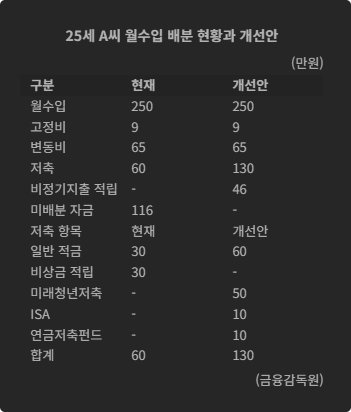
A's monthly income is 2.5 million won. Fixed expenses include 90,000 won in insurance premiums. Variable expenses total 650,000 won, including 300,000 won for allowances and household necessities, 60,000 won for mobile phone bills, 20,000 won for online video streaming services (OTT), 70,000 won for exercise and 200,000 won for fuel. A saves a total of 600,000 won, putting 300,000 won each into installment savings and an emergency fund. The remaining 1.16 million won has not been assigned to any specific use.
A's assets consist of 5 million won in a checking account, 3 million won in a housing subscription savings account funded by A's parents and 1.2 million won in installment savings, for a total of 9.2 million won. A has not determined the amount of annual irregular expenses.
A. According to the Financial Supervisory Service, young employees like A, who have just begun earning a stable income, should first review their spending and establish a budget before choosing financial products. If they increase their savings without accounting for irregular expenses, they may have to terminate their savings plan or fail to accumulate the desired lump sum when unexpected expenses arise.
The Financial Supervisory Service recommended that A set an annual irregular-expense budget of 5.5 million won, including 500,000 won for family celebrations and condolence gifts, 1.2 million won for vacations and travel, 2.4 million won for clothing and grooming, 200,000 won for self-development, 1 million won for celebrations and condolence gifts for acquaintances and 200,000 won for vehicle maintenance. This would involve setting aside approximately 460,000 won separately each month.
Expenses should be managed by dividing them among separate bank accounts. The salary account should be used for automatic payments such as installment savings, pension savings, the ISA and insurance premiums. Each month, 300,000 won should be transferred to a living-expenses account, from which weekly spending can be made using a linked debit card. The irregular-expenses account should receive 460,000 won each month and be used for related expenses such as family events and travel.
Investing is also necessary, but it is not advisable to assign an excessively large portion of funds to investments from the outset. With little investment experience, investing too aggressively may lead someone to terminate a financial product or stop investing after incurring losses. Investments should begin with surplus funds after defining the purpose of the investment, the target return and when the money will be needed.
Novice investors can use a systematic investment plan that involves contributing a fixed amount each month. This approach buys more units when prices are low and fewer when prices are high, lowering the average purchase price. Rather than seeking short-term profits, investors should build experience with small amounts and realize gains after reaching their target return or when the funds are needed.
An ISA and a pension savings fund serve different purposes. An ISA can combine savings products and investment products while providing tax-exempt and separate-taxation benefits, making it suitable for accumulating funds needed for a purpose five or more years away. A pension savings fund provides year-end tax credits while helping prepare retirement funds to be used after age 55.
Although it is necessary to prepare for retirement from the beginning of one's career, allocating too much to pension savings can make it difficult to build funds for other life stages, such as marriage and home purchases. Savings should be allocated according to clearly separated objectives: medium-term asset growth and long-term retirement planning.
The Financial Supervisory Service proposed that A save 1.3 million won per month. The amount would be divided into 600,000 won for regular installment savings, 500,000 won for Future Youth Savings, 100,000 won for an ISA and 100,000 won for a pension savings fund. The 300,000 won currently being set aside as an emergency fund would be redirected to installment savings, while the 5 million won in the checking account would be used as an emergency reserve.
Saving 1.3 million won a month for one year would produce 15.6 million won. Adding 5 million won in annual irregular income and saving it all would allow A to accumulate approximately 20 million won in one year, with a three-year goal of saving a total of 60 million won. Funds to be used within two to five years should primarily be placed in savings and deposit products with low risk of principal fluctuations. The proposal calls for starting ISA investments at 100,000 won per month, increasing the amount after gaining experience, and contributing to a pension savings fund only after clearly defining its purpose as retirement money.
A Financial Supervisory Service official advised, "For young employees who have just entered the workforce, identifying monthly and irregular expenses and setting savings goals should come before choosing financial products. They need to establish sound spending-management habits while they can receive support from their parents and make the most of their capacity to save."
Free, personalized financial counseling is available by searching for the Financial Supervisory Service's FINE portal online or calling the Financial Supervisory Service Call Center 1332 (▶ press 7 for financial advisory services).
[email protected] Lee Jeong-hwa Reporter