Nara Space Succeeds in Two-Way Communication with GYEONGGISat-2A, South Korea's First Methane-Observing Satellite
- Input
- 2026-10-02 10:16:42
- Updated
- 2026-10-02 10:16:42
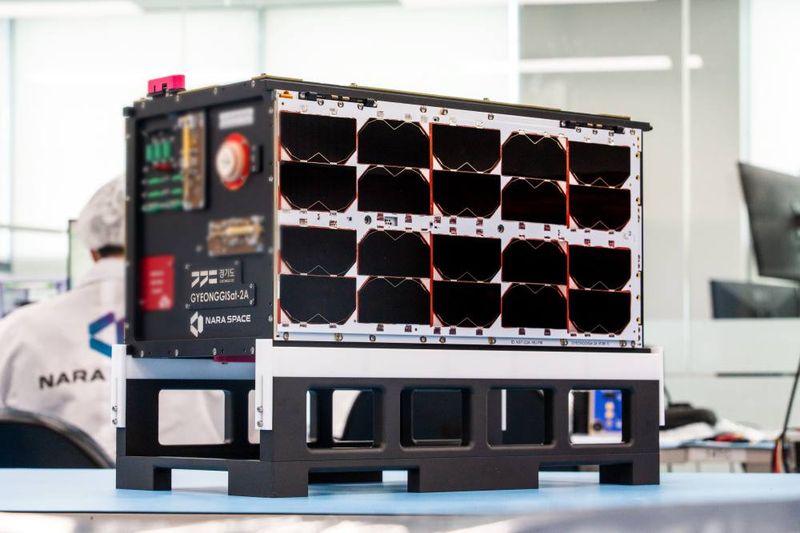
[Financial News] Nara Space Technology announced on the 2nd that GyeonggiSat-2A (GYEONGGISat-2A), South Korea's first methane-observing satellite, successfully established two-way communication with a ground station after launch.
GyeonggiSat-2A was launched at 3:32 a.m. on the 2nd, aboard a SpaceX Falcon 9 rocket from Vandenberg Space Force Base in California, the United States. The satellite separated normally from the rocket in orbit about 55 minutes after launch and subsequently completed two-way communication with the satellite control center at Nara Space's headquarters. It is currently undergoing basic status checks and initial operational procedures.
GyeonggiSat-2A is South Korea's first small satellite developed for methane observation and the fourth methane-observing small satellite in the world, following those developed by Canada, Spain and France. Equipped with a hyperspectral sensor specialized for methane observation, it separates light reflected from Earth's surface into detailed wavelength bands and detects emission sources based on methane's characteristic absorption of light at specific wavelengths.
During the initial operations period, Nara Space plans to check the condition of the satellite body and payload and carry out verification and calibration in stages. Once the initial operational procedures are complete, the satellite will transition to normal operations and begin its full-scale methane observation mission.
The observation data collected through GyeonggiSat-2A will be used to identify methane-emitting regions and source locations and to analyze emission volumes. The goal is to provide foundational data needed to assess methane emissions and formulate climate and environmental policies.
GyeonggiSat-2A is the methane-observing satellite of the Gyeonggi Climate Satellite project, which is being jointly pursued by Gyeonggi Province, Nara Space and the Climate Research Laboratory at Seoul National University. The Gyeonggi Climate Satellite project consists of three satellites: one optical satellite, GyeonggiSat-1, and two hyperspectral satellites, GyeonggiSat-2A and GyeonggiSat-2B. GyeonggiSat-1 was launched last November and is currently carrying out an Earth observation mission, while GyeonggiSat-2A and GyeonggiSat-2B observe methane-emitting regions and sources using hyperspectral sensors. Through this effort, the project aims to gradually establish a climate and environmental monitoring system that combines optical imagery with methane emission-source data.
Jung Soo-jong, a professor at Seoul National University's Climate Research Laboratory, emphasized the significance of the launch, saying, "Greenhouse gas monitoring is evolving from a means of providing scientific evidence for responding to climate change into critical infrastructure for energy security, helping governments, companies and local authorities understand their energy conditions." He added, "South Korea's first greenhouse gas satellite will play a very important role in the country's energy security."
Park Jae-pil, CEO of Nara Space, said, "The successful placement of GyeonggiSat-2A into orbit is significant because it marks South Korea's first effort to conduct objective methane measurements using a small satellite." He added, "As satellite-based global methane emissions data have high value and scarcity in terms of the carbon credit market and energy security, we will contribute to establishing space data sovereignty and leading the environmental data market through GyeonggiSat and our proprietary methane-observing satellite constellation, NarSha, for which we are preparing future launches."
[email protected] Yeon Ji-an Reporter