Yun Ho-jung: "Even if investigations and prosecutions are separated, responsibility to the public must not be divided" [Serious Crime Investigation Agency Launch]
- Input
- 2026-10-02 10:28:52
- Updated
- 2026-10-02 10:28:52
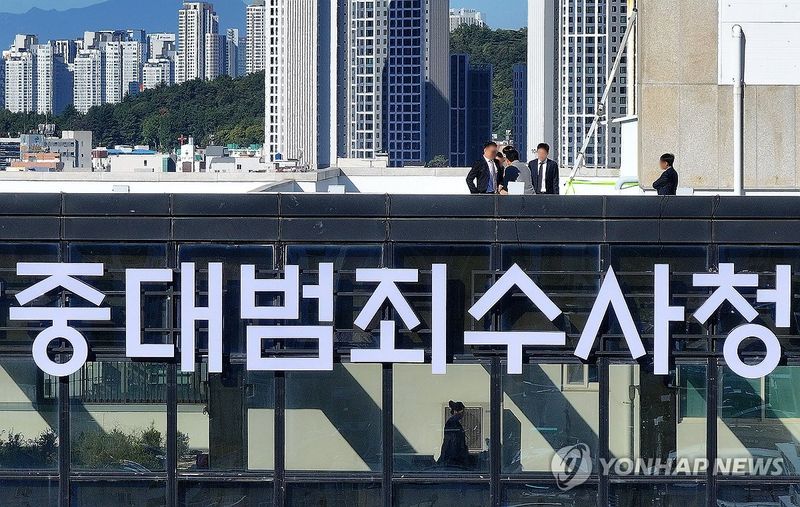
[Financial News] Yun Ho-jung, minister of the Ministry of the Interior and Safety (MOIS), said on the 2nd that, regarding the launch of the Serious Crime Investigation Agency, "Even if investigations and prosecutions are separated, responsibility to the public must not be divided." He called for seamless coordination among criminal justice institutions, including the Korean National Police Agency and the Public Prosecution Office. Under the Lee Jae-myung administration's prosecution reform, the Supreme Prosecutors' Office of the Republic of Korea (SPO), which had exercised investigative and prosecutorial powers together, closed its doors after 78 years. The Public Prosecution Office and the Serious Crime Investigation Agency were launched separately that day, shifting South Korea's criminal justice system to one in which investigations and prosecutions are divided among institutions.
In a congratulatory speech at the agency's opening ceremony, Yun said, "The launch of the Serious Crime Investigation Agency is not the end of reform." He added, "Changing the system does not automatically complete reform." Yun continued, "Each institution must faithfully perform its own role while building a seamless coordination system so that no gaps arise from the beginning to the conclusion of a case."
Yun described the launch of the Serious Crime Investigation Agency as "a major transformation of the criminal justice system that has continued for the past 78 years." He said, "Just two years ago, we painfully experienced how vulnerable the democracy we had cherished and nurtured could become in the face of attacks by extremist forces during the insurrection crisis." He added, "The people's demands also contained a stern order to properly reform the criminal justice system."
He also emphasized that the government had adopted "completing prosecution reform through the separation of investigations and prosecutions" as a national policy task upon taking office. The aim, he explained, is to divide investigative and prosecutorial powers that had been concentrated in a single institution, ensuring that the state's powerful investigative authority is exercised in a way that protects the people's fundamental and human rights.
Regarding the role of the Serious Crime Investigation Agency, Yun said, "It has a duty to rigorously investigate serious crimes that threaten democracy and a fair free-market order." He added that it "must also faithfully carry out the mission of protecting the human rights of socially vulnerable people." He continued, "The agency's mission is to deal with crimes committed by the most powerful people in our society while protecting the rights of those with the least power." He urged the agency to "conduct investigations without being swayed by any power or status, and solely according to the law and principles."
Under the amended Criminal Procedure Act, Public Prosecution Office Act, and Serious Crime Investigation Agency Act, the functions of the former SPO are being divided among several institutions from this day forward. The Public Prosecution Office will decide whether to indict cases referred by investigative agencies and will handle maintaining prosecutions and requesting warrants. It cannot conduct direct investigations or launch supplementary investigations even when it determines that an investigation by the police or the Serious Crime Investigation Agency is insufficient, although it may request supplementary investigations.
Investigations are divided among the police, the Serious Crime Investigation Agency, and the Corruption Investigation Office for High-ranking Officials (CIO). The police will handle most general cases, while special judicial police officers will be responsible for certain specialized fields. The Serious Crime Investigation Agency will be exclusively responsible for seven major crimes: corruption, economic crimes, defense procurement, drugs, national security crimes such as insurrection and external aggression, cybercrime, and the crime of distorting the law. MOIS has also established dedicated organizations at its headquarters and regional offices to handle supplementary investigations into crimes against socially vulnerable people.
In cases in which high-ranking public officials covered by the CIO Act—including judges, prosecutors, and senior police officials—are suspects, the CIO will conduct investigations within the scope prescribed by law and handle indictments in some cases.
The changes will also be significant for the public. Until now, complaints and accusations could be filed not only at police stations but also at prosecutors' offices. From this day forward, however, they must be filed with the police or the Serious Crime Investigation Agency. Because the Public Prosecution Office is not an investigative agency, it will not receive complaints or accusations for independent investigation.
The new system did not launch at full capacity on its first day. The Serious Crime Investigation Agency began operations with 1,900 personnel, or 66.1% of its authorized total of 2,874 positions. It will operate through its headquarters and six regional offices, while the government plans to recruit additional personnel, including experienced outside specialists. Seven Level 1 investigators, including the agency's deputy head and the heads of its six regional offices, were also designated just before the launch.
The transfer of cases previously investigated by the SPO to the new investigative agencies is another challenge. As of August, the SPO had approximately 165,000 pending cases. The Public Prosecution Office must handle cases that were already under investigation for a certain period before transferring them to the police or the Serious Crime Investigation Agency. Legal circles have also raised concerns that case processing could be delayed if transfers and supplementary investigations do not function properly as investigative bodies are divided among the police, the Serious Crime Investigation Agency, and the CIO.
Yun's repeated emphasis on coordination among institutions in his speech that day is understood to reflect these concerns. He said, "All criminal justice institutions, including the Korean National Police Agency and the Public Prosecution Office as well as the Serious Crime Investigation Agency, must cooperate closely with one another." He added, "It is important for the new system to operate as originally intended and bring about tangible changes in people's lives."
Yun said, "As minister of the interior and safety, I have been involved in everything from recommending the first head of the Serious Crime Investigation Agency to designing its organization and system, and have joined in today's launch." He added, "I will fulfill my responsibility to ensure that the Serious Crime Investigation Agency takes firm root with the people's trust."
The selection process for the first head of the Serious Crime Investigation Agency also resumed that day. President Lee Jae Myung approved a request for a confirmation hearing for Kim Ji-yong, the nominee to head the agency, on the 1st, Kang Yoo-jung, a senior presidential spokesperson, said on the 2nd. More than 20 days after Yun recommended Kim for appointment on the 7th of last month, the nominee entered the National Assembly's confirmation hearing process.
Yun said, "Let us join forces so that every member of the public can directly feel that the changes we are beginning today are intended to provide stronger protection for people's fundamental and human rights."
[email protected] Lee Bo-mi Reporter