"I Quit After Monthly Dividends Hit 5 Million Won"... The 'Portfolio' of a 40-Something Office Worker Who Turned 100 Million Won into 500 Million Won
- Input
- 2026-10-02 10:45:45
- Updated
- 2026-10-02 10:45:45
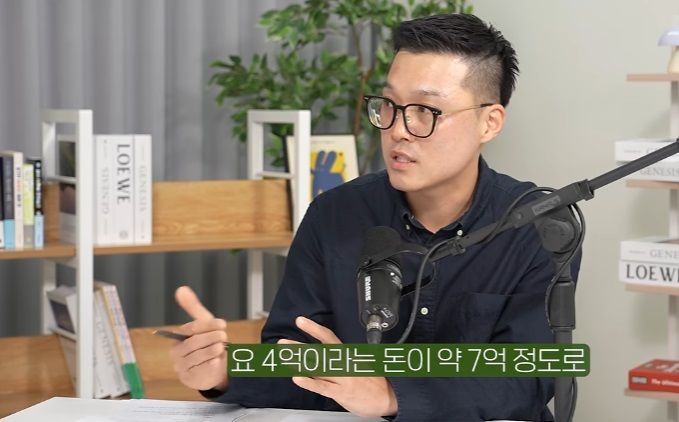
[Financial News] The asset-building strategy of a full-time dividend investor in his 40s, who quit his job after establishing monthly cash flow of 5 million won in dividends, is drawing attention in the personal finance market.
"I couldn't sleep and was stressed after investing in U.S. stocks, so I made a complete switch to dividend stocks"
According to Newsis on the 2nd, full-time investor 'Deputy General Manager Park,' who recently appeared on the YouTube channel 'Money Inside,' said he decided to quit after his dividend income surpassed his salary. He had spent 15 years combining office work with self-employment, including in the food-service franchise industry. He now continues investing full time while working part time three days a week, supported by stable cash flow.
His investment journey began with Samsung Electronics at the end of 2019. He later turned to the U.S. market to avoid the high external volatility of the Korean stock market and made substantial profits by purchasing shares of big-data company Palantir Technologies (PLTR) in installments starting in 2021. However, the overnight monitoring required around each earnings announcement and the extreme psychological stress led him to liquidate his entire position at the end of 2024 and make a decisive switch to dividend stocks.
Investing in high-dividend covered-call products and reinvesting distributions in index-tracking ETFs
Notably, instead of the Schwab U.S. Dividend Equity ETF (SCHD), a leading dividend ETF among Korean retail investors in U.S. stocks, he chose an ultra-high-dividend covered-call ETF as his first investment.
Deputy General Manager Park said, "SCHD's annual dividend yield is only in the 3% to 4% range, making it difficult to create meaningful cash flow with seed capital of around 100 million won. Unless you have assets worth several hundred million won or more, SCHD is inefficient for small investors. With that amount of money, investing in an index ETF would grow your assets faster."
Rather than using the high distributions from ultra-high-dividend covered-call products purchased with just over 100 million won in principal for living expenses, he reinvested all of them in ETFs tracking major U.S. indexes such as the S&P 500, as well as leveraged index products. Through this strategy, he more than tripled his principal in roughly a year.
Covered calls carry the risk of principal loss... Diversifying into index-tracking products
He also offered a realistic approach to the risk of principal loss, which is considered a drawback of covered calls. He explained, "Ultra-high-dividend products are structurally likely to erode principal—essentially eating into one's own principal—but if investors clearly understand their nature and immediately reinvest the distributions in index-based assets, using them as a 'funding lever,' these products can serve as a useful stepping stone for salaried workers investing small amounts. However, investors who already have ample cash flow have no need to take on that risk; the best choice is to invest for the long term in index-tracking products."
His current portfolio consists of 70% dividend stocks and 30% index-tracking products. More specifically, he maintains a 40% allocation to Korea-listed U.S. index covered-call ETFs and a 30% to 40% allocation to U.S.-listed high-dividend and covered-call ETFs. He has sharply reduced the share of ultra-high-dividend products, for which he has already recovered his principal, to around 11%. With total assets exceeding the mid-400-million-won range and now on a stable trajectory, he plans to sell off his ultra-high-dividend stocks and shift his assets into dividend-growth stocks such as SCHD.
"It is difficult to feel the effects of compounding with monthly contributions of just 100,000 won"—a pointed piece of advice
Emphasizing that the power of compounding becomes more pronounced as assets grow, Deputy General Manager Park offered small investors some pointed advice. He said, "The value of my assets, which was around 400 million won at the beginning of this year, grew to between 450 million and 460 million won in just six months. It is nearly impossible for an office worker to save 60 million won in six months, but once the principal base becomes larger, compounding makes it possible."
He added, "It is difficult to experience a meaningful compounding effect through small monthly contributions of around 100,000 won. In the early stages, investors need to quickly build a powerful cash-flow stream, even through an aggressive strategy, and continue investing with the funds generated by that pipeline in order to narrow the wealth gap."
[email protected] Moon Young-jin Reporter