One Year After the National Information Resources Service Fire... "Information Systems to Be Restored Within One Hour of a Disaster; Critical Systems to Operate Redundantly"
- Input
- 2026-10-02 09:56:17
- Updated
- 2026-10-02 09:56:17
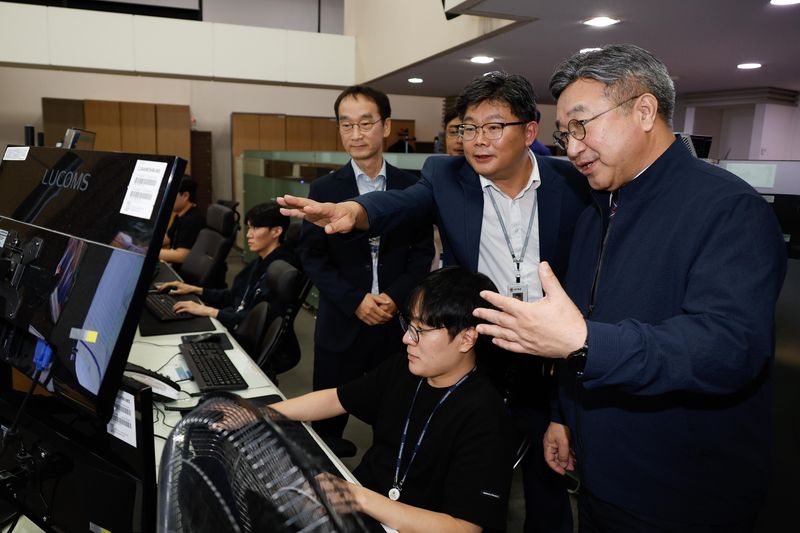
[Financial News] The government is overhauling the national information system operating framework so that core administrative services, including resident registration, can be restored within one hour even if a data center is shut down by a fire or other disaster. It will reclassify more than 15,000 public information systems based on their impact on people's daily lives and establish redundant systems with the same functions at other data centers for critical services.
Hwang Gyu-cheol, head of the AI Government Office at the Ministry of the Interior and Safety, held a briefing at the Seoul Government Complex on the 2nd and announced a plan to strengthen information system stability. The plan follows a fire at the National Information Resources Service in September last year that caused major administrative services to be suspended simultaneously.
The government has first changed the criteria for grading information systems. Previously, the number of users was the main criterion, but going forward, priority will be given to how severely a service interruption would affect people's daily lives. Under the revised criteria, more than 15,000 public information systems had been reclassified into grades A1 through A4 by August.
The target recovery time for the most critical A1 systems is within one hour. The targets are three to 12 hours for A2, one to five days for A3, and within three weeks for A4.
A1 systems must have backup systems with the same functions as the primary systems at other data centers. This structure allows services to continue at another center even if one center is shut down by a fire or other disaster.
Hwang said, "To prevent service interruptions and data loss during disasters, we have made it mandatory to establish and conduct drills for disaster recovery systems by grade, as well as to back up and store data off-site."
The disaster recovery framework will be established in stages. Storage-based disaster recovery systems that replicate and store data at another location will be installed by 2027 for A1 through A3 systems operated by the National Information Resources Service.
A dual-operation system capable of immediately taking over actual services will take longer to establish. It will be implemented for A1 and A2 systems at the Daejeon Center by 2028, and for A1 and A2 systems at the Gwangju and Daegu centers by 2030.
Thirteen critical systems at the Daejeon Center—including Safety Didimdol, dBrain, Postal Information, Resident Registration, 119 Emergency Smart, and Long-Term Organ, Tissue and Blood Management—will be prioritized for establishment by the first half of 2027.
The training method will also change. A1 and A2 systems will conduct annual failover drills in which services are transferred to actual disaster recovery systems. A3 systems must also be activated in an actual disaster recovery drill at least once every three years.
The government will also work to reduce fire risks at data facilities. A full inspection of 1,459 public information system facilities nationwide found that 56 had not separated lithium batteries in accordance with strengthened standards. MOIS recommended improvements to the relevant institutions and plans to monitor implementation until the measures are completed.
For facilities where moving the batteries to a separate space is difficult because of space or structural constraints, the government will also consider transferring the systems themselves to private cloud services.
The aging Daejeon Center of the National Information Resources Service will be closed by 2030. The government selected a KT consortium in July as the contractor for a project to develop an innovation plan for the National Information Resources Service and will prepare plans for a replacement center and the relocation of systems by the first quarter of 2027.
The government is considering both constructing and leasing the replacement center. It will determine the location and operating model based on the required data center floor space and power capacity, as well as the distance from the disaster recovery center.
Some systems currently operated at the Daejeon Center will be moved to other National Information Resources Service centers or private cloud services. The government plans to first move 50 systems to private cloud services this year and substantially expand the number of systems covered starting next year.
Hwang said, "Providing public services reliably is the basic foundation for realizing an AI Democratic Government. We will devote all our efforts to strengthening information system stability so that people can trust and use government services when they need them."
[email protected] Lee Bo-mi Reporter