DEEPNOID's 'Brain Metastasis AI' Ranks No. 2 Worldwide, Demonstrating Multimodal Strength
- Input
- 2026-10-02 09:26:16
- Updated
- 2026-10-02 09:26:16
[Financial News] DEEPNOID has demonstrated its artificial intelligence (AI) capabilities across different types of medical imaging, from brain magnetic resonance imaging (MRI) to chest computed tomography (CT) and X-rays, on the international stage. The company is expanding beyond the interpretation of specific diseases into multimodal medical AI that connects multiple medical images with radiology-reporting tasks.
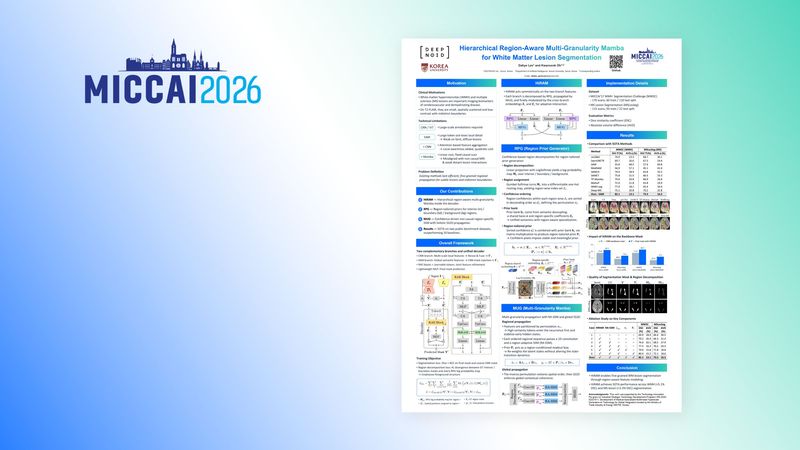
DEEPNOID said on the 2nd that it presented research findings on HiRAM, an AI model for white-matter lesion segmentation in brain MRI, at the International Conference on Medical Image Computing and Computer Assisted Intervention (MICCAI) 2026, held in Strasbourg, France, from the 27th of last month to the 1st of this month.
HiRAM automatically distinguishes white matter hyperintensities (WMH) and multiple sclerosis (MS) lesions in brain MRI scans. It was designed to learn the characteristics of lesions by dividing them into internal regions, boundaries and background.
In validation using two public datasets, HiRAM outperformed 10 existing AI models used for comparison. Its Dice similarity coefficient (DSC), a measure of image-segmentation accuracy, was 5.1 percentage points higher than that of the previous top-performing model for WMH lesions and 3.3 percentage points higher for MS lesions.
DEEPNOID also posted strong results in official competitions. It finished second in the brain-metastasis category of Brain Tumor Segmentation (BraTS) 2026, a leading competition in brain-tumor imaging AI. At the VLM3D Challenge, a 3D medical-imaging vision-language AI competition, it placed first in brain MRI abnormality classification and second in chest-CT abnormality classification. It also ranked fourth in chest-CT report generation.
The breadth of the technology's application is notable. DEEPNOID's AI technology is expanding beyond MRI, CT and X-rays to include lesion detection and segmentation, disease classification and report generation. As the medical AI market moves beyond interpreting individual diseases toward supporting the overall workflow of medical professionals, this demonstrates that the company has secured multimodal capabilities.
DEEPNOID plans to connect these capabilities to its 'agent AI' strategy. The structure goes beyond AI that interprets individual images, supporting the analysis of multiple medical images, disease classification, lesion detection and report generation.
Woosik Choi, CEO of DEEPNOID, said, "From chest X-rays to CT scans and brain MRI, our technologies for lesion detection and segmentation, disease classification and report generation have been validated on the international stage. We will expand agent-AI medical services that support the entire radiology workflow based on the technologies we have secured across multiple modalities."
Meanwhile, the research was conducted with support from the Ministry of Trade and Industry's project on the development of global-linked, multimodal, medical-specialized, ultralarge generative AI technology.
An industry official in medical AI said, "Medical AI has now reached a stage where it is difficult to evaluate a company's value based solely on the accuracy of a single solution. The ability to combine multiple modalities and connect them to the reading workflow in actual clinical settings will determine commercialization competitiveness," the official assessed.
[email protected] Kim Kyung-a Reporter